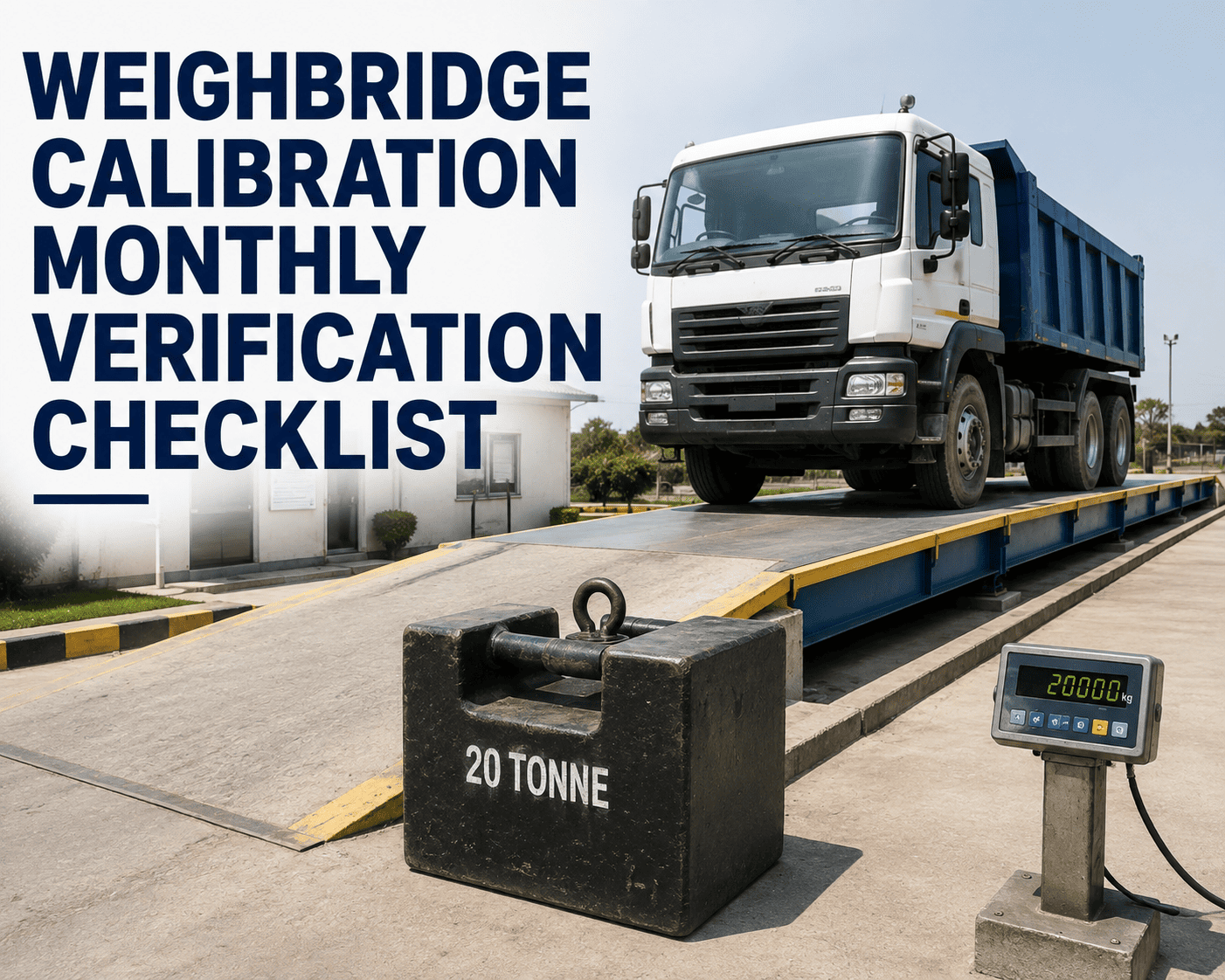
Every truckload that crosses a cement plant's weighbridge becomes a number on an invoice, a production record, or a dispatch report. If that scale drifts half a percent and nobody catches it for a month, the plant has been over-billing or under-billing every single load in that window. Sign up to log every monthly test-load check against traceable calibration records, before drift turns into a dispute with a customer or a hauler.
Why It Matters
A weighbridge is a legal trade instrument, not just a production tool. Under OIML R 76 and equivalent national standards, a commercial scale must be verified against traceable test loads at defined intervals, and a missing verification record is treated the same as an out-of-tolerance scale during an audit.
The Monthly Verification Flow
1
Confirm test weight traceability
Check that each test weight's calibration certificate is current and traceable to a national standard before it touches the platform.
2
Zero the platform and record baseline
With the deck clear, confirm the display reads zero and log it as the starting reference for every load applied afterward.
3
Apply incremental test loads
Add certified weights in steps across the scale's range, recording the indicated value against the known applied load at each increment.
4
Calculate error and log the result
Compare each reading against the maximum permissible error for the scale's accuracy class, and route anything out of tolerance to maintenance before the next load crosses the deck.
Every Test Load, Traceable And On Record
Oxmaint logs every monthly verification against the certificate behind it, flags a weighbridge the moment a reading drifts toward tolerance, and keeps the full history ready for a trade inspection. Sign up for a free trial to run it on your own weighbridge data, or book a demo to see it configured for your plant.
What The Checklist Actually Covers
Test Weight Certificates
Expiry dates checked against every certified weight used, before it's placed on the deck
Load Cell Balance
Corner load applied and checked so weight is registering equally across all cells
Physical Condition
Deck surface, junction box seals, and cable routing inspected for damage or moisture ingress
Where Weighbridge Drift Comes From
Drift on a weighbridge rarely announces itself. Moisture works into a junction box over months and the reading softens by a few kilograms before anyone notices. Ground settling under one corner of the deck shifts load distribution across the cells so one corner reads slightly heavy while the average still looks correct. A cable connector loosens from vibration and the signal degrades gradually rather than failing outright. None of these show up in a single load crossing, they show up as a pattern across the monthly test-load history, which is exactly why the verification record matters as much as the reading it produced.
Accuracy Classes At A Glance
| Standard |
Governing Body |
Applies To |
| OIML R 76 |
International Organisation of Legal Metrology |
Non-automatic weighing instruments, including weighbridges |
| NIST Handbook 44 |
National Institute of Standards and Technology |
Commercial weighing devices used in trade, US jurisdictions |
| Test weight classes |
OIML E2, F1, F2, M1 |
Selected by required accuracy of the scale under test |
Frequently Asked Questions
Q
Why does test weight traceability matter so much?
If the reference weight itself isn't traceable to a national standard, the verification result is meaningless regardless of how carefully the check was performed. Traceability is what lets an auditor trust the number on the log, not just the number on the scale.
Q
What happens if a monthly verification is missed?
Every load weighed during the gap becomes disputable, since there's no evidence the scale was reading accurately across that window. In a legal metrology context, a missed verification carries the same weight as a documented failure.
Q
Does corner load testing need to happen every month too?
Corner load balance should be checked as part of the same monthly cycle, since uneven load distribution across the cells is one of the most common causes of a weighbridge that passes a center-load check but still weighs inconsistently in real traffic.
Never Miss A Monthly Weighbridge Check Again
Oxmaint schedules every monthly verification automatically, ties each result to its test weight certificate, and keeps a full drift history ready before an inspector or a customer ever asks for it. Sign up for a free trial to run it on your own plant data, or book a demo to see it configured for your weighbridge.