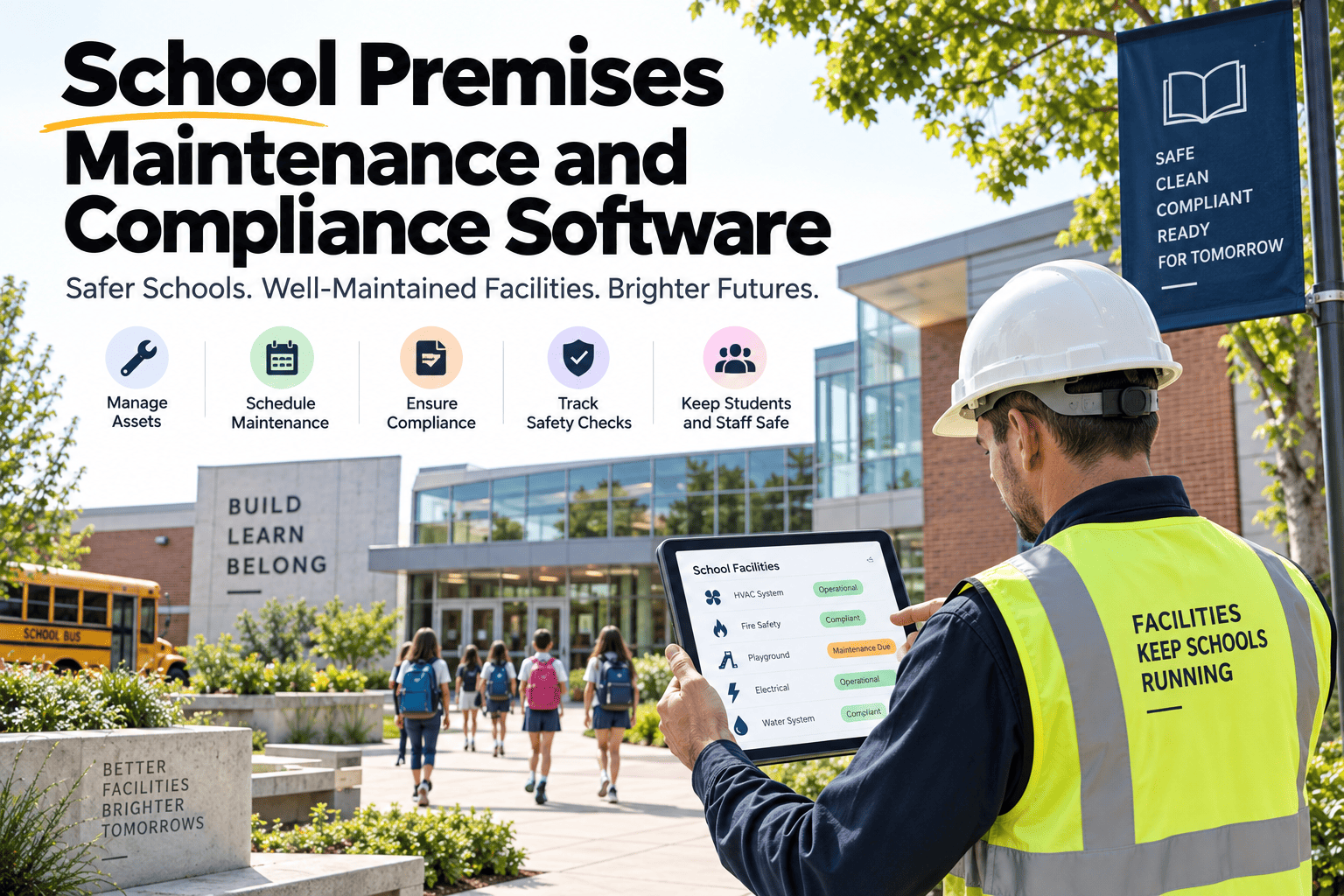
School premises work is unlike any other estate job, because the building is full of children, the budget is fixed, the person responsible usually has four other roles, and the only real windows for disruptive work are the holidays. A business manager can be handling a boiler failure, an asbestos query, a PE equipment inspection and a safeguarding-adjacent access issue in the same morning — and still be expected to produce a complete compliance file when governors or inspectors ask. Nothing about that is a software problem in itself, but visibility makes all of it survivable. OxMaint maintenance management software gives school and trust teams one register, one schedule and one evidence trail. Start a free OxMaint trial or book a 30-minute demo to see it on your site.
School Premises Maintenance and Compliance Software
Track every statutory check, reactive repair and holiday project across one school or a whole trust — with the asbestos register, servicing certificates, condition data and contractor evidence held in one place that anyone authorised can open in seconds.
One Person, Four Job Titles, and an Estate That Never Stops
In most schools the premises brief sits with a business manager, a site manager, or the two of them sharing it alongside finance, HR, catering, lettings and health and safety. There is rarely an estates department, rarely a dedicated budget line for systems, and almost never spare capacity. The consequence is not that things go undone — school site teams are among the most resourceful people in any sector — but that everything is held informally. The boiler service date is in someone's diary, the asbestos register is a folder in the site office, the fire alarm certificates are in a filing cabinet, the PAT testing schedule lives in an email thread, and the person who knows where all of it is has been there eleven years. That arrangement works perfectly right up until it doesn't: a governor asks for assurance, an inspector asks for evidence, a contractor drills into a ceiling void, or the long-serving site manager retires.
The Checks a School Site Has to Evidence
School premises compliance is unusually broad because a school is simultaneously a workplace, a public building, a place where vulnerable people spend the day, and — in the case of DT workshops, science labs, kitchens and sports halls — a light industrial environment. The result is a long list of duties spread across several regimes. The table below covers the core programme most schools operate. In OxMaint each row becomes a scheduled, assigned task with its certificate stored against the asset.
| Duty area | Typical cycle | Usual owner | Common weak point |
|---|---|---|---|
| Fire alarm, detection and drills | Weekly test, periodic service, termly drill | Site team and specialist contractor | Weekly tests recorded inconsistently in holidays |
| Emergency lighting | Monthly function, annual duration test | Site team or electrical contractor | Failed units noted but never replaced |
| Fire extinguishers and doors | Monthly visual, annual service | Site team and contractor | Doors wedged open, defects unrecorded |
| Asbestos management | Register plus periodic re-inspection | Named duty holder | Contractors not shown the register before work |
| Water hygiene and legionella | Monthly temperatures, holiday flushing | Site team and water specialist | Stagnation over long holiday closures |
| Gas safety and heating plant | Annual service and safety check | Registered engineer | Booked too late to fix faults before winter |
| Fixed electrical installation | Periodic inspection at set intervals | Qualified contractor | Coded remedials left unactioned after report |
| Portable appliance testing | Risk-based frequency by equipment | Site team or contractor | New and staff-brought items never registered |
| PE, play and outdoor equipment | Annual specialist inspection, routine checks | Site team and specialist | Routine visual checks not documented |
| DT machinery and LEV | Inspection and examination cycles | Specialist contractor | Extraction testing overlooked entirely |
| Kitchen extract and equipment | Cleaning and servicing cycles | Catering and contractor | Split responsibility with catering provider |
| Lifts, hoists and access equipment | Statutory examination plus servicing | Insurer engineer and contractor | Examination defects not converted to jobs |
Frequencies depend on your risk assessments, insurer requirements, equipment type and the age of the building, and some duties apply only where particular facilities exist. The pattern worth noticing is in the final column: almost every weak point is a recording or follow-through failure rather than a technical one, which is precisely the kind of problem a system solves.
OxMaint shows completion by duty area across every building, holds the certificate behind every green line, and flags what is overdue before anyone has to ask. Assurance becomes something you can show on a screen in a meeting rather than something you promise to check and come back on.
Planning Premises Work Around a Calendar You Cannot Move
Every other sector schedules maintenance around operational convenience. Schools schedule it around a fixed academic year in which the building is either full of pupils or completely empty, with nothing in between. That constraint shapes everything, and the schools that manage their estates well are the ones that treat the year as a planning framework rather than a set of interruptions.
The holiday flushing point deserves emphasis. Long closures create exactly the stagnation conditions that water hygiene regimes exist to prevent, and the outlets at greatest risk are in the parts of the building nobody visits during the break. Scheduling flushing as tracked, evidenced tasks across every closure is one of the highest-value things a school estate can formalise.
The Duty That Sits Behind Every Contractor Visit
A very large proportion of the school estate predates the ban on asbestos-containing materials, which means most schools hold a live management duty rather than a historical one. The duty is not simply to have a survey. It is to maintain a register, know the condition of the materials, monitor them, manage the risk through a written plan, and ensure that information reaches anybody who might disturb them.
Frequently Asked Questions
Is this practical for a school with one site manager?
Can teaching staff report faults without full access?
Does it work across a multi-academy trust?
Can we store the asbestos register and share it with contractors?
How does it help with capital funding bids?
The Site Team Already Does the Work. Give Them a System That Proves It.
OxMaint gives schools and trusts a building-level asset register, scheduled statutory checks with certificates attached, mobile task completion, staff fault reporting, asbestos register access at the point of work, holiday project tracking and condition data for funding bids. Assurance governors can see, and knowledge that stays when people move on.