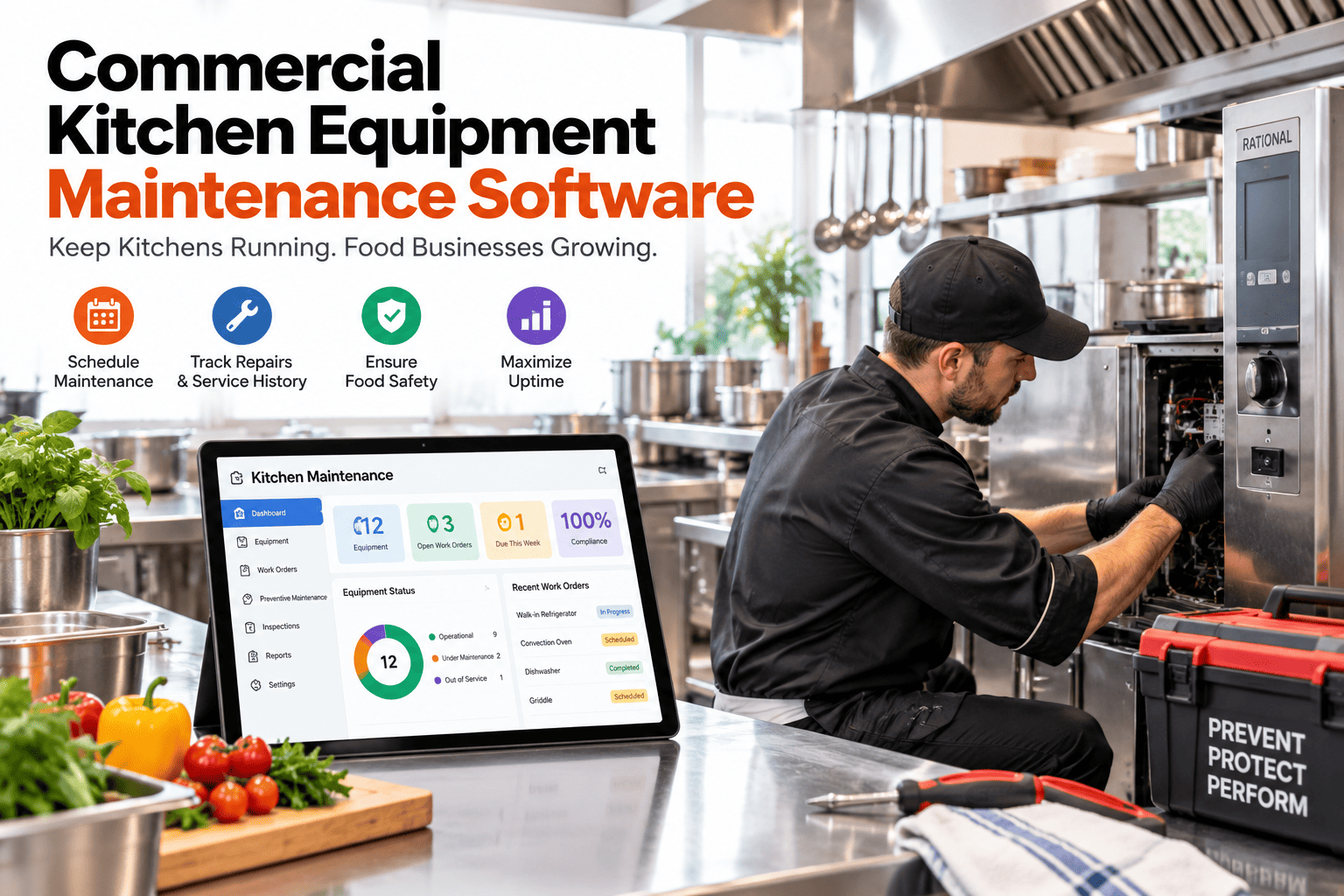
A commercial kitchen has no tolerance for equipment failure. A fryer that goes down at half past six does not reduce capacity, it removes a third of the menu for the rest of service, and the cost lands as refunds, walkouts and a team working twice as hard for a worse result. The equipment rarely fails without warning, but the warnings are noticed by chefs mid-service and forgotten by the time the kitchen closes. Capturing them is the whole job. To see how, start a free trial.
Commercial kitchen equipment maintenance software
The fryer did not fail at 18:30. That is just when you found out
Kitchen equipment gives notice. A combi that takes longer to reach temperature, a chiller running warmer than it used to, a gas burner that needs two attempts to light, an extraction canopy pulling less than it should. Every one of those is a fault with a lead time, and every one is noticed by someone who is too busy to report it. OxMaint makes reporting take seconds and turns planned servicing into something that happens on schedule rather than after a breakdown.
Four zones, four completely different maintenance problems
Treating a kitchen as one category of equipment is why maintenance schedules there tend to be either useless or ignored. The four zones fail differently, cost differently when they fail, and need different intervals. Structuring the asset register by zone makes the schedule obvious and the priorities defensible.
Zone one
The cook line
Fryers, ranges, griddles, chargrills, combi ovens, salamanders. Heavy thermal cycling and constant grease exposure. Failures here stop service immediately, which makes this the zone where planned servicing pays back fastest.
Zone two
Cold storage and prep
Walk-ins, under-counter fridges, blast chillers, ice machines. Failures here are slower but far more expensive, because a chiller drifting warm overnight puts stock and food safety records at risk simultaneously.
Zone three
Wash and water
Dishwashers, glasswashers, water softening and filtration, boilers. Limescale is the dominant failure cause and the most preventable one, and untreated water quietly destroys equipment across the whole kitchen.
Zone four
Extraction and gas
Canopies, ductwork, fans, interlocks and gas supply. This zone carries the highest safety and insurance consequence, and it is the one where deferred maintenance is least visible until something serious happens.
Structuring by zone also changes how replacement decisions get made. A fryer that has needed four repairs in eighteen months is usually kept because each individual repair looked cheaper than a new machine, and nobody ever added them together. Once the register holds repair history and cost per machine, that arithmetic becomes visible at the point where it can still be acted on, and capital requests stop being a matter of persuasion and start being a matter of arithmetic.
Early warnings chefs see and nobody writes down
Kitchen teams are excellent at noticing equipment behaving differently and terrible at reporting it, for entirely reasonable reasons. The table below maps the symptoms most commonly mentioned in passing to what they usually mean and what they cost if ignored for a few more weeks.
| What the team notices | Usual cause | If left alone | Preventive action |
|---|---|---|---|
| Fryer takes longer to recover | Element scaling, thermostat drift, oil quality | Inconsistent product, higher oil use, element failure | Scheduled calibration and element check |
| Combi oven not reaching temperature | Door seal, scaling, fan or sensor fault | Longer cook times and eventual total failure | Descaling regime and seal replacement |
| Chiller running warmer than before | Dirty condenser, worn door seal, low refrigerant | Stock loss and food safety record problems | Condenser cleaning and seal inspection |
| Dishwasher leaving residue | Scale build-up, blocked jets, failed softener | Rewashing, chemical overuse, element failure | Water treatment servicing and jet cleaning |
| Burner slow or uneven to light | Blocked jet, ignition fault, gas supply issue | Safety risk and an out-of-service range | Qualified gas servicing at a set interval |
| Kitchen feels hotter than usual | Reduced extraction from grease or fan wear | Working conditions, compliance and fire risk | Duct and canopy cleaning with records |
| Ice machine producing less | Scaling, filter blockage, condenser fouling | Bought-in ice and an eventual replacement | Filter changes and scheduled cleaning |
Why kitchen faults never get reported
Understanding the reporting problem is more useful than adding another form. Kitchens do not fail to report because they do not care. They fail to report because every barrier in the chain sits exactly where the team has least capacity.
There is a fifth barrier worth naming, which is turnover. Hospitality teams change frequently, and a reporting process that depends on knowing who to ring or where the folder is kept breaks every time a new chef or a new general manager arrives. A system that a new starter can use correctly on their first shift, without being shown anything beyond where the app is, survives turnover in a way that an informal process never does.
See your kitchen equipment list running in OxMaint
Book a 30-minute walkthrough and we will build your kitchen in OxMaint — equipment by zone, planned servicing intervals, the reporting route for your team and the contractor visit records behind it — using your own site as the worked example.
A servicing rhythm built around service, not around the diary
The other half of the problem is scheduling. Kitchen servicing is frequently booked when a contractor has availability rather than when the equipment needs it, and carried out during trading hours because nobody coordinated it with the rota. A rhythm that respects the operation gets completed.
| Rhythm | What happens | Who does it | Best timing |
|---|---|---|---|
| Daily | Temperature checks, visual condition, filters and grease traps | Kitchen team | Opening and close-down routine |
| Weekly | Deep clean of cook-line equipment, condenser coil visual, seal check | Kitchen team | Quietest trading day |
| Monthly | Water filter status, descaling checks, extraction fan condition | Site or facilities team | Between service periods |
| Quarterly | Planned servicing of cook-line and refrigeration equipment | Specialist contractor | Closed period or morning before prep |
| Biannual | Extraction duct and canopy cleaning with photographic evidence | Specialist contractor | Scheduled closure |
| Annual | Gas safety inspection, interlock testing, electrical inspection | Qualified engineer | Planned well in advance |
Water treatment deserves to be treated as a maintenance item in its own right rather than as a consumable somebody replaces when they remember. In a hard water area, untreated supply attacks combi ovens, dishwashers, coffee equipment, ice machines and boilers simultaneously, and the resulting failures appear as unrelated breakdowns across several suppliers and several invoices. Once filter changes and softener servicing are scheduled and recorded, the connection becomes obvious, and the reduction in callouts across the affected equipment is usually the clearest single return a kitchen sees from planned maintenance.
It is also worth recording what was replaced and when, not just that a service happened. An element, a seal, a thermostat or a pump fitted eight months ago that has failed again is telling you something about either the part, the installation or the operating conditions. Without that detail on the equipment record, the second failure looks like bad luck instead of a pattern, and the same replacement gets fitted a third time.
Frequencies should flex with how hard the kitchen works. A site doing four hundred covers a day needs a tighter interval on cook-line equipment than one doing eighty, and a kitchen in a hard water area needs descaling far more often than the manufacturer's generic recommendation suggests. Intervals driven by actual usage rather than by a standard contract are where most of the avoidable breakdowns disappear.
How OxMaint keeps kitchens running
OxMaint is maintenance management software for operations where equipment downtime is felt immediately by customers. In hospitality, that means making it effortless for a kitchen to report a problem and giving operations a real view across every site.
Equipment register by zone and site
Every fryer, oven, chiller and washer held with its model, location, warranty and service history, so repeat faults and end-of-life equipment are obvious rather than anecdotal.
History per machine
One-minute fault reporting
Kitchen staff report from a phone with a photo and the equipment selected from a list, fast enough to be done during a changeover rather than remembered afterwards.
Early warnings captured
Planned servicing schedules
Intervals set per equipment type and adjusted for how hard each site works, with alerts in advance so bookings are made before the equipment is struggling.
Servicing that actually happens
Contractor job tracking
Visits, findings, parts and costs logged against the equipment, so recurring recommendations and repeat callouts on the same machine become visible at renewal.
Contractor value you can check
Compliance record store
Gas safety certificates, extraction cleaning reports with photographs and electrical inspection records attach to the site with due dates tracked automatically.
Evidence for insurers
Multi-site comparison
Open jobs, downtime, repair spend and equipment reliability compared across kitchens, which is usually where a persistent problem with one model first becomes obvious.
Estate-wide patterns
Four signs a kitchen is running on luck
These patterns are common across hospitality estates, and the useful thing about all four is that they can be checked in an afternoon using invoices and callout records you already hold. Each one is an early indicator that maintenance is reactive rather than planned.
Repairs are mostly emergency callouts
If the majority of contractor spend is unplanned attendance rather than scheduled servicing, the estate is paying premium rates to fix things it could have prevented.
The same machine keeps coming back
Repeat visits to one piece of equipment usually mean a root cause that is never addressed, most often water treatment, ventilation or an installation problem.
Nobody can produce last year's duct cleaning records
Extraction cleaning evidence is increasingly expected by insurers, and an undocumented regime is treated the same as no regime when a claim is assessed.
Sites solve the same problem separately
Without a shared system, one kitchen discovers a fix that three others are still paying a contractor to rediscover, several times a year.
Commercial kitchen maintenance software questions
What does commercial kitchen maintenance software do?
It holds every piece of equipment with its service schedule and history, lets kitchen staff report faults in under a minute, and tracks contractor visits and compliance records. Start a free trial.
Will kitchen staff actually use it?
Reporting is a short mobile form with a photo and the equipment picked from a list. Teams adopt it when they see reports turn into completed jobs, which usually happens within the first week.
Does it manage external contractors?
Yes. Visits, findings, parts and costs are logged against each machine, so repeat callouts and unactioned recommendations are visible at contract renewal. Book a demo to see it.
Can it store extraction and gas safety records?
It can. Certificates and cleaning reports with photographs attach to the site with due dates tracked, which covers what most insurers and environmental health officers ask for.
How does it work across multiple sites?
Each kitchen manages its own equipment and jobs while operations sees downtime, spend and reliability compared across every site in one view, including by equipment model.
Catch the fault before service does
Give your kitchen a one-minute way to report what they notice, put every machine on a service interval that matches how hard it works, and keep the compliance records assembled across every site.
Free 14-day trial. No credit card required.