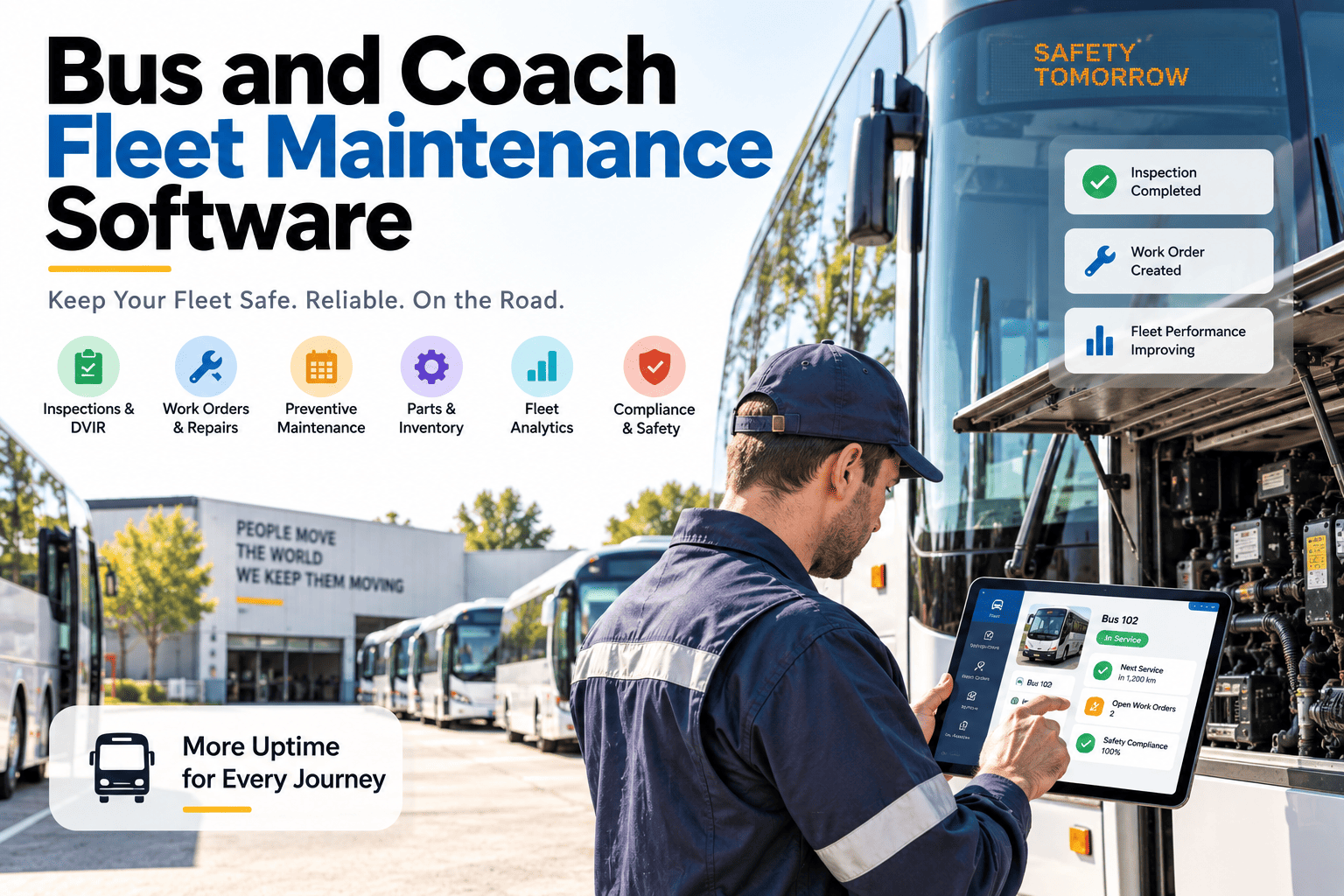
A bus fleet does not fail an audit on the day of the audit. It fails on the hundreds of ordinary days before it, when a safety inspection slipped a week, a driver defect was fixed but never written down, or a brake test result went into a folder nobody indexed. Passenger vehicle maintenance is judged almost entirely on records, and records are exactly what paper systems lose. Bus and coach maintenance software keeps inspections, defects, test dates and evidence on one vehicle record from day one. To see how that works across your own fleet, start a free trial.
Bus and coach fleet maintenance software
Could you prove the last twelve months of maintenance on any vehicle, today?
Not the service history in general terms, but the actual chain: every safety inspection at its stated interval, every driver defect report including the nil returns, what was found, who repaired it, when it was signed off, and the brake test evidence behind it. That chain is the substance of an operator's maintenance undertakings, and it is the first thing examined when anything goes wrong. OxMaint keeps it assembled continuously instead of reconstructed under pressure.
The four commitments behind every passenger fleet
Operators sometimes describe compliance as a single obligation, which makes it hard to see where a fleet is actually weak. In practice there are four separate commitments, each with its own frequency, its own owner and its own record. Fleets rarely fail all four. They usually fail one, quietly, for a long time.
Commitment one
Safety inspections at the stated interval
Inspections carried out at the frequency declared for the fleet, to a proper inspection sheet, by a competent person. The interval itself is a promise, and drifting past it repeatedly is one of the most visible failures a fleet can have.
Commitment two
Daily driver walkaround checks
Every vehicle checked before service, with defects and nil returns both recorded. A system that only captures faults cannot demonstrate that checks were carried out on the days nothing was found, which is most days.
Commitment three
Prompt, evidenced defect rectification
Reported faults assessed, actioned and signed off, with any vehicle taken out of service where required. The gap between report and repair is where most fleets lose control of their own evidence.
Commitment four
Complete, retrievable records
Inspection sheets, defect reports, brake test results, test and certification dates, all held for the required period and produced on demand. A commitment that is met but not recorded counts as one that was not met.
It is worth being blunt about why the fourth commitment carries so much weight. Everything a fleet does well is invisible unless it was written down. An inspection carried out perfectly and recorded on a sheet that was later lost counts for nothing when someone asks for it, and a defect rectified the same morning but never closed out on paper looks identical to one that was ignored. The record is not administration attached to the work. For compliance purposes it is the work, and any system that treats it as an afterthought will eventually put an otherwise well-run fleet in a difficult position.
Where paper systems break on a passenger fleet
The problem is almost never that people do not care. It is that the information has to survive a journey across several hands, and each handover is a chance to lose it. The table below is the honest failure map for a paper-based or partially digital fleet.
| Where it breaks | What actually happens | What it costs you | The fix |
|---|---|---|---|
| Walkaround sheets | Pads left in cabs, damaged, or handed in days late | Gaps in the daily record that cannot be filled afterwards | Mobile check completed and submitted at the vehicle |
| Nil defect returns | Drivers only hand in a sheet when they find something | No evidence a check happened on clean days | Every check logged, defect or not |
| Defect handover | A verbal report to a fitter that never becomes a job | Repairs done with no record, or not done at all | Defect raises a job automatically against the vehicle |
| Inspection scheduling | A wall planner maintained by one person | Intervals drift when that person is away | Forward planner by date and mileage with alerts |
| Brake test evidence | Printouts filed loose in a vehicle folder | Results cannot be matched to the inspection they belong to | Result attached to the inspection record |
| Test and certification dates | Tracked across a spreadsheet and several inboxes | Near-misses on expiry dates and last-minute bookings | One due-date view across the whole fleet |
| Record retrieval | Folders per vehicle in a filing cabinet | Days of work to answer a single question | Filter by vehicle and date range |
The defect journey, from cab to sign-off
A driver defect report is the most frequent compliance event in a passenger fleet — hundreds of them a week across a depot — and it is the one most likely to be handled informally. Breaking it into stages shows where a fleet loses both time and evidence.
Driver completes the check
Before the vehicle goes into service, against a defined list covering the items that matter for passenger safety. Completed at the vehicle on a phone or tablet so the record carries a genuine time and place.
Defect raised with evidence
Anything found is reported with a photo and a description against the specific vehicle. A picture of a cracked lens or a damaged seat removes the ambiguity that leads to a second inspection later.
Assessed for severity
Someone competent decides whether the vehicle is safe to operate or must be held. That decision, and who made it, becomes part of the record rather than a conversation in a depot office.
Job created and allocated
The defect becomes a work order with the vehicle, the fault, the reporter and the priority already attached, allocated to a fitter without anyone re-keying information from a paper sheet.
Repaired and signed off
The fitter records what was done, the parts used and the time taken, and signs it off. The vehicle returns to service against a closed record rather than a verbal confirmation.
Reviewed for patterns
Repeat defects on the same vehicle or the same component across the fleet feed back into the inspection schedule, which is how a defect system stops being administration and starts reducing failures.
The sixth stage is the one almost every fleet skips, and it is where the return sits. Once defects are categorised consistently, patterns emerge quickly: one vehicle generating a disproportionate share of reports, a component failing across a whole batch of vehicles, a depot reporting far fewer defects than its neighbours because its checks are being rushed. None of that is visible on paper.
See your depot's inspection planner built live
Book a 30-minute session and we will set up your vehicles, inspection intervals, driver check list and defect routing in OxMaint, using your own fleet structure, so you can see the forward planner and the evidence trail working before you commit to anything.
Setting inspection intervals that survive contact with reality
Inspection frequency is not a single number for a whole fleet. Vehicles working hard on urban stop-start routes accumulate wear far faster than a coach doing motorway mileage, and a uniform interval either over-services one group or under-services the other. Factoring operating conditions into the interval is both better engineering and a stronger position to defend.
| Operating profile | Wear driver | Interval consideration | Watch closely |
|---|---|---|---|
| Urban stop-start service | Very high brake and door cycle counts | Shorter intervals, driven by time rather than mileage | Brakes, doors, suspension, kneeling systems |
| Interurban and rural | Mixed load with sustained running | Balanced interval on time and distance | Tyres, steering, cooling system |
| Long-distance coach | High mileage, lower cycle counts | Mileage-led intervals within the declared maximum | Tyres, driveline, air conditioning |
| School and contract work | Low mileage, long standing periods | Time-led intervals regardless of low distance | Batteries, corrosion, brake condition |
| Accessible and wheelchair-equipped | Frequent ramp and lift operation | Additional checks between inspections | Ramps, lifts, restraints, securing points |
| Older vehicles | Age-related deterioration | Tighter intervals than the fleet standard | Structure, corrosion, wiring |
Vehicles returning from long off-road periods deserve particular attention, because time-based deterioration continues whether or not a bus is earning. Batteries discharge, brake components corrode, tyres develop flat spots and seals dry out. A vehicle that has stood for six weeks and is then put straight back into passenger service on the strength of its last inspection date is carrying risk that no mileage-based schedule will catch. Building a return-to-service check into the process, separate from the routine inspection cycle, closes a gap that catches out a surprising number of otherwise well-run fleets.
How OxMaint runs a bus and coach fleet
OxMaint is maintenance management software for operations where equipment availability and documented compliance carry equal weight. For passenger fleets, it connects the driver in the cab, the fitter in the workshop and the person who has to produce the records.
Mobile driver checks
Drivers complete the walkaround on a phone at the vehicle, with photos, timestamps and nil returns captured every time, so the daily record is complete without any paper moving.
No missing sheets
Forward inspection planner
Safety inspections scheduled by date and mileage per vehicle, with advance alerts and a fleet-wide view of what falls due over the coming weeks.
Intervals that hold
Defect to work order routing
A reported defect becomes an allocated job automatically, carrying the vehicle, fault, photo and reporter, with severity driving whether the vehicle is held.
Nothing lost in handover
Document and certificate store
Inspection sheets, brake test results, test certificates and warranty documents attach to the vehicle record and stay retrievable for as long as you need them.
Evidence in one place
Parts and cost tracking
Parts used, labour time and external invoices accumulate against each vehicle, producing a real cost per vehicle for replacement and contract pricing decisions.
True cost per vehicle
Multi-depot reporting
Overdue inspections, open defects, check completion rates and downtime compared across depots, so problems are visible before they become a pattern.
One view of the fleet
Four signals a fleet is drifting
Fleet maintenance rarely collapses. It erodes, and these four signals are the most reliable early indicators that the evidence base is weaker than the operation feels from the inside.
One depot reports far fewer defects
Vehicles do not differ that much between depots. A low defect rate usually means checks are being rushed or sheets are not reaching the office, not that the fleet is healthier there.
Inspections cluster at the end of the month
A rush of inspections in the final week means the planner is being caught up rather than followed, and it is the pattern that most reliably precedes a missed interval.
Defect closure dates are missing
A repaired defect with no recorded completion is an open defect as far as any external review is concerned, regardless of what the fitter remembers doing.
Producing records takes days
If answering a straightforward question about one vehicle requires someone to visit a filing cabinet, the system is not built for the moment when the question is not straightforward.
Bus and coach maintenance software questions
What does bus and coach maintenance software do?
It schedules safety inspections by date and mileage, captures driver walkaround checks on mobile, routes defects into work orders and stores every record against the vehicle. Start a free trial to load your fleet.
Does it record nil defect returns?
Yes, and this matters more than most operators expect. Every completed check is logged whether or not a fault was found, so the daily record is continuous rather than made up of exception reports.
Can drivers use it without training?
The driver check is a short guided list on a phone with photo capture, designed to be completed at the vehicle in a couple of minutes. Book a demo to see the driver view.
How long are records kept?
Records are retained for as long as you need them and remain searchable by vehicle and date range, which comfortably covers the retention periods expected of passenger fleet operators.
How long does setup take for a depot?
Most operators have vehicles, intervals, check lists and defect routing live within two to three weeks, with driver adoption typically settling inside the first fortnight of daily use.
Build the evidence as you go, not when you are asked
Put every inspection, driver check, defect and certificate on one vehicle record, keep the planner ahead of the interval, and answer any question about any vehicle in seconds instead of days.
Free 14-day trial. No credit card required.