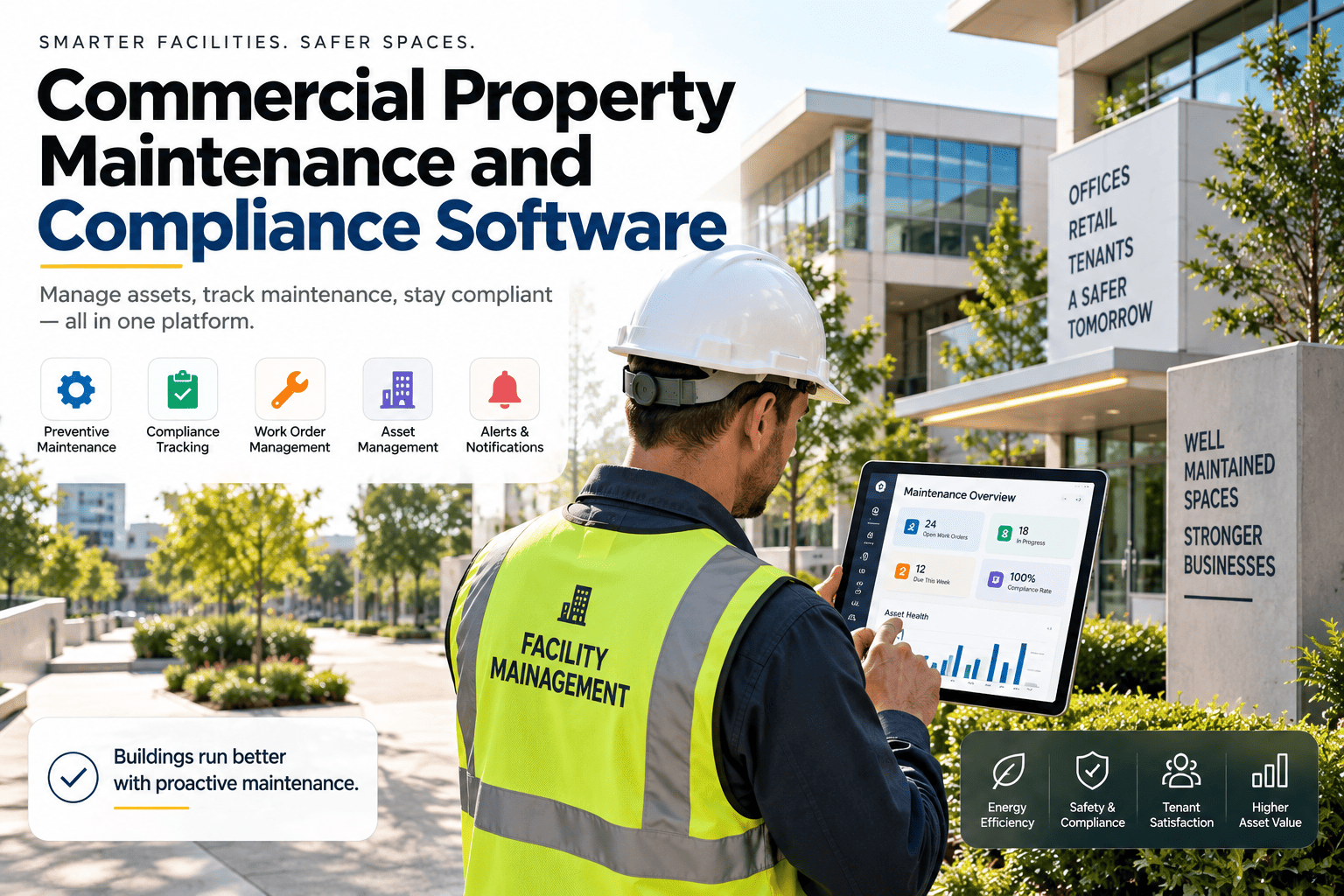
In commercial property, maintenance is never a purely technical question. Every planned check, every contractor visit and every plant replacement sits inside a lease, a service charge, a set of statutory duties and a relationship with an occupier who is paying for all of it. Get the work right and nobody notices; get the record wrong and you are defending a service charge line, a dilapidations claim or an enforcement notice with paperwork assembled after the fact. OxMaint maintenance management software gives landlords, managing agents and in-house estate teams one system for planned works, contractor governance and compliance evidence across every building. Start a free OxMaint trial or book a 30-minute demo to see the estate on one screen.
Commercial Property Maintenance and Compliance Software
Run planned preventative maintenance, statutory inspections, contractor permits and reactive repairs across a portfolio of offices, retail units, industrial sites and multi-let estates — with evidence that defends every service charge line and every audit.
Who Is Actually Responsible for What
The first thing that separates commercial property from every other maintenance environment is that responsibility is contractual before it is technical. The same air conditioning unit may be the landlord's to maintain in one building, the tenant's in another, and a shared cost recovered through service charge in a third — determined entirely by what the lease says and where the demise line falls. When a maintenance system does not reflect that split, two failures follow immediately: work is carried out that cannot be recovered, and work that should have been carried out is left undone because each party assumed the other owned it. Mapping responsibility onto the asset register itself is the fix, and it is the foundation everything else depends on.
The Inspection Calendar Behind a Compliant Building
A commercial building carries a dense layer of statutory duties spread across several regimes and usually several contractors. Individually each is manageable; collectively they are the reason portfolio managers lose track. The table below shows the core programme most managed buildings operate. In OxMaint each line attaches to a specific asset in a specific building, generating work orders with the right checklist and holding the resulting certificate in the same place as the asset history.
| Duty area | Typical cycle | Who normally performs it | Evidence held |
|---|---|---|---|
| Fire risk assessment and review | Annual review, reassess on change | Competent fire risk assessor | Assessment, action plan, closure records |
| Fire alarm and detection | Weekly test, periodic service | Site team plus specialist contractor | Logbook, service certificate, fault history |
| Emergency lighting | Monthly function, annual duration | Site team or electrical contractor | Per-luminaire results, remedial list |
| Fixed electrical installation | Periodic inspection at set intervals | Qualified electrical contractor | Condition report plus coded remedial jobs |
| Lifts and lifting equipment | Statutory examination plus servicing | Insurer engineer and lift contractor | Examination report, defect actions, callouts |
| Pressure systems | Written scheme examination | Competent person appointed by insurer | Scheme, examination report, actions |
| Water hygiene and legionella | Monthly monitoring, annual inspections | Water treatment specialist and site team | Temperature logs, tank records, sampling |
| Asbestos management | Register plus periodic re-inspection | Asbestos surveyor | Survey, register, condition re-inspection |
| Gas and heating plant | Annual service and safety check | Registered heating engineer | Safety record, service report, parts fitted |
| Refrigerant systems | Leak checks by charge size | Certified refrigeration engineer | Charge data, check dates, recovery records |
Cycles vary with building type, occupancy, insurer requirements and risk assessment findings. What does not vary is the expectation that the landlord or managing agent can produce the whole set for a named building, for a named period, without a week of retrieval — and that every defect a report identified has a corresponding record of repair.
OxMaint links every contract, visit, certificate and repair to the asset and the building it belongs to. When an occupier queries a line, or an auditor asks what was done for the money, the answer is a filtered export rather than a fortnight of reconstruction across inboxes and drives.
Five Control Points Between Appointing a Contractor and Paying Them
Most commercial maintenance is delivered by third parties, which means the estate team's real job is governance rather than spanners. The risk is not that contractors do poor work — most do good work — but that the controls around them exist as habits rather than as a process, and habits fail quietly when someone is on leave or a new provider is mobilised mid-year.
Three Places the Maintenance Record Turns Into Money
Estate teams often struggle to make the business case for better maintenance systems because the savings appear in other people's budgets. In commercial property they appear in three very specific places, all of which sit close to the asset's value rather than its running cost.
Managing Ten Buildings Is Not Managing One Building Ten Times
The moment a portfolio grows beyond what one person can hold in their head, the failure mode changes. Individual buildings continue to be managed adequately while the portfolio as a whole becomes opaque — nobody can say which building is behind, which contractor is underperforming across sites, or where the next capital demand is coming from. Standardisation is what restores the view.
Frequently Asked Questions
Can it distinguish landlord, tenant and service charge responsibility?
Do external contractors need their own licences?
How does it handle multi-let buildings with mixed uses?
Can we report compliance across the whole portfolio at once?
What does implementation involve?
Buildings Are Judged on Condition. Managers Are Judged on the Record Behind It.
OxMaint gives landlords, managing agents and estate teams a building-level asset register with responsibility mapping, planned preventative schedules, statutory compliance tracking, contractor onboarding and permits, mobile evidence capture, and portfolio-wide exception reporting. Defensible service charges, stronger dilapidations positions and capital plans built on data.