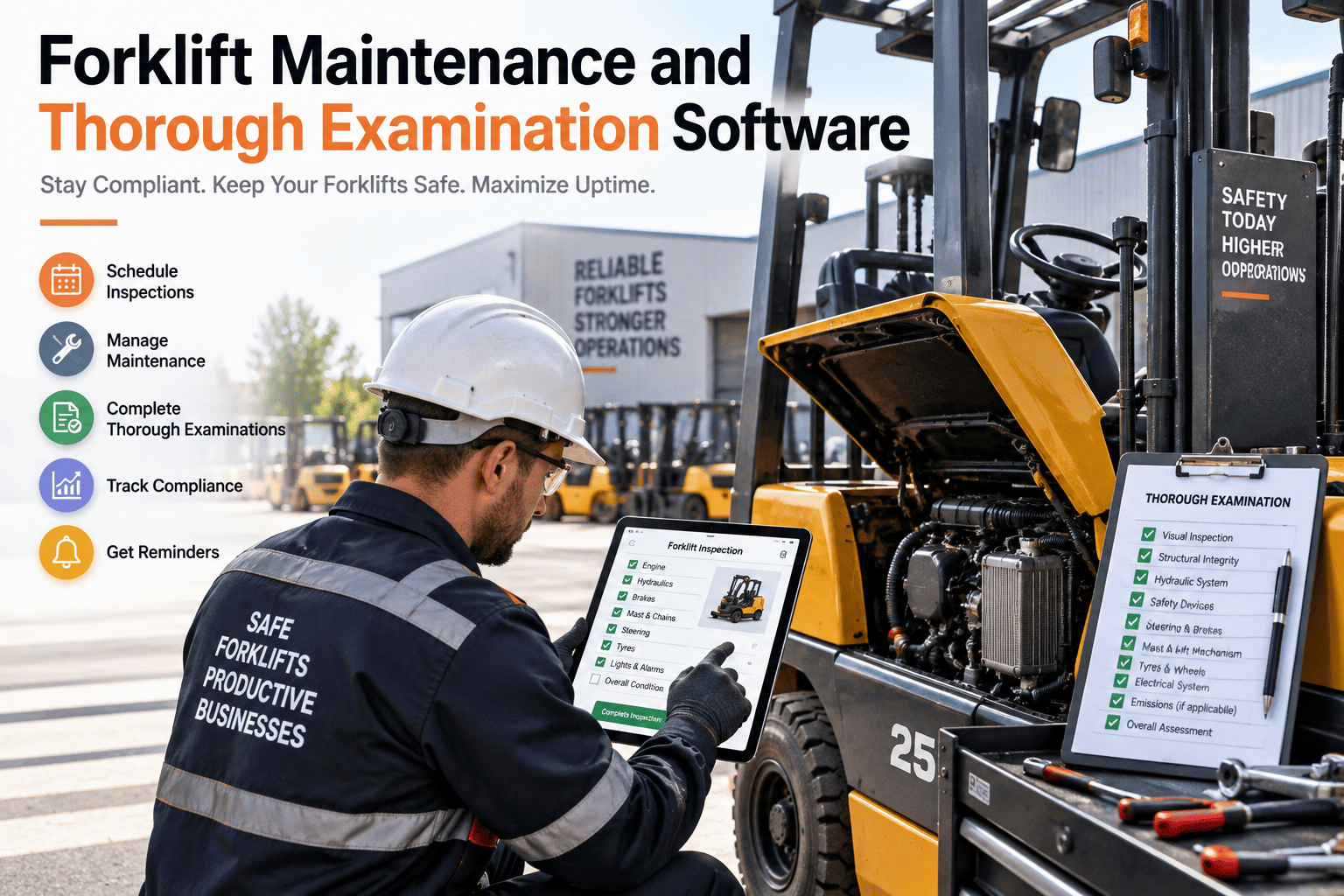
Forklifts occupy an awkward position in most businesses. They are not quite vehicles and not quite plant, they are often hired rather than owned, and responsibility for them tends to sit between operations, health and safety, and whoever signed the lease. The result is a class of equipment that lifts several tonnes near people every day, on a compliance regime nobody fully owns. Getting forklift maintenance right means three separate layers of checking, each with its own record. To see all three tracked in one place, start a free trial.
Forklift maintenance and thorough examination software
Servicing is not examination, and examination is not a daily check
Three different obligations, three different people, three different records — and in most warehouses they are all referred to as the forklift being serviced. That conflation is why an audit so often finds a truck with a full service history, no recorded pre-use checks, and a thorough examination report nobody has read. OxMaint separates the three, schedules each on its own interval, and keeps the evidence attached to the truck rather than to a supplier's system.
The three layers, side by side
The quickest way to find a gap in a materials handling fleet is to lay the three layers next to each other and ask who owns each one, how often it happens, and where the record lives. In most sites, two of those questions have clear answers and one does not.
| Layer | Purpose | Who carries it out | Typical frequency | Record produced |
|---|---|---|---|---|
| Pre-use check | Confirm the truck is safe to operate today | The operator, before each shift | Daily, every shift | Completed check with defects and nil returns |
| Planned servicing | Keep the truck reliable and in condition | Engineer, in house or supplier | By hours run or calendar interval | Service sheet with work done and parts |
| Thorough examination | Independently verify safety of lifting parts | A competent person | Six or twelve months by application | Report of thorough examination |
The point most often missed
A supplier service contract usually covers the second layer and sometimes arranges the third. It almost never covers the first, and the first is the one generating a record every single day. A site with 12 trucks running two shifts should be producing around 6,000 completed pre-use checks a year. If that number does not exist anywhere, the daily layer is not being evidenced.
What actually gets checked, and why
Pre-use checks are frequently reduced to a glance and a signature because the list is too long or too generic. A focused list built around the things that genuinely fail — and that fail dangerously — gets completed properly and catches more. These are the areas worth the operator's two minutes.
Forks and carriage
Cracks, bending, heel wear and locking pins. Fork wear is gradual and easy to miss by eye, which is why measured checks at service intervals matter alongside the daily visual inspection.
Mast, chains and hydraulics
Chain stretch and lubrication, hose condition, visible leaks, drift under load. A chain that has stretched unevenly is one of the clearest indicators that a thorough examination should not wait.
Tyres and wheels
Wear, chunking, debris and loose nuts. Tyre condition affects stability far more on a counterbalance truck than most operators assume, particularly when travelling with a raised load.
Brakes and steering
Service brake, parking brake and steering response tested before use. These are the checks operators most often skip because the truck feels normal, and the ones that matter most when it does not.
Operator protection
Seat belt or restraint, overhead guard, load backrest, horn, lights and beacon. Damage here is usually from impact, which makes it a signal about how the truck is being driven as well as a defect.
Battery, fuel and charging
Electrolyte and connections on lead acid, cable and connector condition, gas bottle security on LPG. Charging area faults tend to be reported late because they are nobody's specific truck.
Electric, LPG and diesel trucks each fail in their own way, and a single generic check list papers over that. Electric trucks live or die on battery care, connector condition and charging discipline, and a fleet that neglects those pays for it in replacement batteries rather than in breakdowns. LPG trucks bring bottle handling, changeover safety and ventilation into the picture. Diesel trucks add exhaust, filtration and fuelling to the list, along with emissions considerations in enclosed spaces. Tailoring the daily check to the power type takes minutes to configure and materially improves what it catches.
Impact damage: the problem nobody logs
Forklift damage is a running cost that most warehouses absorb without measuring. Racking legs, door frames, product and the trucks themselves take repeated low-level impacts, and because each one is minor it is rarely reported. The cumulative effect is significant, and it is entirely invisible without a reporting route.
The impact is not reported
An operator clips a racking upright, sees no obvious damage and carries on. Nothing is written down, so the event never exists as far as the business is concerned.
Damage accumulates unseen
Racking legs collect several strikes over months. Each is survivable, the combination is not, and there is no record showing when the deterioration began or how quickly it is progressing.
Truck damage is treated as wear
Bent overhead guards, damaged backrests and cracked lenses appear on service sheets as items replaced, absorbed into the maintenance budget rather than attributed to impacts.
Something gives way
A racking bay is condemned, a truck is written off early, or a near miss triggers an investigation that finds no history at all for equipment that has been struck repeatedly.
Operator behaviour and truck condition are linked more tightly than most sites acknowledge. A truck with a damaged overhead guard, a worn seat restraint or a horn that does not work has usually been through a period of hard use, and the same period tends to show up in tyre wear and mast damage. Reading those signals together, rather than as separate line items on a service sheet, often identifies a training or layout issue long before it produces an incident worth investigating.
See your truck fleet set up in OxMaint
Book a 30-minute walkthrough and we will configure your trucks, pre-use check list, service intervals by hours run and thorough examination due dates, so you can see the full three-layer record for a real truck in your own fleet.
Owned, leased and hired trucks all need the same record
Mixed fleets are the norm, and they are where responsibility gets blurred most easily. The contractual arrangement changes who performs the work and who pays for it. It does not change the fact that the equipment is being used on your site by your people, and the evidence that it was safe to use needs to exist on your side of the arrangement.
| Arrangement | Usually handled by supplier | Always your responsibility | Common gap |
|---|---|---|---|
| Owned outright | Nothing unless contracted | All three layers | Examination dates drifting past due |
| Long-term lease with full maintenance | Servicing and often examination arrangement | Pre-use checks, defect reporting, acting on findings | No copy of reports held on site |
| Contract hire | Servicing, breakdown response | Pre-use checks, impact and damage reporting | Damage disputes at end of contract |
| Short-term hire | Condition at delivery | Checks during the hire period | Nothing recorded for the hire duration at all |
| Attachments and accessories | Varies, often assumed included | Confirming they are examined and in date | Clamps and rotators missed entirely |
Attachments deserve a separate mention because they are so frequently invisible. A clamp, rotator, fork extension or jib changes what the truck is capable of and what it is carrying, and each one is a piece of lifting equipment in its own right. Sites that hold a full truck register very often hold no attachment register at all, which means nobody can say when a clamp was last examined or whether the derated capacity for that combination is still being observed. Adding attachments to the register is usually an afternoon of work and closes one of the most common findings on a materials handling audit.
How OxMaint manages materials handling equipment
OxMaint is maintenance management software for organisations running equipment that has to be both available and demonstrably safe. For forklifts and materials handling, it holds all three layers of checking against each truck, whoever performs them.
Operator pre-use checks on mobile
A short guided check completed at the truck, with photo capture and nil returns recorded, so the daily layer produces a continuous record instead of an occasional sheet.
Daily evidence that exists
Hours-based service scheduling
Servicing triggered by hours run rather than by calendar alone, so a truck working double shifts is serviced ahead of one that sits idle for weeks.
Intervals matched to real use
Examination due tracking
Thorough examination dates held per truck and per attachment, with advance alerts, so nothing runs past its interval because of a supplier scheduling gap.
Nothing runs out of date
Defect and impact reporting
Operators report faults and impacts from the same app, raising a job where needed and building the damage history that makes layout and training problems visible.
Damage you can finally see
Report and certificate store
Examination reports, service sheets and hire documents attach to the truck, so the evidence stays with you even when the supplier or the contract changes.
Your records, not theirs
Fleet and site reporting
Check completion rates, open defects, overdue items and cost per truck compared across sites, which is usually the first place an obvious saving appears.
Cost per truck, per site
Four warning signs in a materials handling fleet
These patterns are common, easy to check and almost always indicate a gap worth closing before anyone external finds it first.
Pre-use checks return almost no defects
A fleet producing thousands of checks and almost no findings is not a healthy fleet, it is a fleet where checks are being signed rather than done.
Nobody holds the examination reports
If the only copies sit with the supplier, you cannot demonstrate that findings were acted on, which is the part that matters more than the report itself.
Attachments are not on the register
Clamps, rotators, extensions and jibs are frequently absent from any list, and they are exactly the components most likely to be overlooked between examinations.
Hired trucks have no records at all
Equipment on site for a few weeks carries the same daily obligations as owned equipment, and is the most likely to be operating with nothing recorded.
Forklift maintenance software questions
What does forklift maintenance software manage?
It holds each truck with its pre-use checks, hours-based service schedule, thorough examination due dates, defect history and documents in one record. Start a free trial to add your fleet.
How often does a forklift need thorough examination?
Generally every twelve months, or every six where the truck is used to lift people, unless an examination scheme drawn up by a competent person specifies otherwise for that application.
Does servicing count as thorough examination?
No. Servicing maintains the truck, while thorough examination is an independent safety verification producing its own report. Book a demo to see both tracked separately.
Can it cover hired and leased trucks?
Yes. Hired equipment sits in the same register with an off-hire date, so pre-use checks and defect reports are captured for the period it is on your site.
How long does it take to set up?
Most sites have trucks, attachments, check lists and due dates loaded within a fortnight, and operator adoption usually settles within the first week of daily use.
Three layers of checking, one record per truck
Capture every pre-use check, schedule servicing on hours actually run, track examination dates for trucks and attachments, and keep the reports on your side of the supplier relationship.
Free 14-day trial. No credit card required.