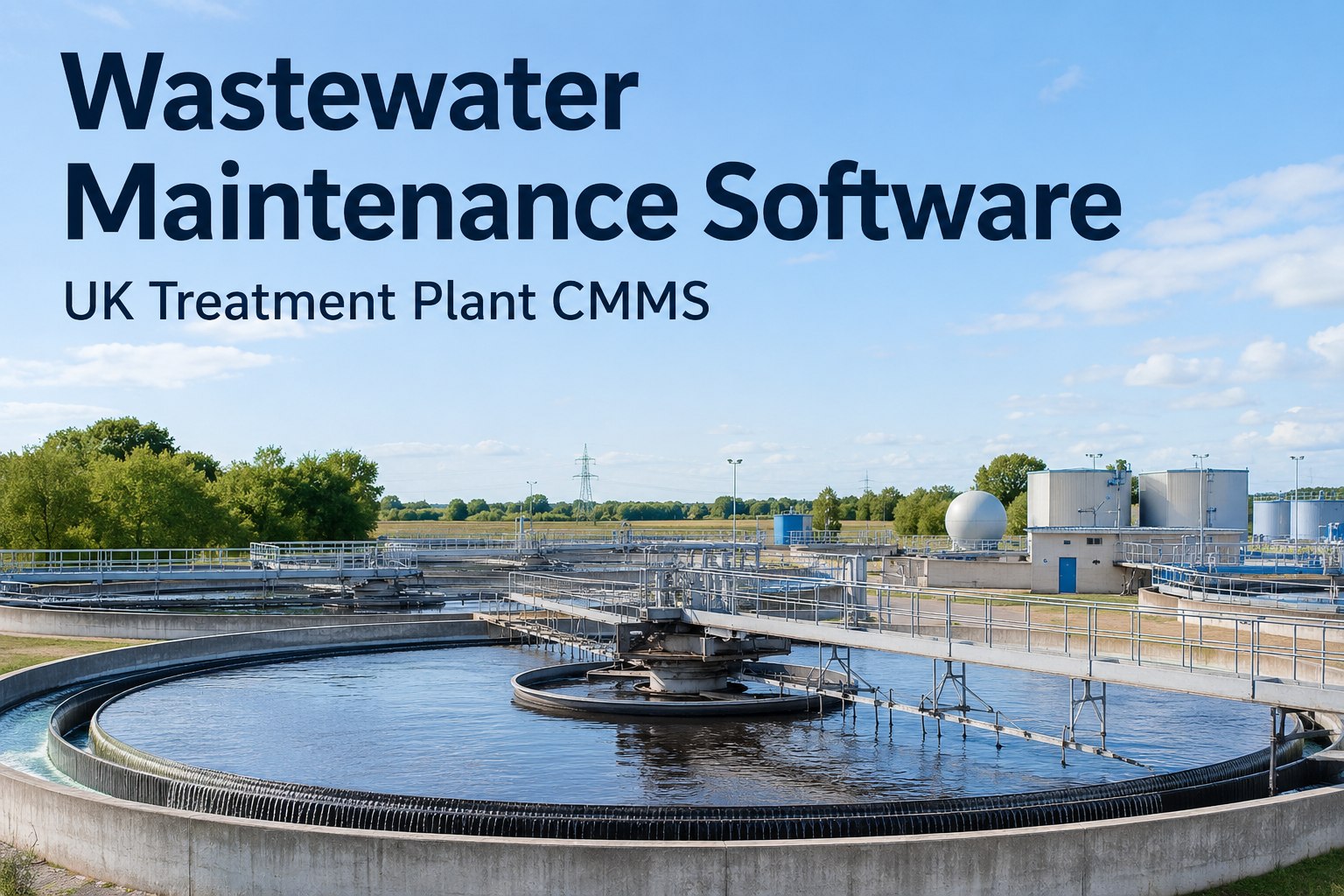
A wastewater treatment works turns raw sewage into consented effluent through six or seven process stages — each stage carrying critical rotating equipment, each failure capable of pushing effluent outside the site's Environment Agency permit within hours. A single blower failure on an activated sludge plant can trigger a permit breach. A clogged UV bank drops microbial disinfection below consent. A screen bypass sends debris downstream. Every UK sewage works needs a maintenance discipline structured around the process — not just the assets. Book a demo to see wastewater workflows in action.
UK WASTEWATER · WHY EVERY PROCESS STAGE MATTERS
Effluent leaves the works within hours. Permit breaches don't wait for you to notice.
EPR 2016
Environmental Permitting Regulations — the legal framework for every discharge consent
5yr
Minimum EA-compliant maintenance record retention for discharge-permitted plants
£416m
Ofwat enforcement action taken since April 2020 against seven UK water companies
The Treatment Process Chain — What Fails Where
A conventional UK sewage treatment works runs raw influent through six sequential process stages. Each stage has its own critical assets, its own failure modes and its own downstream consequence when it fails. Oxmaint separates PM programmes by process stage rather than by generic asset type — so blower maintenance sits inside the aeration process context, not the generic-rotating-equipment context.
1
Screening
Bar screens · Grit removal · Rags collector
Bypass sends debris downstream
→
2
Primary Settlement
Primary tanks · Scraper drives · Sludge pumps
Sludge carry-over overloads secondary
→
3
Aeration / Biological
Blowers · Diffusers · RAS pumps · DO sensors
Blower loss = biology collapse in hours
→
4
Final Settlement
Final tanks · Bridge scrapers · WAS pumps
Solids carry-over breaches SS consent
→
5
Tertiary / Disinfection
UV banks · Sand filters · Chemical dosing
UV failure breaches microbial consent
→
6
Sludge Handling
Centrifuges · Digesters · Cake conveyors
Backlog forces process bypass
The Consent Parameters That Actually Matter
Every UK sewage treatment works discharges under an Environment Agency permit (or NRW in Wales, SEPA in Scotland) that specifies numeric limits on effluent quality — usually BOD, suspended solids, ammonia, and site-specific parameters like phosphorus or microbial standards. Miss a consent, breach the permit, incident logged. The maintenance implication is that certain assets carry direct-consent-impact status — their failure creates a permit exposure within hours. The table below is how Oxmaint flags asset criticality against consent parameter.
Aeration Blowers — Where Maintenance Discipline Pays Back Fastest
The aeration blower is the single highest-consequence asset in most UK sewage treatment works. It runs continuously. It draws serious electrical load — often 20-40% of the site's total energy consumption. It has a defined failure trajectory — bearings, valves, diaphragms, motor windings all degrade predictably. And when it fails, biological treatment collapses within hours because the microorganisms that consume BOD cannot survive without oxygen. Every UK operator with a permit breach in their five-year history can usually trace at least one back to blower failure. Sign up free to protect aeration blowers with structured PM.
See Wastewater CMMS in Action
Walk through process-stage-organised PM programmes, blower and pump condition monitoring, UV bank tracking, discharge consent linkage, and EA-ready maintenance records — configured against your sewage works assets. Thirty minutes with the Oxmaint team.
The Real Payback of Structured Wastewater Maintenance
The economic case for structured wastewater maintenance sits in three places. First, prevented permit breaches — each one carries direct enforcement exposure plus reputational cost, and a single Category 1 pollution incident on a large works can cost hundreds of thousands in remediation and fines. Second, blower energy savings — properly maintained aeration blowers running against DO-optimised control can cut treatment energy by 10-20%, which at UK power prices is material against site operating cost. Third, reduced reactive labour — sites tracking condition-based intervention typically see 25-40% fewer emergency callouts than reactive-run peers. Sign up free to model wastewater maintenance ROI on your site.
Expert Perspective — Why Wastewater Maintenance Sits Between HSE and EA
"
Wastewater is one of the very few UK sectors where maintenance discipline is watched simultaneously by two enforcement regulators. HSE looks at whether pressure systems, confined spaces, working at height and electrical isolation on your sewage works are managed under HSG253 and PSSR — a worker safety lens. The Environment Agency looks at whether your effluent quality stayed inside permit limits and whether you can evidence why it did or didn't — a public health and environmental lens. A blower failure that breaches BOD consent is an EA incident. A blower failure during maintenance that injures a technician is an HSE incident. Both regulators eventually ask for the same underlying records. Sites running maintenance across spreadsheets, shift logs and paper permits typically pass one enforcement conversation while failing the other. Sites with one properly configured platform pass both.
01
Process-stage PM structure
PM programmes organised by treatment stage. Consequence-of-failure visible in the same view as the schedule.
02
Consent-linked criticality
Every asset tagged to the discharge consent parameter it affects. Critical PMs prioritised structurally.
03
HSG253 isolation records
Safe isolation certificates linked to every intervention. HSE-ready evidence chain from permit to sign-off.
04
Five-year record retention
EA-compliant maintenance records retained per site — retrievable in seconds during enforcement enquiries.
Who Uses Oxmaint Across UK Wastewater
The platform is used by the UK operational roles that own sewage works maintenance delivery: treatment works managers running PM programmes against process-stage criticality across primary, aeration, tertiary and sludge streams, mechanical and electrical maintenance engineers coordinating blower, pump, UV and screen interventions, compliance officers producing permit-linked evidence packs for EA/NRW/SEPA enquiries, operations directors tracking site performance against discharge consent history, contractor managers running third-party specialist maintenance under CDM 2015 alongside British Water-accredited engineer verification, and energy managers targeting blower and pump reductions under ESOS and SECR obligations. Each role sees the same asset data filtered to their view — process criticality dashboard, permit exposure list, isolation certificate queue or five-year records archive. Sign up free to configure wastewater workflows for your team.
Getting Wastewater Maintenance Live in 30-60 Days
Deployment starts by importing the sewage works asset register — organised by process stage rather than flat list — including blowers, pumps (RAS/WAS/sludge/inlet), screens, tanks, UV banks, dosing systems, digesters and instrumentation. Existing SCADA and telemetry from Emerson, ABB, Siemens SPPA, Endress+Hauser and Hach instrumentation integrate via OPC-UA, MODBUS TCP and direct APIs to pull DO, flow, effluent quality and equipment status into the maintenance workflow. PM templates configure per asset class against OEM guidance (Gardner Denver blowers, Flygt pumps, Trojan/Xylem UV). Discharge consent parameters link to asset criticality. HSG253 isolation workflow templates deploy inline. Most sites see process-organised PM, consent-linked criticality and isolation workflows live within 30-45 days on primary treatment; full site coverage typically inside two quarters. Book a walkthrough to see live UK wastewater deployments.
Turn Wastewater Maintenance Into Regulatory Assurance
Oxmaint gives UK sewage works operators one platform for process-organised maintenance — blower and pump PM, UV bank tracking, discharge-consent-linked asset criticality, HSG253 isolation certificates and five-year records retention aligned to EA, NRW and SEPA expectations.
Frequently Asked Questions
What is wastewater treatment maintenance software?
Wastewater treatment maintenance software (also called a wastewater CMMS or sewage works CMMS) is a maintenance management platform configured for the specific assets and regulatory context of UK sewage treatment works. It manages planned preventive maintenance on blowers, pumps, screens, UV and instrumentation across process stages, tracks reactive work and incidents, produces the maintenance record evidence required under Environmental Permitting Regulations 2016, and links asset criticality to the discharge consent parameters each asset affects. A generic CMMS treats treatment plant assets as generic rotating equipment — a wastewater CMMS organises them by process stage and consent impact.
What are the key UK wastewater regulations that affect maintenance?
The Environmental Permitting (England and Wales) Regulations 2016 provide the legal framework for discharge consents, with permits issued by the Environment Agency (England), Natural Resources Wales, or SEPA (Scotland). Permits specify numeric effluent limits — typically BOD 20 mg/l, SS 30 mg/l, site-specific ammonia, phosphorus and microbial parameters. HSE requirements under HSG253 (safe isolation of plant), PSSR 2000 (pressure systems), COSHH (chemical exposure), and confined space regulations apply throughout maintenance execution. Ofwat's PR24 outcomes framework adds Performance Commitment scoring for storm overflow spills, pollution incidents and treatment works compliance across the AMP8 period.
Which sewage works assets are most critical for maintenance discipline?
Aeration blowers top the criticality list — they run continuously, consume 20-40% of site energy, degrade predictably (bearings, valves, diaphragms, motor windings), and their failure collapses biological treatment within hours. RAS/WAS pumps directly affect solids settling and downstream permit compliance. UV disinfection banks matter enormously at bathing water sites where microbial consent is the binding constraint. Screens matter for downstream asset protection — a bypass sends debris through the entire process chain. Sludge handling equipment matters because backlogs force process bypass. Oxmaint's asset criticality scoring can be configured against these consent-impact realities rather than generic reliability metrics.
How does Oxmaint support permit compliance evidencing?
Every work order in Oxmaint can be tagged to the discharge consent parameter its asset affects — so evidence packs for EA, NRW or SEPA enquiries assemble by filter rather than manual compilation. Maintenance records retain per site with configurable retention (minimum five years for permitted plants; longer per site policy). Isolation certificates under HSG253 link to intervention records so HSE and EA evidence chains are simultaneously complete. Where an incident occurs, the full pre-event maintenance history and post-event response can be reconstructed per asset in seconds. This is workflow evidence supporting the operator's regulatory compliance — the compliance decisions themselves remain with the site.
How quickly can a UK sewage works go live with Oxmaint?
Most UK sewage works see process-organised PM, consent-linked asset criticality and HSG253 isolation workflows live within 30-45 days on the primary treatment train. Full site coverage — including sludge handling, tertiary treatment, storm tanks and instrumentation — typically completes within two quarters. Integration with existing SCADA (Emerson, ABB, Siemens, Endress+Hauser, Hach) is scoped per site and generally deploys in parallel with the PM configuration work. Portfolio deployments across multiple works — typical for water company estates or contract O&M providers — take longer per site count but benefit from template reuse across sister sites once the first site is live.