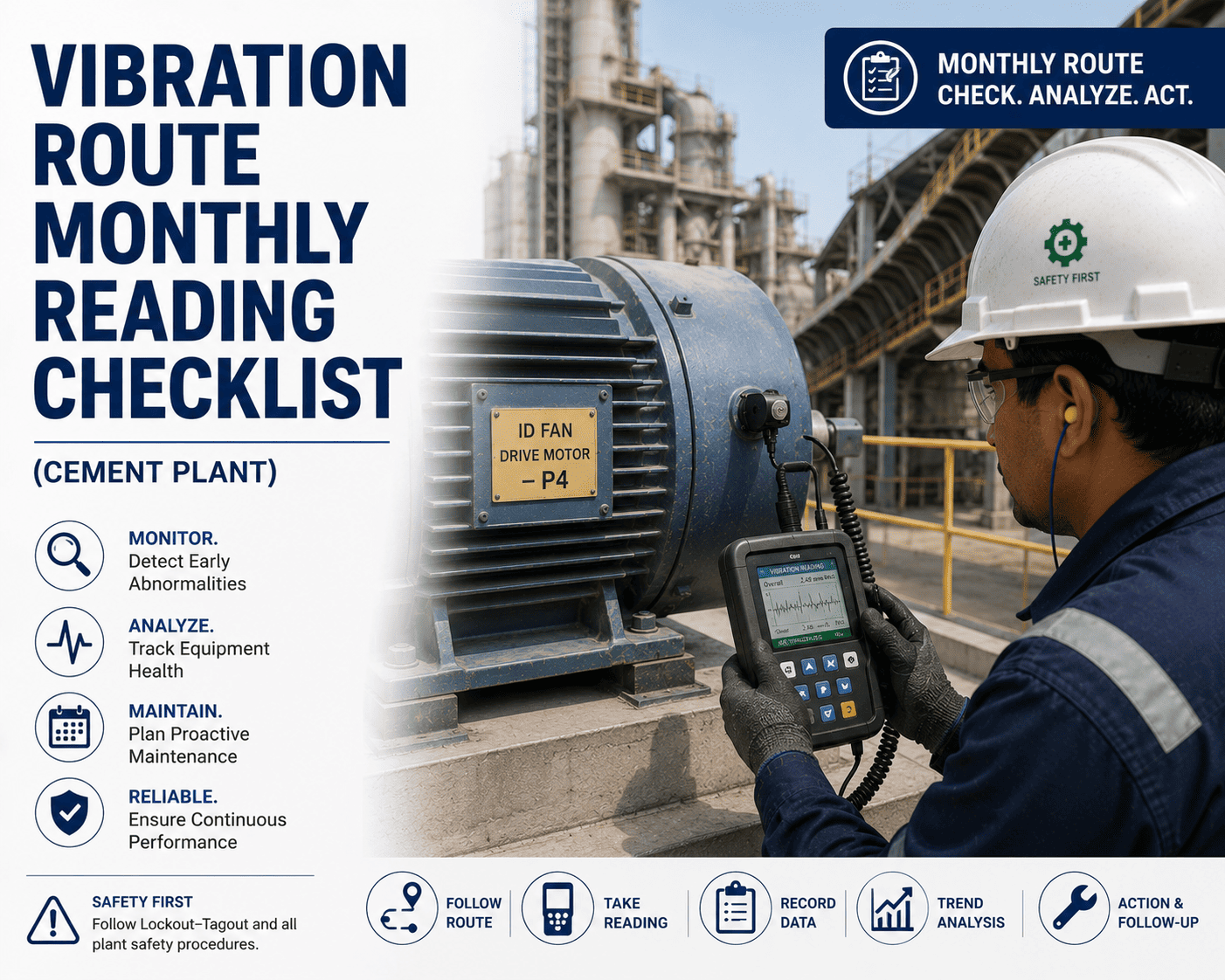
A monthly vibration route only works if it's walked the same way every time. Same point on the bearing housing, same orientation, same load condition, or the number collected this month can't honestly be compared to last month's. Sign up to log every route reading against its ISO 10816 zone automatically, and see a trend building on the kiln drive or a fan bearing weeks before it reaches the danger zone.
Why It Matters
Vibration is the earliest reliable signal of bearing wear, gear tooth damage, misalignment, and imbalance, all of which develop a characteristic signature weeks before functional failure. A monthly route only delivers on that promise if every reading is taken consistently and logged against the same asset history, point by point.
ISO 10816 Zones, At A Glance
Zone A
New machine condition, no action needed
Zone B
Acceptable for unrestricted long-term operation
Zone C
Unsatisfactory, corrective action should be scheduled
Zone D
Damage occurring, machine is at risk of failure
Walking The Monthly Route
Confirm the asset is at normal operating load: a reading taken during startup or a partial-load condition isn't comparable to the baseline and should be flagged, not logged as-is
Take the reading at the same point every time: mark measurement points physically on the housing so every technician on the route hits the identical spot and orientation
Log velocity, and note anything audible or visual: unusual noise, heat, or leakage spotted on the walk is often the first clue before the vibration number itself moves
Compare against the machine's own ISO 10816 zone: the correct threshold depends on machine class, power rating, and foundation type, not a single number applied plantwide
Escalate any Zone C or D reading immediately: route a work order the same day rather than waiting for the report to be compiled and reviewed at month end
Every Route Point, Zoned And Trended
Oxmaint logs every monthly vibration reading against its machine-specific ISO 10816 zone, tracks the trend point by point across the kiln drive, fans, and gearboxes, and turns a Zone C reading into a work order the same shift. Sign up for a free trial to run it on your own vibration route, or book a demo to see it configured for your plant.
What A Rising Trend Is Actually Telling You
A single elevated reading rarely means much on its own, ambient conditions and load variation can nudge a number for one visit. It's the shape of the trend across several months that tells the real story. A steady climb at 1x running speed usually points to imbalance building up gradually, often from material buildup on a fan wheel or coupling wear. A rise concentrated at gear mesh frequency signals tooth wear developing inside a gearbox long before it's audible. A spike at bearing defect frequencies, particularly in the high-frequency envelope, is often the earliest and most specific warning a route can catch, sometimes weeks ahead of any other symptom. Reading the route as a trend across a full asset history, not a pass or fail on a single visit, is what turns the monthly check into an actual early warning system.
Fault Pattern Reference
| Frequency Signature |
Likely Cause |
Typical Asset |
| 1x running speed |
Imbalance, often material buildup on a wheel |
ID fan, FD fan |
| 2x running speed |
Shaft misalignment between coupled machines |
Motor-gearbox-fan trains |
| Gear mesh frequency |
Tooth wear or backlash developing inside the gearbox |
Kiln main drive, mill gearbox |
Frequently Asked Questions
Q
Is monthly really often enough for critical assets?
Monthly routes work well for Zone A and B machines, but assets already sitting in Zone C benefit from weekly checks, and genuinely critical drives like a kiln main gearbox are increasingly moved to continuous monitoring, since a monthly interval can miss a fast-developing fault entirely.
Q
Why does the exact measurement point matter?
Vibration readings change meaningfully depending on where and in what orientation they're taken on a bearing housing. If different technicians take the reading from slightly different spots each month, the trend line becomes noise instead of a signal.
Q
Does overall vibration level tell you what's actually wrong?
Overall level tells you severity, but not cause. Identifying whether the problem is imbalance, misalignment, or a developing bearing fault requires looking at which frequency the vibration is concentrated at, which is why a route reading and a frequency spectrum serve different diagnostic purposes.
Catch A Rising Trend Before The Route Report Does
Oxmaint zones every reading automatically, tracks trend history point by point across kiln, fan, and gearbox assets, and dispatches a work order the moment a reading crosses into Zone C. Sign up for a free trial to run it on your own vibration route, or book a demo to see it configured for your plant.