Steel plants run some of the harshest rotating equipment anywhere, rolling mill drives, blast furnace blowers, and continuous caster rollers under constant thermal and mechanical stress. When a main drive bearing fails without warning, the cost isn't just the repair, it's the production stop and the cascade of delays across everything downstream. A properly run vibration route catches these failures weeks before they become emergencies. Sign up to auto-plot ISO trend data and fire work orders the moment a reading crosses zone.
Why It Matters
ISO 20816 now replaces ISO 10816 for industrial machinery above 15 kW, and the four severity zones, A through D, only mean something if every route reading is collected the same way, at stable load, with the right sensor coupling and duration. A rushed or inconsistent route corrupts the trend it was supposed to protect.
ISO Severity Zones At A Glance
Zone A
New or reconditioned machine condition, baseline reading
Zone B
Acceptable for unrestricted long-term operation
Zone C
Short-term acceptable, investigate and schedule corrective action
Zone D
Damage occurring, immediate action required
Machine Class
Small under 15kW, medium 15-75kW, large above 75kW
Foundation Type
Rigid or flexible, flexible foundations carry lower limits
Before You Collect: The Route Checklist
Stable load confirmed: equipment at normal operating temperature and load, cold-start or no-load readings corrupt the trend
Accelerometer coupling: threaded onto the stud hand-tight plus a quarter turn, every time, on every asset
Measurement duration: minimum 60 seconds on any equipment running below 600 RPM to catch cyclic events
Overall velocity RMS: captured in mm/s across 10 Hz to 1000 Hz as the primary zone-classification metric
Envelope & high-frequency detection: enabled on every route, velocity alone misses early-stage bearing degradation
Classification confirmed: machine power class and foundation type set correctly before comparing against zone limits
Stop Trending Vibration In A Spreadsheet
OxMaint connects your vibration routes, auto-plots ISO trend history per asset, and fires prioritized work orders the moment a reading crosses alert threshold. Sign up for a free trial to explore it on your own rotating equipment, or book a demo to see it configured for your plant.
Fault Signatures To Watch For On The Spectrum
Peak at 1x RPM: classic rotor imbalance signature
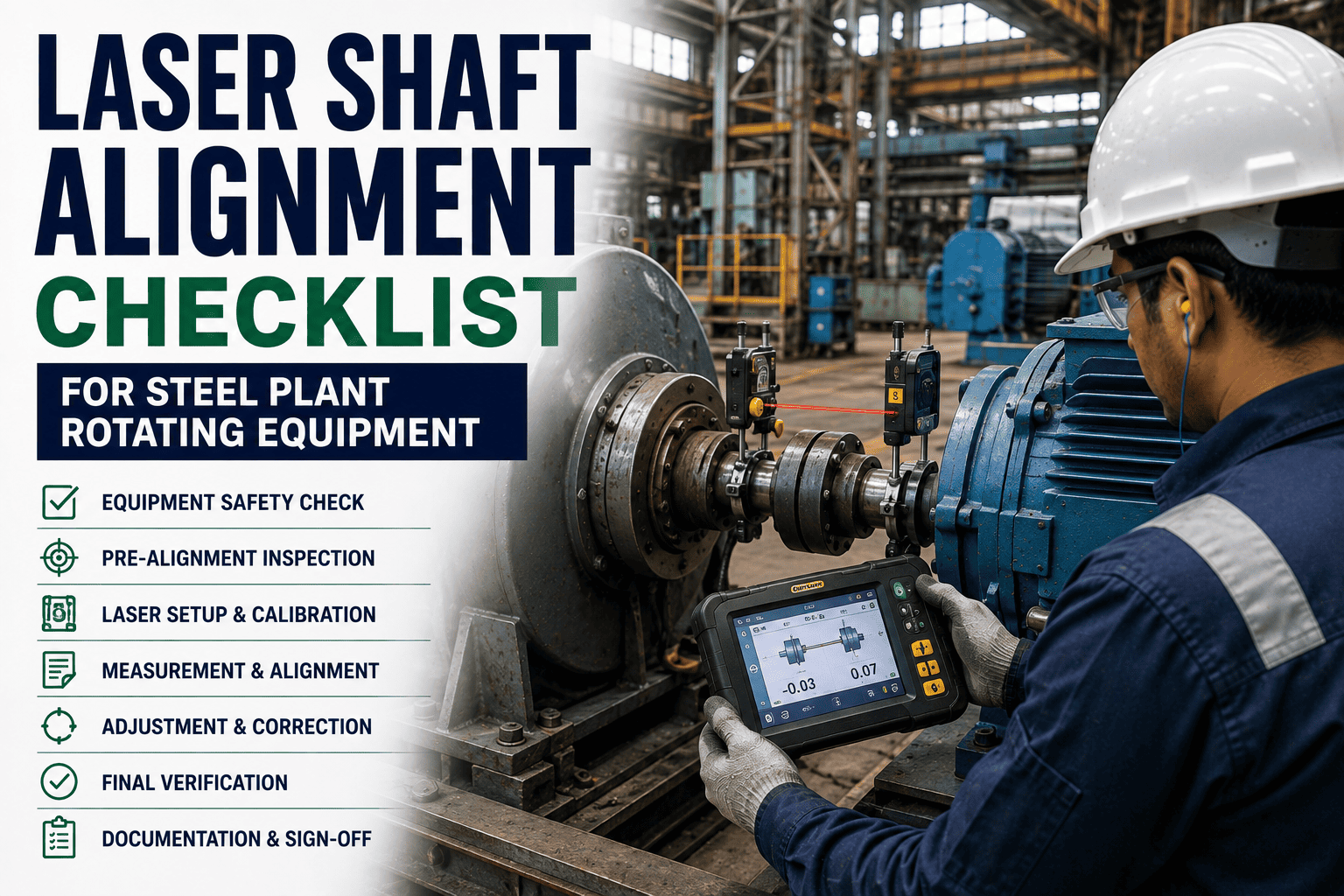
Peak at 2x RPM: shaft misalignment between coupled equipment
Multiple harmonics with a truncated waveform: loose bolts, bearing clearance, or a cracked structure
Broadband noise above 5 kHz: cavitation, blocked suction, or air entrainment on pumps and fans
Asset, Primary Fault Mode & Route Frequency
| Asset |
Primary Fault Mode |
Route Frequency |
| Motors |
Rotor imbalance, bearing wear, electrical faults |
Weekly, continuous for critical drives |
| Fans & Blowers |
Cavitation, impeller damage, bearing wear |
Weekly, continuous for blast furnace blowers |
| Mill Drives & Gearboxes |
Gear mesh defects, bearing defects, lubrication issues |
Continuous online monitoring, highest downtime cost |
| Pumps |
Cavitation, NPSH issues, bearing degradation |
Weekly route based on criticality |
The Takeaway
A vibration route is only as good as its consistency, same load condition, same coupling torque, same duration, every single collection. Get that discipline right and the ISO zones do the diagnosis for you, weeks before a main drive bearing takes the mill down.
Frequently Asked Questions
Q
Should I still use ISO 10816 or has it been fully replaced?
ISO 20816 is the updated successor and now replaces ISO 10816-3 for industrial machinery above 15 kW. It combines the original bearing housing measurement principles with shaft vibration data, so teams still referencing ISO 10816 should update their procedures for full compliance.
Q
How often should critical assets actually be monitored?
It depends on equipment criticality. Rolling mill drives, blast furnace blowers and caster drives should carry continuous online monitoring or a weekly route at minimum, since these carry the highest downtime cost when a bearing fails without warning.
Q
Why does overall vibration level alone not tell the full story?
Overall vibration tells you severity, but frequency analysis tells you the cause. The same overall reading could indicate imbalance at 1x RPM, misalignment at 2x RPM, bearing defects, or looseness, so the spectrum is what turns a zone alert into an actual diagnosis.
Turn Every Route Into A Trend You Can Act On
OxMaint auto-plots ISO 10816 and ISO 20816 trends per asset, supports configurable zone thresholds, and fires prioritized work orders the moment a reading crosses alert. Sign up for a free trial to explore it on your own rotating equipment, or book a demo to see it configured for your plant.