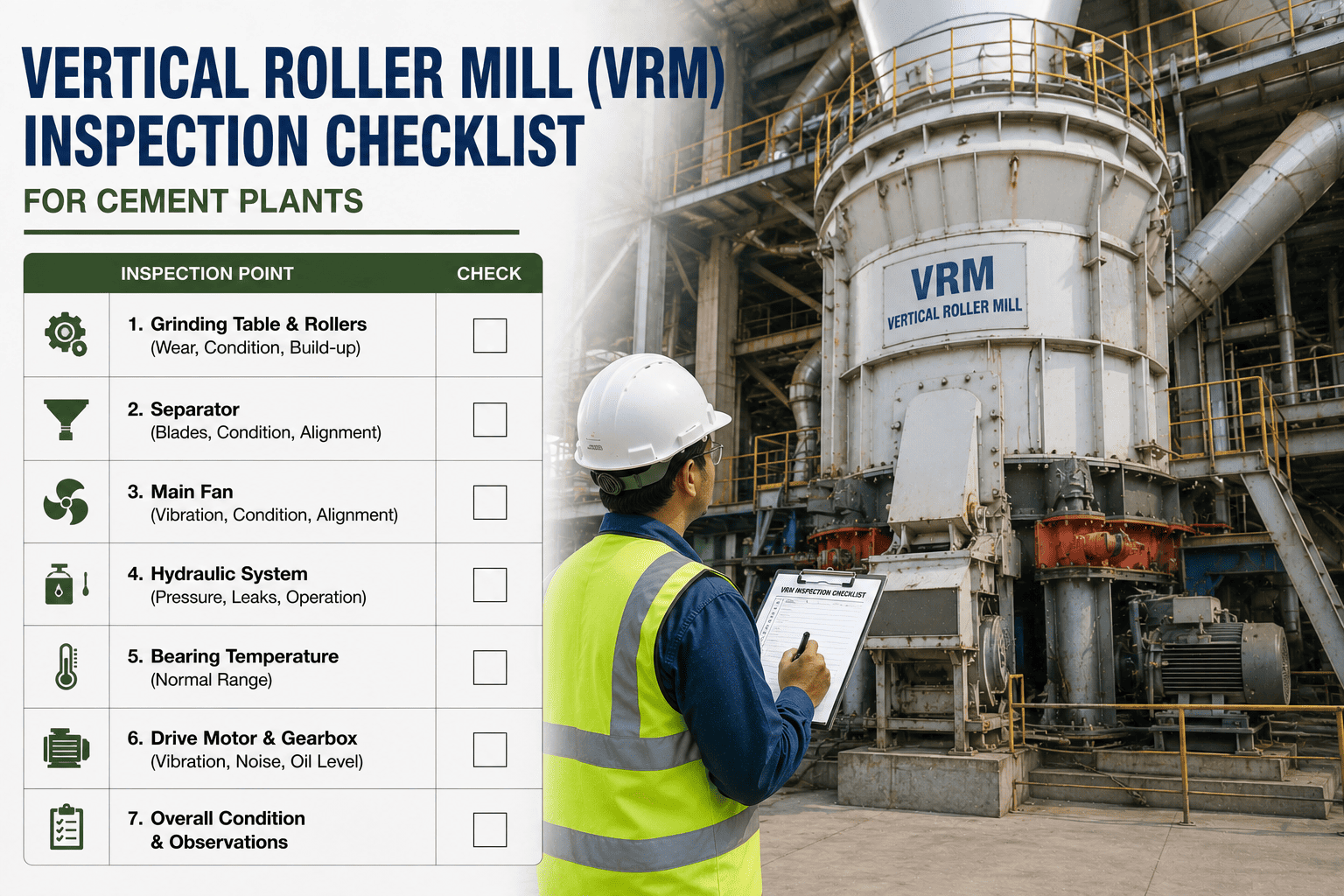
A Vertical Roller Mill grinds raw meal or clinker between rollers and a rotating table using hydraulic pressure to press the rollers down, all while a dam ring and gas flow carry finished material up to the separator. A hydraulic accumulator losing nitrogen charge lets roller pressure fluctuate under load, a worn roller tire or table liner throws grinding efficiency off balance, and rising vibration on the mill housing often means an unstable bed of material before anyone notices a drop in output. This checklist covers what to verify across the hydraulic system, grinding rollers and table, and vibration monitoring. Sign up to turn this checklist into a guided digital procedure your VRM crew follows on every shift.
3 Zones Checked
Hydraulic system, grinding rollers and table, and vibration covered in this checklist
Every Shift
How often hydraulic pressure and vibration readings should be logged
Zero Tolerance
Room for skipping an accumulator nitrogen check or a vibration trip test
All Rollers Checked
Check point for tire wear pattern across every roller, not just one
Why VRM Checks Can't Be Rushed
A vertical roller mill balances hydraulic pressure, table speed, and bed stability all at once, so a small drift in any one of them shows up as vibration long before it shows up as a breakdown. The same hydraulic, roller, and vibration checks repeated every shift catch that drift early.
Hydraulic System Inspection
Accumulator Nitrogen Pre-Charge
Check nitrogen pre-charge on hydraulic accumulators, since a low charge lets roller pressure fluctuate under load
Cylinder Seal & Leak Check
Inspect hydraulic cylinders and hoses for seal weeping or leaks that would drop roller loading force
Hydraulic Oil Condition & Filter
Check oil cleanliness and filter condition, since contaminated oil accelerates wear on pumps and cylinders
Make VRM Checks A Habit, Not A Memory
Oxmaint guides your crew through hydraulic, roller, and vibration inspections step by step, with photo proof and sign-off logged against each mill asset. Sign up for a free trial to build your VRM routine, or book a demo to see it in action.
Grinding Roller & Table Checks
Roller Tire Wear Pattern
Check each roller tire for even wear, since an uneven pattern signals a pressure or alignment imbalance
Table Liner Condition
Inspect table liner segments for gouging or thinning that changes the grinding bed profile
Dam Ring Height & Bed Depth
Verify dam ring height still holds the correct material bed depth for stable grinding conditions
Vibration Monitoring Checks
Mill Housing Vibration Trend
Log vibration readings on the mill housing each shift and compare against the normal baseline range
Vibration Trip & Alarm Test
Verify high-vibration trips and alarms actually respond so the mill stops before damage escalates
Feed Rate & Bed Stability Correlation
Cross-check feed rate changes against vibration spikes to confirm whether an unstable bed is process-driven
What A Skipped Check Can Cost You
| Check Skipped |
Likely Consequence |
| Accumulator nitrogen check |
Roller pressure fluctuates, causing uneven grinding and vibration |
| Roller tire wear check |
An uneven tire throws off the grinding bed and accelerates further wear |
| Vibration trip test |
A failed trip lets high vibration run unchecked until it damages bearings |
| Table liner inspection |
A gouged liner changes the bed profile, destabilizing grinding conditions |
Where A CMMS Fits Into VRM Checks
Oxmaint ties this checklist to the hydraulic system, grinding rollers, and table as tracked assets, logging vibration and pressure trends over time so a developing imbalance gets flagged before it turns into a mill stop.
Frequently Asked Questions
Q
What causes high vibration in a vertical roller mill?
High vibration usually traces back to an unstable material bed, uneven roller tire wear, a fluctuating hydraulic pressure from a low accumulator charge, or a sudden change in feed rate that the mill hasn't adjusted to yet.
Q
How often should hydraulic accumulators be checked?
Nitrogen pre-charge should be verified at every planned inspection round, since a slow leak can drop pressure gradually and won't always trigger an alarm before it starts affecting grinding stability.
Q
Can a CMMS track VRM vibration trends automatically?
Yes, a CMMS can log vibration and hydraulic pressure readings per shift against the mill asset and flag a reading that drifts outside the normal baseline before it escalates into a mill stop.
Keep Your VRM Running Stable And On Spec
Oxmaint guides your crew through hydraulic, roller, and vibration inspections and logs every reading against the mill asset automatically. Sign up for a free trial to build your VRM checklist, or book a demo to see it in action.