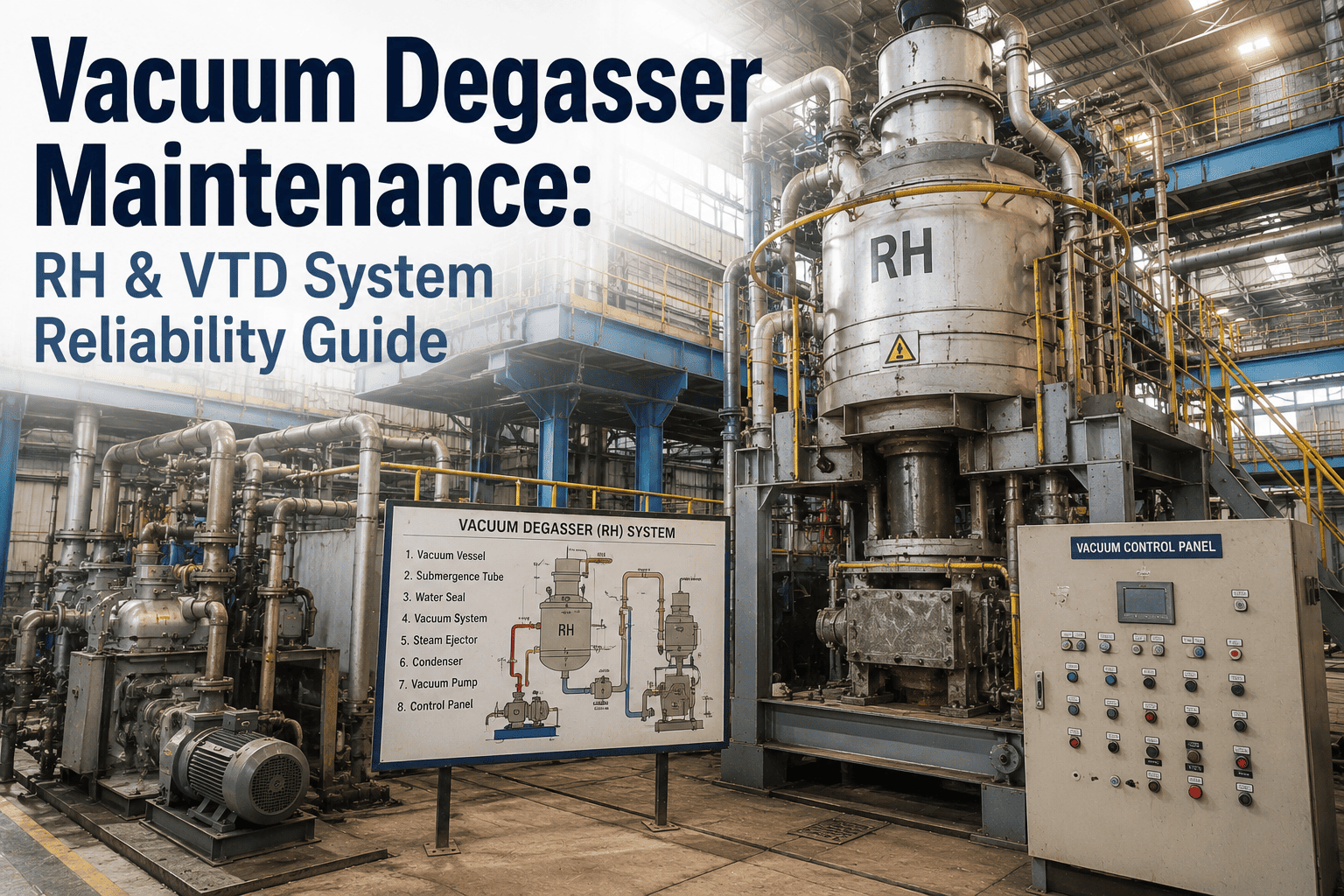
A vacuum degasser is where steel gets pushed to specs the primary furnace can't reach on its own, ultra-low carbon, ultra-low hydrogen, cleanliness that other process steps simply can't deliver. That performance depends on three systems staying healthy together: the refractory lining that survives repeated thermal shock, the vacuum system that has to hold a seal nobody can see leaking, and the mechanical components that keep the whole vessel cycling reliably heat after heat. Sign up for a free trial to see how Oxmaint tracks all three as linked but independent asset records instead of one generic PM plan.
<30 ppm
Ultra-low carbon target that pushes the vessel and vacuum system to their limits
<2 ppm
Ultra-low hydrogen target that depends entirely on vacuum seal integrity
30-50 Heats
Interval at which snorkel gunning frequency typically needs to increase
Every Shift
Recommended frequency for vacuum seal and flange inspection, not just per campaign
A Leaking Seal Doesn't Announce Itself, It Just Costs You the Target Carbon Level
Vacuum leaks rarely look dramatic while they're happening, a flange or seal can leak quietly across multiple heats before anyone traces a missed carbon target back to it. Seal inspection scheduled every shift, backed by a work order that can't be deferred without a record, is what closes that gap before it turns into a repeated quality incident.
Three Domains, Tracked Separately But Linked
| Maintenance Domain |
What It Covers |
Key Failure Risk |
| Refractory |
Snorkel bore, vessel lining, gunning and de-skulling schedule |
Chemical dissolution and thermal shock cracking at the bore |
| Vacuum system |
Pump capacity, seal and flange integrity, pump-down time |
Slow seal leaks that quietly erode achievable vacuum level |
| Mechanical |
Lifting system, lance mechanism, alloy hopper feed system |
Cycle delays that stack up against a tight heat schedule |
Refractory, Vacuum and Mechanical, One Connected View
Oxmaint runs automatic PM scheduling and heat count thresholds configurable per vessel and steel grade, so a drifting pump-down time and an aging snorkel bore both surface before either one causes a missed heat. Sign up for a free trial to test it against your own RH or VTD data, or book a demo and we'll walk through your degasser reliability setup.
RH or VTD: Different Strengths, Different Upkeep
| System |
Process Strength |
Maintenance Consideration |
| RH |
Fast circulation cycle, strong decarburization for ultra-low-carbon grades |
Snorkel preparation and exchange needed before each treatment |
| VTD |
Simpler operational setup, ready whenever the vacuum pump is available |
Carbon boiling and slopping control during vacuum treatment |
Snorkel Wear Moves Through Predictable Phases
Snorkel bore wear doesn't jump straight from fine to failed, it moves through stages: routine gunning, then increased gunning frequency as heat count climbs, then more frequent bore measurement and de-skulling, and finally a relining planned with lead time once the bore nears its replacement limit. Calculating where a specific vessel sits in that progression from its own measured wear rate, rather than a fixed calendar shared across every vessel, is what keeps a relining planned instead of forced.
Frequently Asked Questions
Q
Why does RH snorkel refractory wear out faster than most other linings?
The snorkel faces several wear mechanisms working together rather than one at a time, chemical dissolution from the alkaline slag mixed into circulating steel, plus repeated thermal shock from argon injection cycling on and off. Magnesia-chrome or alumina-magnesia bricks are chosen specifically to handle that combination, but even the right material still wears on a measurable schedule.
Q
How is a slow vacuum leak actually caught before it affects steel quality?
A rising pump-down time is usually the earliest signal, since a leaking seal or flange forces the pump to work harder to reach the same vacuum level. Tracking that trend against a threshold, alongside routine per-shift seal inspection, catches the drift while it's still a maintenance fix rather than a missed carbon or hydrogen target.
Q
Does choosing RH over VTD change the maintenance workload significantly?
Yes. RH requires snorkel preparation and periodic exchange as part of its normal operating rhythm, which VTD doesn't need in the same way, so an RH unit generally carries a heavier and more specialized refractory maintenance load in exchange for its faster cycle time and stronger decarburization performance.
Q
Should refractory, vacuum and mechanical maintenance really be tracked separately?
They wear on different timelines and fail in different ways, so folding them into one shared checklist tends to under-serve whichever domain is least visible day to day. Tracking them as linked but independent records, sharing the same vessel and heat count context, keeps each one on a schedule that actually matches its own wear pattern.
Keep Every Heat Meeting Its Vacuum Degassing Target
Oxmaint gives steel plant teams per-shift vacuum seal checks, snorkel wear-phase tracking, pump-down time alerts and campaign life prediction across your RH and VTD vessels in one platform. Sign up for a free trial to explore it yourself, or book a demo and we'll walk through it against your own degasser operation.