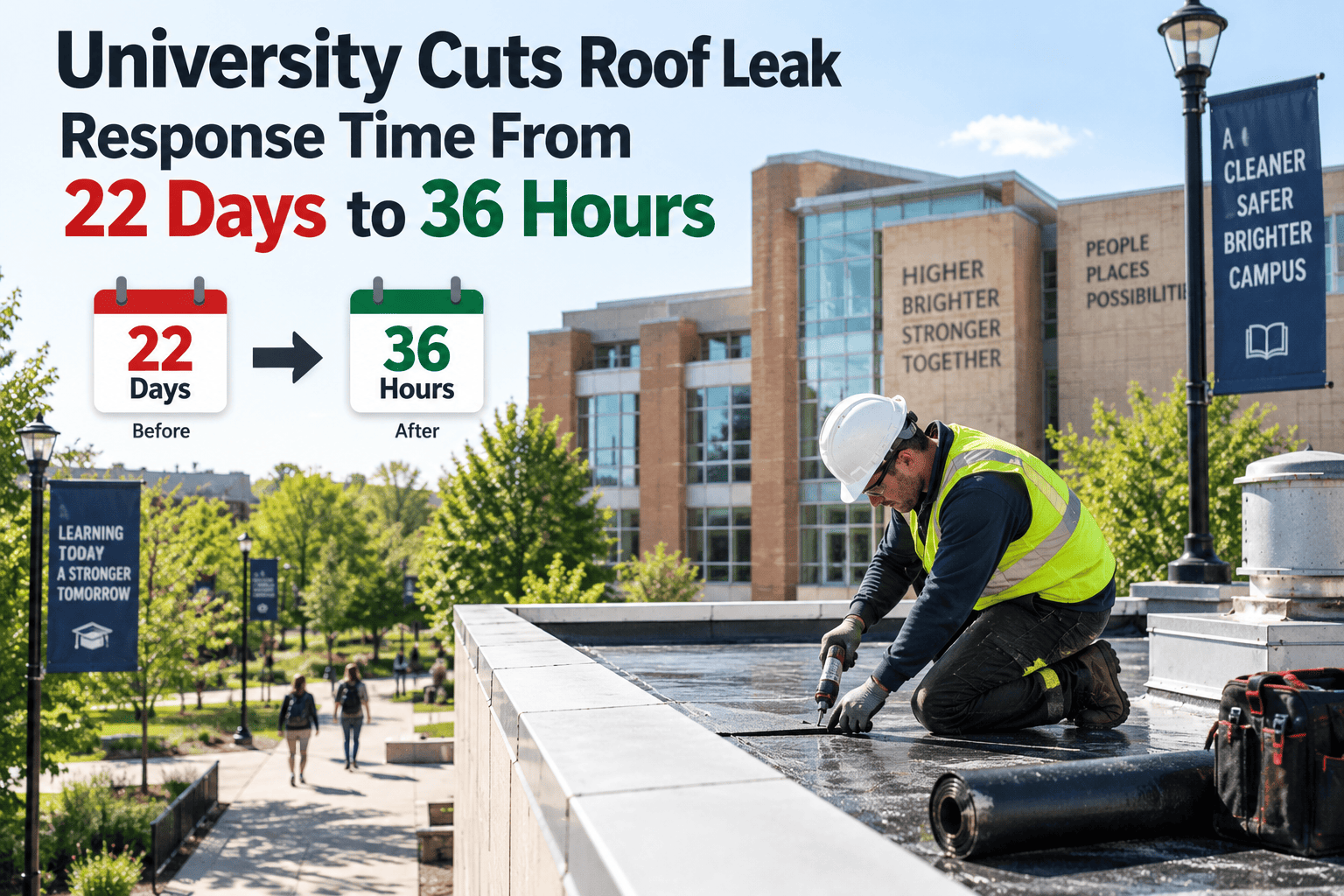
University estates and facilities teams often spend weeks chasing a single roof leak report through phone calls, spreadsheets, and paper job sheets before a contractor ever climbs a ladder. When lecture halls, libraries, and student residences depend on watertight buildings, every day a leak sits unresolved raises the risk of structural damage, mould, and safety complaints from staff and students. One UK university with more than forty buildings across its estate was averaging 22 days from the first reported leak to a completed repair, a gap that left roofs exposed through several rounds of rain before anyone was dispatched. After moving incident reporting, work order routing, and roof asset records onto Oxmaint AI, that same university now closes roof leak reports in under 36 hours on average, and this case study walks through exactly what changed.
The Real Cost of Slow Roof Leak Response
Before looking at what the university changed, it helps to understand what a slow response was actually costing the estate. Roof leaks rarely stay small. A drip ignored for three weeks becomes a soaked ceiling tile, a damaged research lab, or a flooded archive room, and each of those outcomes turns a cheap repair into a five figure claim. Estates directors across the education sector report the same pattern: response time is the single biggest driver of total repair cost, not the leak itself. The longer a leak sits open, the more it spreads into insulation, wiring, and plasterboard that a roofing contractor cannot see from the outside, which is why the first 48 hours after a leak is spotted matter more than almost any other stage of the repair.
22 days
average old response time
Time from a reported roof leak to a completed repair before Oxmaint was introduced.
36 hours
new average response time
Time from report to fix after mobile incident routing and warranty tracking went live.
£38,000
avoided secondary damage
Estimated cost of water damage, mould remediation, and lost teaching space prevented in year one.
Why Roof Leaks Are So Hard to Manage on a University Estate
Roof leak maintenance for education providers is not like maintaining a single building. A typical campus mixes Victorian teaching blocks, 1970s concrete residences, and glass-fronted research centres, each with a different roof type, a different original contractor, and a different set of warranty documents that may or may not still exist. Some roofs were replaced under a capital works programme five years ago and are still fully covered, while others have never been formally surveyed. Without a single, searchable record, estates staff end up treating every leak as an unknown, which means every job starts from zero instead of from the roof's actual history. The challenges below are the specific reasons a routine leak turns into a multi week backlog.
Reporting
Reports Arrive by Phone and Email
A porter or lecturer spots water coming through a ceiling tile and calls the helpdesk, who then types a rough description into a spreadsheet with no photo, no exact location, and no building reference.
Records
No Central Roof Asset Records
Warranty dates, last inspection notes, and the original roofing contractor live in filing cabinets, so nobody can quickly tell if a leak is still under warranty before booking an external contractor.
Routing
Manual Job Assignment
Someone has to manually decide whether a leak goes to the in house maintenance team or an external roofing contractor, and that decision often sits in an inbox for days before it is actioned.
Weather
Seasonal Backlogs
Autumn storms and winter freeze thaw cycles can generate dozens of leak reports in a single week, overwhelming a paper based system that was never designed to prioritise urgent cases.
Compliance
Weak Audit Trail
When governors or insurers ask for evidence of how quickly a leak was addressed, estates teams often cannot produce timestamps, photos, or a clear record of who did what and when.
Accountability
Split Contractor Responsibility
Multiple roofing contractors cover different buildings under different contracts, and without a shared system it is unclear who owns the fix until several phone calls have been made.
See how Oxmaint gives your estates team one mobile system for reporting, routing, and tracking every roof leak on campus.
Case Study: From a 22-Day Backlog to a 36-Hour Fix
The university's estates director began the project by mapping every roof across the campus into Oxmaint as a tracked asset, recording the roof type, installation date, warranty expiry, and the contractor responsible for each building. Maintenance staff and porters were given the Oxmaint mobile app so a leak could be reported from the corridor where it was spotted, complete with a photo and an exact location, instead of a second hand description typed up later. The comparison below shows what changed once that single workflow replaced the old system of calls, emails, and spreadsheets.
Before Oxmaint
Leak reports logged by phone with no photo or exact location
Warranty status unknown until paperwork was located
Jobs assigned manually, often sitting in an inbox for days
No shared view of open, in progress, or completed repairs
Average time to repair: 22 days
After Oxmaint
Leak reports logged from a phone with photo, location, and timestamp
Warranty and contractor details visible instantly on the asset record
Work orders routed automatically to the correct in house or external team
Live dashboard shows every roof leak status across the estate
Average time to repair: 36 hours
How Different Roof Leak Management Approaches Compare
Estates teams typically manage roof leaks in one of four ways. The table below compares them across the factors that actually determine how fast a leak gets fixed and how well the process holds up during a compliance audit.
| Approach |
Reporting Speed |
Warranty Visibility |
Audit Trail |
Typical Repair Time |
| Paper logs and phone calls |
Slow, description only |
Manual paper search |
Incomplete |
2 to 4 weeks |
| Email and spreadsheet tracking |
Delayed by inbox triage |
Separate spreadsheet |
Partial |
1 to 3 weeks |
| Generic IT ticketing tool |
Fast to log, slow to route |
Not built for assets |
Basic |
1 to 2 weeks |
| Oxmaint mobile CMMS |
Instant, with photo and location |
Built into the asset record |
Full digital history |
Under 36 hours |
How Oxmaint Solves the Roof Leak Problem
Fixing a leak faster is not really about the repair itself, it is about removing every delay that happens before a technician arrives. Oxmaint rebuilds that entire chain around mobile reporting, tagged assets, and automated routing so nothing sits waiting in an inbox.
Mobile Incident Reporting
Anyone on campus can report a leak from the Oxmaint mobile app in under a minute, attaching a photo and pinning the exact building and room so the maintenance team knows precisely where to go.
QR Code Roof Asset Tagging
Each roof section carries a QR code linked to its Oxmaint asset record, so scanning it on site instantly pulls up installation date, warranty status, and the full repair history for that roof.
Automated Work Order Routing
Based on the building, roof type, and warranty status, Oxmaint automatically routes the job to the correct in house technician or external contractor, removing the manual triage step entirely.
Digital Compliance Records
Every report, photo, work order, and completion note is timestamped and stored against the roof asset, giving estates directors a ready made audit trail for governors and insurers.
Preventive Inspection Scheduling
Oxmaint schedules recurring roof inspections ahead of storm season, catching flashing and seal issues before they turn into a reported leak in the first place.
Beyond Roofs: Why Estates Teams Extend This Across the Campus
Once the roof leak workflow was running smoothly, the estates team did not stop there. The same mobile reporting, asset tagging, and automated routing that fixed roof leaks applied just as well to heating faults, blocked drains, broken door access, and lighting failures across the campus. A building fabric issue reported in a residence hall now follows the same path as a roof leak: a photo, an exact location, an instant check of the relevant asset record, and an automatic routing decision, rather than a fresh set of phone calls every time.
This matters for education providers in particular because estates teams are usually stretched across an enormous range of asset types with a relatively small in house team. Standardising every reactive maintenance request through one mobile workflow, backed by one shared record of every building and every warranty, means new starters can be productive within days instead of months, and cover for annual leave or turnover no longer depends on one person's memory of which contractor handles which building. Estates directors describe it less as a roofing tool and more as the operating system their whole reactive maintenance programme now runs on.
Results After the First Year on Oxmaint
Twelve months after rolling out mobile reporting and asset tagging, the university's estates team reviewed the numbers against their old paper based process. The improvements went well beyond response time, extending into cost control and audit readiness.
94%
Faster Repair Time
Average time from report to completed fix dropped from 22 days to 36 hours.
100%
Roofs Tagged
Every roof section across the estate now has a warranty linked asset record.
61%
Fewer Repeat Leaks
Preventive inspections caught seal and flashing issues before they became reported leaks.
£38,000
Damage Avoided
Estimated water damage and mould remediation costs avoided in year one alone.
Your Path to Faster Roof Leak Response
Estates teams considering the same move can follow the same four stage rollout the university used, spread across a single term rather than a full academic year.
1
Map Every Roof as an Asset
Log each roof section into Oxmaint with its installation date, warranty expiry, and responsible contractor, pulling records from old paperwork and contractor invoices.
2
Tag Roofs With QR Codes
Attach a QR code near each roof access point so any staff member can scan it, view the asset record, and log a leak without hunting for a building reference.
3
Roll Out Mobile Reporting
Give porters, lecturers, and residence staff access to the Oxmaint mobile app so a leak can be reported with a photo the moment it is spotted.
4
Turn On Automated Routing
Configure routing rules so leaks are sent straight to the correct in house team or contractor based on building, roof type, and warranty status.
We used to find out about a roof leak weeks after it started, usually from a stained ceiling tile rather than a report. Now a porter scans a QR code, takes a photo, and the right contractor has a work order within minutes. Governors ask for evidence of our maintenance response times every year, and for the first time we can show them a complete digital record instead of a stack of paper. The warranty tagging alone paid for the rollout, because we stopped paying out of pocket for repairs that should have been covered.
Director of Estates, UK University
Ready to cut your own roof leak response time from weeks to hours? See how Oxmaint's mobile reporting and warranty-tagged assets work for your estate.
Frequently Asked Questions
How did the university cut roof leak response time to 36 hours?
By combining mobile incident reporting with warranty-tagged roof assets in
Oxmaint, so every leak arrives with a photo, exact location, and warranty status, and is routed automatically instead of sitting in an inbox.
What is warranty-tagged asset tracking for roofs?
Each roof section is logged as an asset in Oxmaint with its installation date, warranty expiry, and responsible contractor, so estates teams know instantly whether a repair should be claimed under warranty before booking work.
Can any staff member report a roof leak, not just estates staff?
Yes, porters, lecturers, and residence staff can all report a leak through the Oxmaint mobile app with a photo and location, removing the need to route every report through a central helpdesk first.
How does Oxmaint help with compliance audits?
Every report, work order, and completion note is timestamped and stored against the roof asset record, giving estates directors a complete digital history they can hand to governors or insurers on request.
Is this approach only useful for large university estates?
No, any education provider managing multiple buildings can apply the same workflow. Smaller colleges typically see the same gains in response time once reporting and asset records move into one mobile system, and you can
book a walkthrough to see it configured for your estate.
Stop Losing Weeks to Roof Leak Backlogs
Give your estates team one mobile system for reporting, routing, and tracking every roof leak, backed by warranty-tagged asset records and a complete digital audit trail.