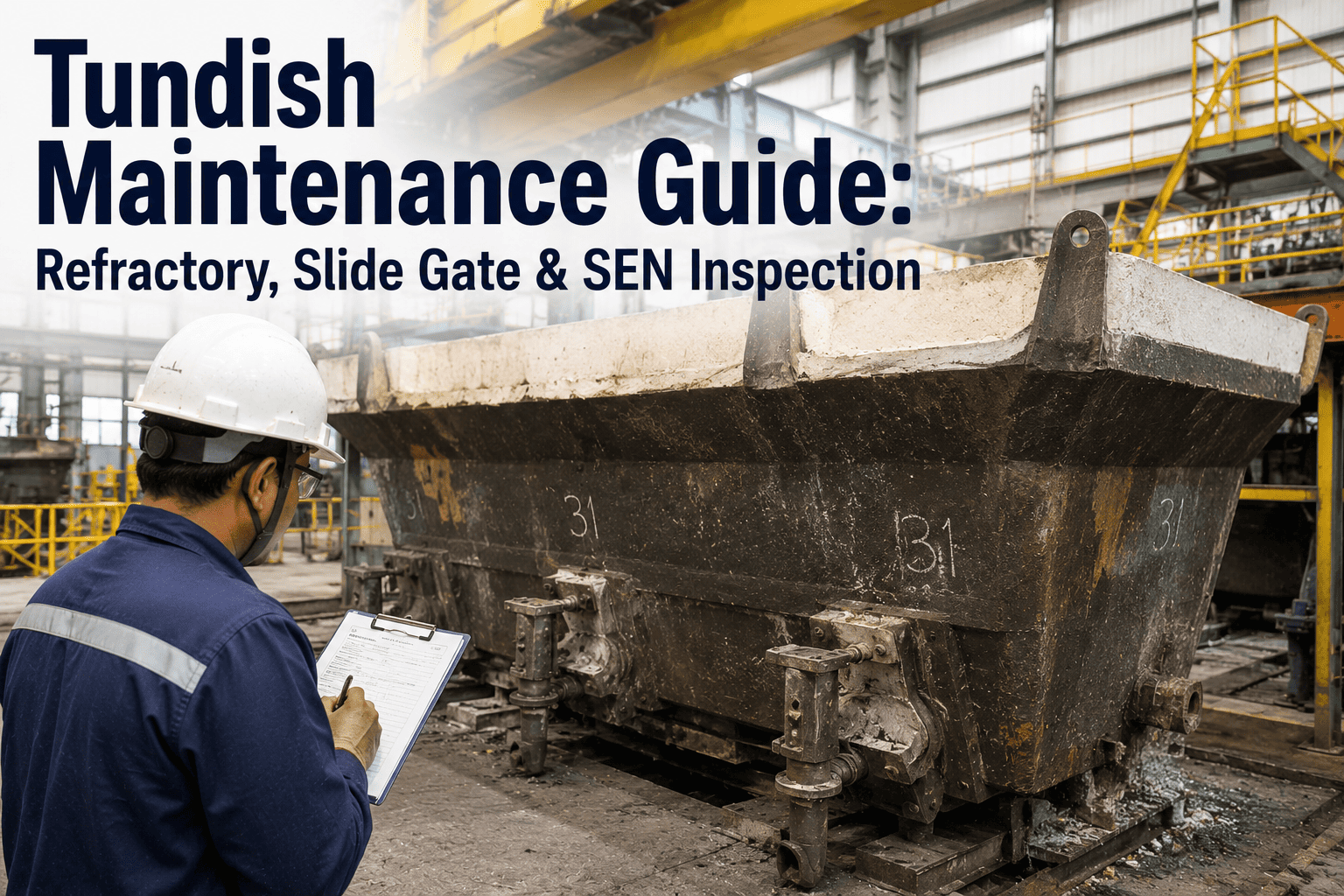
A tundish only looks simple from the outside, a refractory-lined vessel that briefly holds molten steel between the ladle and the mold. Underneath that, its campaign life is decided by how well the working lining, slide gate, stopper rod and SEN survive heat after heat, and its turnaround between sequences is an unstructured handover zone where a skipped step can cost far more than the few minutes it saved. Sign up for a free trial to see how Oxmaint gate-controls every step of tundish turnaround so nothing proceeds to casting unverified.
20-80
Heats a tundish campaign typically achieves depending on steel grade mix
$150K
Average cost of an unplanned sequence break including refractory and lost production
20-40 Min
Warning most SEN clogging events give through flow restriction signals before blockage
40%
Fewer stopper rod emergency changes when wear is tracked digitally per heat
The Flow Control Assembly Is Where Small Wear Becomes Big Risk
Slide gate plate erosion, stopper rod tip wear, and nozzle clogging from alumina buildup all lead to the same outcome: loss of controlled flow, either flooding the mold or starving it into a strand freeze. None of these fail without warning, but they do fail fast once wear crosses a threshold, which is why this assembly deserves inspection every sequence, not just at the next scheduled reline.
The Tundish Turnaround, Step by Step
| Turnaround Step |
What Gets Checked |
Risk If Skipped |
| Post-sequence inspection |
Working lining condition by zone, skull weight, campaign tonnage logged |
Wear rate model loses accuracy for the next campaign decision |
| Lining & coating |
Refractory application against zone thickness minimums |
Thin spots at the impact pad shorten campaign life unexpectedly |
| Preheat |
Burner performance, thermocouple accuracy, temperature-time curve versus grade spec |
Thermal shock cracking and cold spots that freeze steel on first contact |
| Transfer & positioning |
Turret rotation travel, ladle shroud centreline alignment with pour point |
Misalignment risks steel penetration and uneven refractory erosion |
| Pre-opening checks |
Slide gate and stopper rod assembly condition, actuator response verification |
Uncontrolled flow at first heat, flooding or starving the mold |
No Tundish Reaches Casting Without a Verified Sequence
Oxmaint timestamps every turnaround step against the responsible person and flags anything running overdue, so the handover from post-sequence inspection to pre-opening checks never gets rushed under production pressure. Sign up for a free trial to test it against your own tundish cycle, or book a demo and we'll walk through your turnaround workflow.
Slide Gate, Stopper Rod or SEN: Different Parts, Different Limits
| Component |
Typical Service Life |
Watch For |
| Slide gate plates |
Roughly 8-15 heats for tundish applications |
Plate erosion and actuator response lag during pre-opening checks |
| Stopper rod |
Tracked per heat against cumulative campaign tonnage |
Tip degradation and position drift signaling wear before leak-by |
| SEN |
Zirconia-carbon designs favored for extended service life |
Alumina buildup and argon pressure drift ahead of clogging |
The Impact Pad Zone Wears Faster Than the Rest of the Lining
Refractory wear across a tundish is never uniform, and the zone directly below the ladle shroud absorbs the most erosive impact from incoming steel. Comparing zone-level thickness readings against a minimum threshold, rather than relying on one average number for the whole lining, is what catches a campaign approaching its real limit before steel penetration becomes a breakout risk.
Frequently Asked Questions
Q
What decides how many heats a tundish campaign actually gets?
Campaign life is largely set by the endurance of the stopper rod and metering nozzle refractories, alongside how evenly the working lining erodes across zones. Steel grade mix plays a big role too, which is why campaign length varies from roughly 20 to 80 heats between plants and product mixes rather than following one fixed number.
Q
Can SEN clogging really be caught before it stops the flow?
In most cases, yes. Flow restriction signals typically appear 20 to 40 minutes before a full blockage, which is enough lead time to intervene if argon pressure and flow readings are being watched continuously rather than checked only when a problem is already visible on the caster.
Q
Why does the turnaround sequence matter as much as the refractory itself?
A perfectly good refractory can still fail if preheat is inadequate or the turret and shroud aren't properly aligned before the next sequence starts. The turnaround is where thermal shock cracking, cold spots and misalignment get introduced, so treating it as a gated checklist rather than an informal handover protects the refractory investment already made.
Q
Is tracking stopper rod wear per heat worth the extra logging?
Plants that log stopper rod position deviation and tip wear against every heat rather than relying on visual judgment report meaningfully fewer emergency changes, since drift becomes visible as a trend well before it becomes a leak-by event during casting.
Turn Every Tundish Sequence Into a Verified, Repeatable Cycle
Oxmaint gives steel plant teams gate-controlled turnaround tracking, zone-level refractory wear monitoring, per-heat stopper rod and SEN records, and campaign life prediction in one platform. Sign up for a free trial to explore it yourself, or book a demo and we'll walk through it against your own tundish operation.