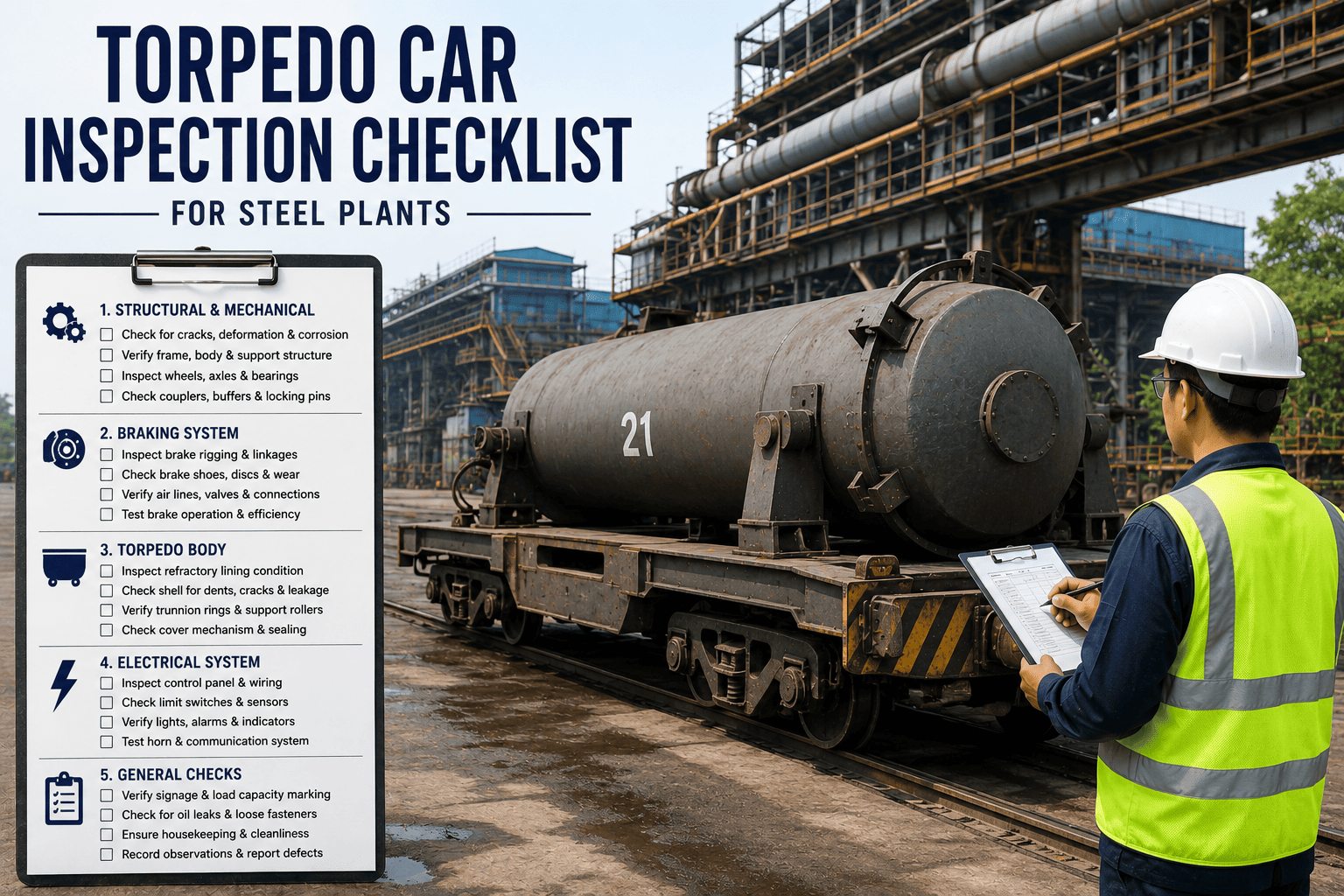
A torpedo car hauls molten iron above 1300°C down the same rail line, shift after shift, and every safe pour depends on a refractory lining that hasn't thinned out, a tilting mechanism that responds exactly on command, and wheels that stay on the track. This checklist covers what to verify on the vessel, the tilting drive, and the running gear before a torpedo car goes back into rotation. Sign up to turn this checklist into a guided digital procedure your crew follows on every shift.
1300°C+ Hot Metal
Approximate temperature the refractory lining holds back on every run
Rail-Bound
Wheel and track condition that decides whether the car stays on line
Zero Tolerance
Room for skipping a refractory thickness check or tilting mechanism test
Why Torpedo Cars Get Checked Every Run
A torpedo car doesn't sit still between pours, it stays in constant rotation between the blast furnace and the steel shop. That means refractory wear, tilting drive condition, and wheel wear accumulate fast, and a check that gets pushed to next week is a check that gets skipped for dozens of runs in between.
Refractory & Vessel Inspection
Refractory Lining Thickness Check
Measure remaining refractory thickness at known hot spots so a thin section is caught before it burns through
Shell Plate & Weld Seam Check
Inspect the outer shell and weld seams for bulging or discoloration that signals heat coming through
Mouth Ring & Spout Condition Check
Check the mouth ring and pouring spout for erosion that could affect a clean, controlled pour
Track Refractory Wear Before It Becomes A Breakout
Oxmaint guides your crew through refractory, tilting, and wheel checks step by step, with wear readings logged against each torpedo car. Sign up for a free trial to build your torpedo car checklist, or book a demo to see it in action.
Tilting Mechanism & Drive
Tilting Gear & Rack Check
Inspect the tilting gear and rack teeth for wear that could cause slippage mid-tilt during pouring
Tilting Motor & Brake Check
Test that the tilting motor responds smoothly and the brake holds the vessel at any tilt angle
Trunnion Bearing Lubrication Check
Check trunnion bearing lubrication so the vessel tilts freely without binding under load
Wheels, Rail & Motion Systems
Wheel Flange & Tread Wear Check
Measure wheel flange and tread wear against tolerance before the car is cleared for another run
Traction Motor & Coupling Check
Verify traction motor performance and coupling condition between the car and locomotive
Rail Track & Buffer Stop Check
Check the rail track for obstructions and confirm buffer stops are secure along the transfer route
What A Skipped Check Can Cost You
| Check Skipped |
Likely Consequence |
| Refractory thickness check |
A thinned lining burns through, causing a hot metal breakout |
| Tilting mechanism check |
Uncontrolled tilt during pouring, spilling hot metal outside the ladle |
| Wheel wear check |
A worn flange increases the risk of derailment on the transfer track |
| Trunnion bearing lubrication |
Bearing seizure mid-tilt, stopping the pour partway through |
Where A CMMS Fits Into Torpedo Car Checks
Oxmaint ties this checklist to each torpedo car as a tracked asset, logging refractory thickness readings, tilting mechanism tests, and wheel wear so trends are visible across the whole fleet, not just one car at a time.
Frequently Asked Questions
Q
How often should torpedo car refractory be inspected?
Refractory thickness should be checked on a fixed cycle tied to the number of runs completed, since wear depends more on usage than on calendar time between inspections.
Q
What happens if a torpedo car's tilting mechanism fails?
A failed tilting mechanism can leave the vessel stuck mid-pour or let it tilt further than intended, both of which risk spilling hot metal outside the receiving ladle.
Q
Can a CMMS track refractory wear across multiple torpedo cars?
Yes, a CMMS can log thickness readings against each torpedo car individually, making it possible to compare wear rates across the fleet and plan relining before a car reaches its limit.
Keep Every Torpedo Car Run Safe And On Schedule
Oxmaint guides your crew through refractory, tilting, and wheel checks and logs every reading against the torpedo car automatically. Sign up for a free trial to build your torpedo car checklist, or book a demo to see it in action.