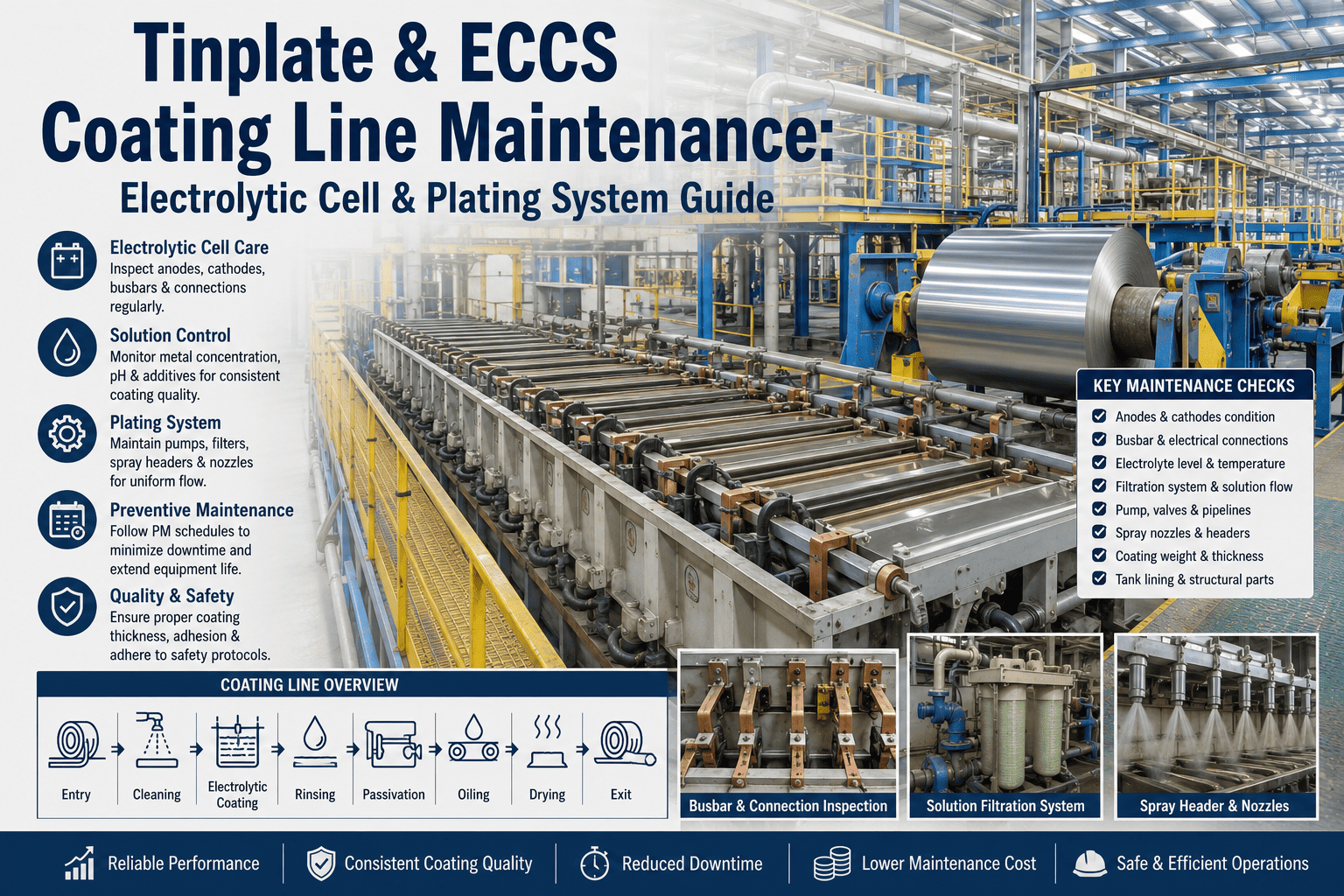
An electrolytic tinning or ECCS line runs on current, not just steel speed. A conductor roll losing contact, a plating bath drifting out of concentration, or an insulator breaking down can shift coating weight across an entire coil before anyone notices on the line. Maintenance on these lines is really about keeping the electrical path as clean as the strip itself. Sign up to see how Oxmaint tracks every cell, roll and bath parameter across your coating line in one place.
Conductor Rolls
The single most common source of current instability on an electrolytic coating line
+/-2%
Typical tolerance window plants target for coating weight consistency across a coil
Daily
Recommended frequency for plating bath concentration and temperature checks
1 Bad Roll
Is often enough to cause visible streaking or coating weight variation across a full coil
Why Conductor Rolls Are the Most Sensitive Part of the Line
Conductor rolls carry the current into the strip, so any pitting, plating buildup, or surface glazing on the roll changes how evenly that current transfers. Unlike a mechanical wear part that fails visibly, a degrading conductor roll shows up first as a coating weight variation or a subtle streak pattern, which is why regular contact resistance checks matter as much as physical inspection.
Core Electrolytic Cell & Plating System Components
| Component |
Common Failure Mode |
Maintenance Task |
| Conductor rolls |
Surface pitting or plating buildup causing uneven current transfer |
Contact resistance testing and periodic surface reconditioning |
| Insoluble anodes |
Passivation layer buildup reducing plating efficiency |
Scheduled cleaning and current efficiency verification |
| Cell insulators |
Electrolyte creep leading to insulation breakdown and current leakage |
Visual inspection and insulation resistance testing |
| Bridle rolls & strip guides |
Surface wear causing strip tracking issues and edge damage |
Alignment check and roll surface wear inspection |
| Rectifiers & bus bars |
Connection loosening causing voltage fluctuation and localized heating |
Thermal scan and connection torque check on a fixed interval |
Every Cell, Every Roll, One Maintenance Record
Oxmaint registers conductor rolls, anodes, insulators and rectifiers as tracked components with their own inspection and repair history, so coating weight drift can be traced back to a cause instead of a guess. Sign up for a free trial to see it against your own coating line, or book a demo and we'll walk through your electrolytic cell setup.
Plating Bath Parameters Worth Watching Daily
| Parameter |
What It Affects |
Monitoring Practice |
| Bath temperature |
Plating rate and deposit adhesion quality |
Continuous logging with an alert on out-of-range drift |
| Electrolyte concentration |
Coating uniformity and current efficiency of the cell |
Scheduled sampling with a logged correction history |
| Current density |
Coating weight consistency along the strip width |
Line-speed correlated readings checked against target curve |
Reactive Fixes vs Predictive Line Maintenance
Reactive Fixes
Conductor rolls reconditioned only after streaking appears on coil
Bath parameters corrected after a quality complaint, not before
Rectifier connections checked only during a full line shutdown
Predictive Line Maintenance
Contact resistance trended to catch conductor roll wear early
Bath chemistry logged daily against a defined target range
Thermal scans flag loose connections before they cause downtime
How Oxmaint Supports Coating Line Reliability
Oxmaint tracks conductor rolls, anodes, insulators, bridle rolls and rectifiers as individual assets on your tinplate or ECCS line, logging inspection readings, bath parameter checks and repair history against each one. Trends that point toward a coating weight issue trigger a work order before the next coil is affected. Book a demo to see it mapped against your own electrolytic line.
Frequently Asked Questions
Q
Why does conductor roll condition matter more than it seems?
A conductor roll doesn't need to fail completely to cause a problem. Even mild pitting or plating buildup changes how current transfers into the strip, which shows up as coating weight variation long before the roll looks visibly damaged.
Q
How often should plating bath parameters be checked?
Bath temperature and concentration are generally worth checking daily, since small drifts in either one accumulate over a shift and can shift coating uniformity before anyone reviewing quality data catches it.
Q
What's the difference between tinplate and ECCS maintenance needs?
Both run on the same electrolytic principles, conductor rolls, anodes and current control, but ECCS lines add a chromium coating stage with its own bath chemistry, so the same discipline applies twice with different target parameters for each cell.
Q
What's the fastest way to start tracking coating line maintenance digitally?
Register each electrolytic cell component, conductor rolls, anodes, insulators, rectifiers, as a tracked asset, then log inspection readings and bath parameter checks against it so trends become visible instead of hidden in separate logs.
Catch Coating Weight Drift Before It Reaches the Next Coil
Oxmaint gives steel plant teams conductor roll tracking, plating bath parameter logging, rectifier and insulator inspection history, and predictive maintenance alerts across the entire electrolytic coating line. Sign up for a free trial to explore it yourself, or book a demo and we'll walk through it against your own coating line.