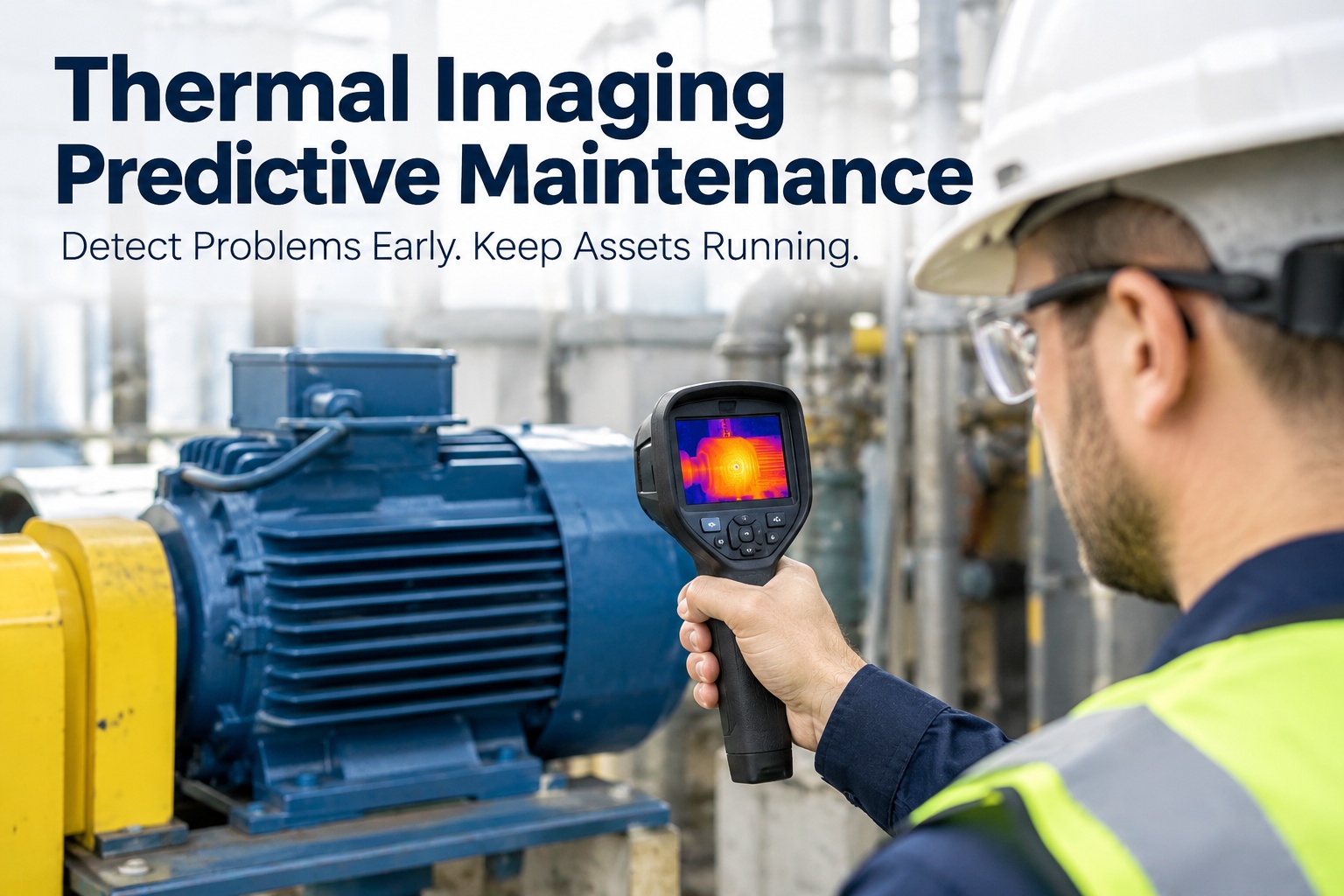
The quarterly thermographic survey gives you four snapshots a year of assets that develop faults over weeks. A loose switchgear lug, a bearing running 15°C above baseline, a motor terminal with degrading torque — all can appear, escalate and fail between one survey and the next. Oxmaint continuously monitors fixed thermal cameras on your critical assets, classifies every anomaly against NETA severity thresholds, and raises a work order the moment a hotspot exceeds the limit for that specific asset. Book a thermal AI demo to see continuous monitoring live.
24/7
continuous monitoring vs quarterly manual surveys — the visibility gap continuous cameras close
4-10×
ROI on infrared inspection per US Department of Energy — avoided repairs plus energy savings
<2%
AI false alarm rate when thermal is fused with vibration — vs 15-20% for threshold-only systems
Why Periodic Thermographic Surveys Miss What Matters
A quarterly survey catches the fault that exists on the day the thermographer walks past. It doesn't catch the fault that develops the following week, escalates over a month, and takes out a distribution board a fortnight before the next scheduled visit. That's not a criticism of thermographers — it's a limit of episodic inspection against a continuous failure mechanism. Fixed cameras change the model entirely: the asset is under thermal observation every minute, the baseline is a live trend, and the alert fires when a hotspot first develops rather than after it's fully formed.
Periodic Survey vs Continuous Thermal AI
Periodic IR Survey
Coverage4 snapshots/year
Detection lagUp to 90 days
Load conditionsWhatever's running that day
BaselinePrior survey — months old
Access requirementPanels open, arc-flash risk
OutputPDF report to inbox
Continuous Thermal AI
Coverage24/7, every asset with a camera
Detection lagMinutes to hours
Load conditionsCaptured across full duty cycle
BaselineLive rolling trend per asset
Access requirementFixed cameras — no panel access
OutputAuto work order in CMMS
The NETA Severity Ladder Every Hotspot Is Judged Against
NETA and NFPA 70B classify thermal anomalies by ΔT — the temperature difference between a component and either its own baseline or an adjacent identical component under similar load. The tiers below are the industry standard for electrical assets. Oxmaint applies them automatically to every anomaly detected by a fixed camera and raises a work order at the appropriate severity, timeline and priority. The reliability engineer doesn't reinterpret raw temperatures — they act on the classified alert.
ΔT > 40°C
Severe — Imminent failure risk
Arc flash hazard territory. Shutdown and repair within 24 hours to prevent catastrophic failure. Oxmaint raises a critical work order and can trigger isolation notification workflows.
ΔT 20-40°C
Major — Significant degradation
Schedule repair within 1-2 weeks. Daily monitoring until corrected to catch acceleration. Work order raised with priority tag and automatic re-inspection reminder.
ΔT 10-20°C
Minor — Early-stage degradation
Add to next planned outage window. Re-inspect in 2-4 weeks to confirm trend direction. Recorded against the asset for pattern analysis over time.
ΔT < 10°C
Normal — Operating variation
Within expected operating variance. No action required. Continues to feed the baseline for that asset — every reading refines the future alert threshold.
Because the baseline is per-asset rather than universal, a motor that habitually runs 15°C hotter than its neighbours doesn't drown you in false alerts. Sign up free to configure per-asset thermal thresholds against your fleet.
What the AI Actually Sees on a Thermal Frame
A fixed thermal camera doesn't just capture temperature — it captures the spatial distribution of temperature across an asset. That matters because failure modes have signatures. A single hot terminal on a bus bar means loose connection torque. Uniform heating across an entire lineup means overload. A hot bearing housing means lubrication or mechanical wear. The AI classifies the pattern as well as the value, which is what makes the work orders it raises specific rather than generic.
Thermal Frame · SWG-B4 · Distribution Panel
Live · 14 Nov 2026 · 14:23 GMT
Alert
ΔT: +34°C vs adjacent phase
Location: Bus bar terminal, Phase B
Pattern classification: Single-point hotspot. Signature consistent with loose connection torque on B-phase lug. No thermal spread to adjacent components — indicates localised fault, not system overload.
Severity band: Major (20-40°C ΔT range) — repair within 1-2 weeks per NETA guidance.
Action taken: Work order WO-3417 auto-raised · assigned to electrical team · priority 2 · thermal frame attached.
See Thermal AI Classify a Real Hotspot
Watch Oxmaint ingest a live thermal frame, classify the anomaly against NETA severity, and raise a work order with the image attached — all in under a minute. Thirty-minute walkthrough on your camera types.
Which Assets Belong on Continuous Thermal Monitoring
Not every asset needs a fixed thermal camera — that's what quarterly surveys are still useful for on non-critical equipment. But there's a specific tier of assets where the failure cost, safety risk, or production dependency justifies continuous coverage. The list below is where fixed thermal cameras typically pay back inside twelve months on any mid-size industrial site.
MV/HV switchgear
IEC 62271 · NETA MTS
Bus bars, breaker terminals, incoming cable heads. A single arc flash event costs more than years of monitoring — insurers increasingly mandate it.
LV distribution panels
BS 7671 context
Panel lugs, fuse holders, sub-main breakers. High density of connections in a small space — the most common electrical hotspot source.
Motor control centres
Reliability-critical
Contactors, overload relays, VFD sections. Thermal signature reveals overload conditions well before winding damage occurs.
Bearings on critical rotating plant
Fusion with vibration
Bearing housing temperature complements vibration data. Rising temperature with vibration change is a very high-confidence signal.
Transformers & reactors
Load-critical assets
Tank temperature, bushing terminals, cooling fin performance. Slow-developing thermal issues are exactly where continuous trending wins.
Battery rooms & UPS
Fire risk critical
Thermal runaway is a documented battery failure mode. Continuous monitoring is the difference between an alert and a fire event.
Expert Perspective — Trends Beat Snapshots
Single thermal readings identify current problems. Trends over multiple cycles predict future ones. That distinction is why continuous monitoring outperforms even the most disciplined quarterly survey: a connection climbing 2°C per week under stable load is telling you something an annual snapshot never will — and every day between surveys is a day that fault is developing without your knowledge.
Load matters
Scanning under low load is the most common survey error. Faults only heat up under load — continuous cameras capture the full duty cycle.
Per-asset baselines
A 75°C reading on a motor that normally runs 70°C is an alert. The same reading on one that normally runs 55°C is a critical emergency.
Repeat offenders
If maintenance keeps retightening the same lug or resetting the same breaker, the pattern points to a deeper issue — chronic overload or installation defect.
Fuse the data
Thermal alerts fused with vibration data run below 2% false alarm rate — versus 15-20% for temperature-threshold-only systems.
Who Uses Thermal AI in Practice
The workflow is used by the specific roles that own electrical and rotating-asset reliability: electrical engineers responsible for switchgear and distribution reliability, reliability managers wanting fused vibration-plus-thermal signals on critical rotating equipment, facilities managers meeting insurer requirements for continuous thermal monitoring on high-value assets, and HSE leads managing arc-flash and battery fire risk. Each role sees the same underlying data filtered to their view — alerts, trends, or compliance evidence. Sign up free to configure thermal monitoring for your critical assets, or book a walkthrough to see camera integration on your existing hardware.
Getting Continuous Thermal Live in 30 Days
Deployment doesn't need a rip-and-replace of your existing camera hardware. If you already have FLIR or ONVIF-compliant thermal cameras installed, Oxmaint connects to the feed and starts baseline learning immediately. If you're specifying new cameras, the platform team can advise on sensor selection for the asset class. Within the first week baselines are established, NETA severity thresholds apply automatically, and every classified hotspot raises an auto work order with the thermal frame attached. Sign up free to connect your existing thermal camera feeds in the first setup session.
Move From Quarterly Surveys to 24/7 Thermal Intelligence
Oxmaint turns fixed thermal cameras into continuous predictive maintenance — classifying every hotspot against NETA severity, trending baselines per asset, and auto-raising work orders with the thermal frame attached.
Frequently Asked Questions
Which thermal cameras does Oxmaint integrate with?
Oxmaint integrates with major fixed thermal camera manufacturers — including FLIR, Fluke, Hikvision thermal, and ONVIF-compliant devices. Existing camera installations can typically be brought into the platform without hardware replacement. For sites without cameras yet, Oxmaint's team can advise on the right sensor specification for the asset class — MV switchgear, LV panel, motor MCC or rotating equipment each carry different sensor requirements.
Do we still need periodic thermographic surveys?
For most sites, yes — as complementary coverage rather than the primary detection method. Continuous cameras cover critical assets 24/7; annual or biannual full-facility surveys catch anomalies on equipment that doesn't warrant fixed cameras (secondary distribution, general lighting, non-critical MCCs). Insurers often mandate periodic certified thermographer surveys regardless. Oxmaint holds both data streams — continuous and periodic — against the same asset record.
How does the AI reduce false alarms?
Three mechanisms. First, per-asset baselines — the AI learns the normal thermal signature of each specific asset under different load conditions, so an asset that always runs hotter than its neighbours doesn't fire constant alerts. Second, pattern classification — a single-point hotspot is treated differently to uniform panel heating, because the underlying failure modes are different. Third, sensor fusion — when thermal data is combined with vibration or load-current data, false alarms drop below 2%, versus 15-20% for temperature-threshold-only systems.
Can this detect problems through closed panels?
Thermal cameras detect heat conducted through metal enclosures, but readings are attenuated — so external monitoring won't measure absolute internal temperatures accurately. What it does very well is detect change: a hot spot developing on a panel exterior always corresponds to an internal issue. Sites typically combine continuous exterior monitoring with periodic panel-open thermographic inspection during scheduled outages to capture both.
What's the payback timeframe?
US Department of Energy research puts the ROI on infrared inspection at 4-10× the programme cost, from avoided repairs, energy savings and extended equipment life. In practice, a single prevented switchgear failure — with its emergency replacement, extended production shutdown and any arc-flash liability — can pay for years of continuous monitoring on that lineup. Sites focusing continuous cameras on their most critical assets usually see payback inside twelve months.