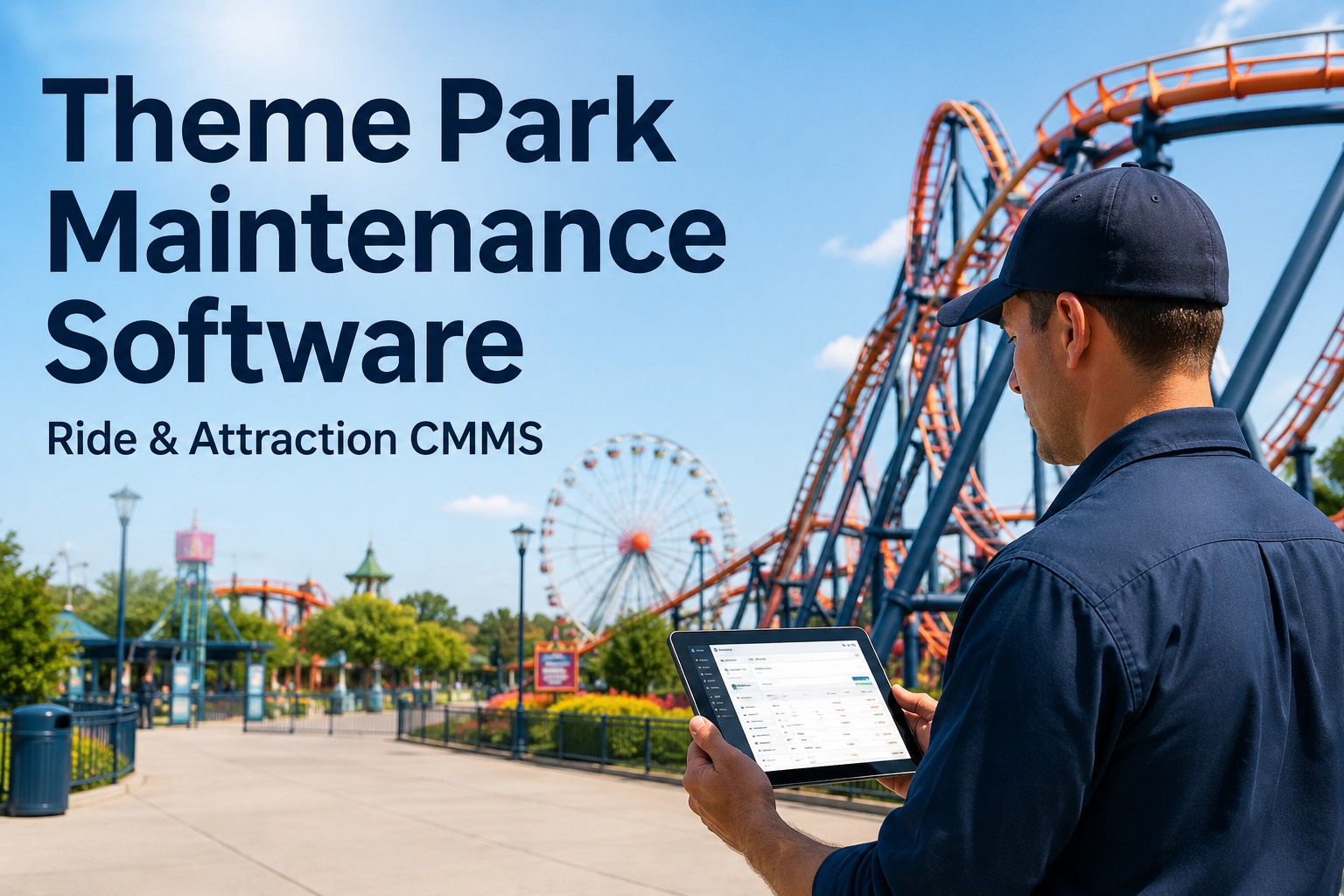
A theme park is a paradox of engineering. The most safety-critical mechanical equipment on a UK visitor site — coasters, drop towers, giant wheels — must be verifiably ready every morning before the gates open, and every ride cycle after that until closing. HSG175, ADIPS and the ride owner's duty under HSWA sit behind every revolution, every day of the season. Parks that keep both guest experience and safety file intact aren't lucky — they run structured maintenance workflows that leave nothing to memory. Book a demo to see park maintenance workflows in action.
◆ THEME PARK OPERATIONS · ADIPS · HSG175 · DAILY INSPECTION
Every day, before every gate opens, every ride must be signed off. That workflow doesn't run on memory — it runs on structure.
Every coaster, every carousel, every water ride, every safety-critical fastener — under one inspection-driven maintenance system.
DAILY INSPECTION WINDOW · PRE-OPENING CADENCE
06:00
Engineering team arrives
07:00
Ride category walk-arounds
08:30
Empty-vehicle test cycles
09:30
Ride-in-charge sign-off
4h
Typical pre-opening inspection window
100%
Rides signed off before every daily opening
200+
Season days · Each with its own inspection record
Ride Category Matrix — Not Every Attraction Needs the Same Regime
The Fairgrounds and Amusement Parks: Guidance on safe practice (HSG175) categorises rides by hazard profile, and the ADIPS scheme applies inspection frequency proportionally. A properly configured CMMS knows the category of every ride and runs a different PPM cadence, different inspection depth and different competent-person requirement per category — not one uniform regime applied to everything. Sign up free to run category-appropriate PPM across your ride portfolio.
RIDE CATEGORY FRAMEWORK · HSG175
Category → Examples → Inspection Regime
HIGH-HAZARD
Roller coasters · Drop towers · Giant wheels · Inversion rides · Water coasters
Regime · Daily walk-around · Weekly deep · Monthly PPM · Annual TE by ADIPS RCA
A
MEDIUM-HAZARD
Family coasters · Log flumes · Rapids · Waltzers · Round-ups · Themed dark rides
Regime · Daily inspection · Monthly PPM · Annual TE by ADIPS RCA
B
LOWER-HAZARD
Carousels · Kiddie rides · Slow-moving family attractions · Tea cups · Panda coasters
Regime · Daily visual · Quarterly PPM · Annual TE by ADIPS RCA
C
SUPPORTING
Queue-line theming · Turnstiles · F&B kiosks · Ride photo systems · Locker facilities
Regime · Facilities-style PPM · Statutory as applicable · Not ADIPS-scope
D
Inspection Cadence — From Daily Walk-Around to Annual Thorough Examination
Ride safety operates on a five-tier inspection ladder, each tier catching different classes of defect at different frequencies. The daily walk-around finds loose fasteners and visible damage; the annual thorough examination finds structural fatigue and material degradation that only shows in specialist NDT. Missing any tier creates a gap in the safety evidence chain — which is why a working CMMS holds all five as scheduled work with sign-off structural to each event. Book a demo to see the inspection cadence workflow live.
DAILY
Pre-Opening Walk-Around
Visual check of ride vehicle, restraints, track, station platform · Empty-vehicle test cycles · Ride-in-charge signs off before first guest boards
Owner · Competent person on-site
WEEKLY
Deep Inspection
Restraint mechanism function test · Brake calibration verification · Lubrication check · Fastener torque check on flagged joints · Photographic evidence
Owner · Ride engineer
MONTHLY
Preventive Maintenance
Manufacturer PPM schedule · Component replacement per cycle count or hours · Wear measurement · System calibration · Extended engineering downtime
Owner · Manufacturer-trained team
QUARTERLY / ANNUAL
Major Component Overhaul
Structural inspection · Weld examination · Cable testing · Hydraulic system service · Control system verification · Off-season deep overhaul
Owner + specialist contractors
ANNUAL
ADIPS Thorough Examination
Independent examination by Registered Competent Assessor · NDT on critical structure · DOC (Declaration of Operational Compliance) issued · Basis for insurance and operating licence
Independent · ADIPS RCA
Defect Triage — Deciding What Runs, What Waits, What Stops
Not every defect stops a ride. The judgement of what does — and the auditable evidence trail of that judgement — is one of the most important workflows in park engineering. Get the classification wrong at the ride and you're either running unsafe or losing guest capacity unnecessarily. Get the evidence trail wrong and any subsequent incident becomes an unwinnable enquiry. A CMMS that structures defect classification against risk and captures the reasoning behind each decision is what turns judgement into a defensible process.
01
Non-Safety Cosmetic
Fading paint, minor theming damage, cosmetic scuffs — no operational impact
RIDE OPERATES · Off-season repair
02
Minor Operational
Guest information sign missing, non-critical light out, spare part running low
RIDE OPERATES · Repair within 7 days
03
Redundancy Degraded
One of two safety-critical systems degraded but redundancy intact · Documented decision by competent person
CONDITIONAL · Restricted operation · Repair < 24h
04
Safety System Fault
Restraint mechanism fault, brake failure, control system anomaly, structural concern
RIDE STOPS · No operation until certified
◆ THEME PARK MAINTENANCE DEMO
See the Full Park Workflow in 30 Minutes
Ride asset hierarchies with category classification, pre-opening inspection workflows, ADIPS Thorough Examination records, defect triage with sign-off chains and audit-ready evidence packs for HSE, insurers and local authority.
Beyond Rides — The Rest of the Park That Also Needs Managing
Rides get most of the engineering attention, but a modern UK theme park is a complete leisure estate. Water treatment plant, kitchens, laundries, coach parks, hotel accommodation, entertainment venues and back-of-house facilities all need structured maintenance and statutory compliance. Running two systems (one for rides, one for everything else) creates gaps; running one system with ride-specific overlays keeps engineering visibility complete. Sign up free to bring rides and estate into a single register.
WATER FACILITIES
Water parks, splash pads, wave pools · L8 Legionella regime · PWTAG guidance · Chemistry monitoring · Filter service · Pump maintenance
FOOD & BEVERAGE
Kitchens, bars, kiosks · Gas Safety · F-Gas refrigeration · Extract cleaning · Deep cleaning cycles · HACCP-linked equipment PPM
HOTELS & LODGING
On-site hotel accommodation · Fire safety (RRO) · L8 · Fire door checks · Statutory calendars per building
FACILITIES & ESTATE
Grounds · Coach parks · Toilets · Backstage · Theming refresh cycles · General grounds & facilities PPM
Expert Perspective — Why Ride Reliability Is About Evidence, Not Just Engineering
"
Every park engineer in the country knows two things about ride safety. First: the engineering standards are well-established, the ADIPS scheme works, the manufacturer PPM schedules are conservative, and the industry has an excellent safety record because those systems are followed. Second: when something does go wrong — and eventually something will, on some ride, somewhere — the enquiry that follows is entirely an evidence exercise. Not "was the ride safe" in the abstract, but "can you prove the inspection was completed on the morning of the incident, and who signed it off, and against what checklist, and where is the photograph of the visual check on the restraint mechanism". Sites with disciplined CMMS-based evidence chains defend themselves easily. Sites relying on paper logbooks and email trails often can't produce the specific evidence needed and end up defending themselves against inferences of negligence rather than facts. The engineering hasn't changed. What's changed is that the evidence bar has risen — and structured maintenance workflow is now the difference between a defensible operator and a vulnerable one.
— Amusement Ride Engineering & ADIPS Practice
01
Category-driven PPM
Every ride tagged HSG175 category. Daily, weekly, monthly and annual cycles configure automatically per category.
02
Mobile daily inspection
Pre-opening walk-arounds captured on mobile with photograph, ride-in-charge sign-off per attraction.
03
ADIPS TE structural
Annual Thorough Examination records ingest per ride with DOC issue, defect classification and remedial tracking.
04
Defensible evidence chain
Every inspection, sign-off, defect and repair timestamped and photographed. Audit and enquiry ready.
Who Uses Oxmaint for UK Theme Parks & Attractions
The platform is used by the UK roles that keep visitor attractions running day-to-day: theme park engineering directors and heads of ride maintenance across national and regional parks, attraction operations managers responsible for daily opening sign-off, visitor attraction general managers overseeing mixed ride and facilities estates, safety officers responsible for HSG175 and ADIPS compliance, water park engineers running combined ride and pool infrastructure, seasonal fairground operators managing travelling equipment inspection cycles, and QSHE directors requiring defensible evidence chains for HSE inspection and post-incident enquiry preparation. Sign up free to configure park maintenance for your operation.
Getting Theme Park Maintenance Live in 30-60 Days
Deployment starts with the ride asset register — every attraction with HSG175 category classification, manufacturer, model, install date, cycle count baseline, and ADIPS TE history. PPM templates configure per category with daily/weekly/monthly/quarterly/annual cadence. Pre-opening inspection templates deploy on mobile with ride-in-charge sign-off workflow. ADIPS TE records ingest per ride with DOC tracking and remedial work-order chains. Defect classification workflow configures with the 4-tier triage decision chain and competent-person approval. Estate register (water, F&B, hotels, facilities) integrates alongside for full-park visibility. Most parks see ride register, daily inspection workflow and PPM cycles live within 30-60 days.
◆ EVERY MORNING. EVERY RIDE. EVERY SIGN-OFF LOGGED.
One Park. One System. Every Evidence Chain Intact.
Oxmaint gives UK theme park operators the full ride and estate cycle in one platform — HSG175 category-driven PPM, pre-opening inspection workflows, ADIPS TE integration, defect triage with sign-off chains and defensible evidence for HSE.
Frequently Asked Questions
What is theme park maintenance software?
Theme park maintenance software is a CMMS configured specifically for amusement rides and visitor attractions under HSG175 and the ADIPS scheme. It holds each ride with HSG175 category classification (High/Medium/Lower hazard), manufacturer and model detail, cycle-count and hours-based lifecycle tracking, ADIPS Thorough Examination history with Declaration of Operational Compliance records, daily pre-opening inspection workflow with ride-in-charge sign-off, weekly and monthly PPM cycles per category, defect classification with 4-tier triage decision chain, and estate-level integration for water facilities, F&B, hotels and grounds where the park operates a complete visitor attraction rather than a rides-only site.
How does it support ADIPS compliance?
The Amusement Device Inspection Procedures Scheme (ADIPS) requires annual independent Thorough Examinations by Registered Competent Assessors (RCAs) with Declaration of Operational Compliance (DOC) issued for each ride. Oxmaint holds ADIPS TE records per ride with examination date, RCA identity, DOC reference, examination scope, defect findings with classification, and remedial action plans linked to tracked work orders. Alerts generate 90 days before the next TE date. Post-examination defects auto-route to work orders with target closure aligned to DOC validity. Complete TE evidence packs export for insurers, HSE inspection and local authority. Duty ownership stays with the ride owner and the competent person; the platform provides the structural evidence system.
Does it handle the daily pre-opening inspection workflow?
Yes. Daily pre-opening inspection templates deploy on mobile with checklists tailored per ride category — visual walk-around covering ride vehicle, restraints, track, station platform, safety fencing; empty-vehicle test cycles with count and duration; brake and restraint function verification; and ride-in-charge sign-off with digital signature before the ride opens to guests. Photographic evidence captures against each check point where relevant. Any deviation escalates through the defect classification workflow before opening is permitted. The complete daily inspection record retains per ride per day and forms the primary evidence chain for post-incident review or HSE inspection — turning what used to be a paper logbook into a searchable, defensible digital record.
Can it manage the defect classification workflow?
Yes. The 4-tier defect classification chain — cosmetic (ride operates), minor operational (ride operates with 7-day repair), redundancy-degraded (conditional operation with 24-hour repair and documented competent-person decision), safety system fault (ride stops until certified) — configures per ride with structural workflow. Any defect finding routes to the classification workflow with competent-person approval before status changes are actioned. The reasoning behind each classification decision captures against the record, so audit and post-incident enquiry can reconstruct exactly what was known, when, and by whom. This is critical for defending operations in the event of any subsequent enquiry — evidence of structured, documented judgement is what separates defensible operators from vulnerable ones.
How long does deployment typically take for a UK theme park?
A single park with 20-60 rides plus supporting estate typically goes live within 30-60 days — ride asset register import with HSG175 category classification per ride (High/Medium/Lower hazard), PPM cycle configuration per category with daily/weekly/monthly/quarterly/annual cadence, pre-opening inspection templates with ride-in-charge sign-off workflow, ADIPS TE record structure with DOC tracking, defect classification workflow with competent-person approval chains, and estate register integration for water, F&B, hotels and grounds facilities. Multi-park portfolios (national operators, regional attraction groups) typically complete within a quarter. Manufacturer-specific PPM schedule migration from existing paper or spreadsheet systems is the largest single scoping variable, particularly for parks with mixed heritage-ride and modern-coaster populations.