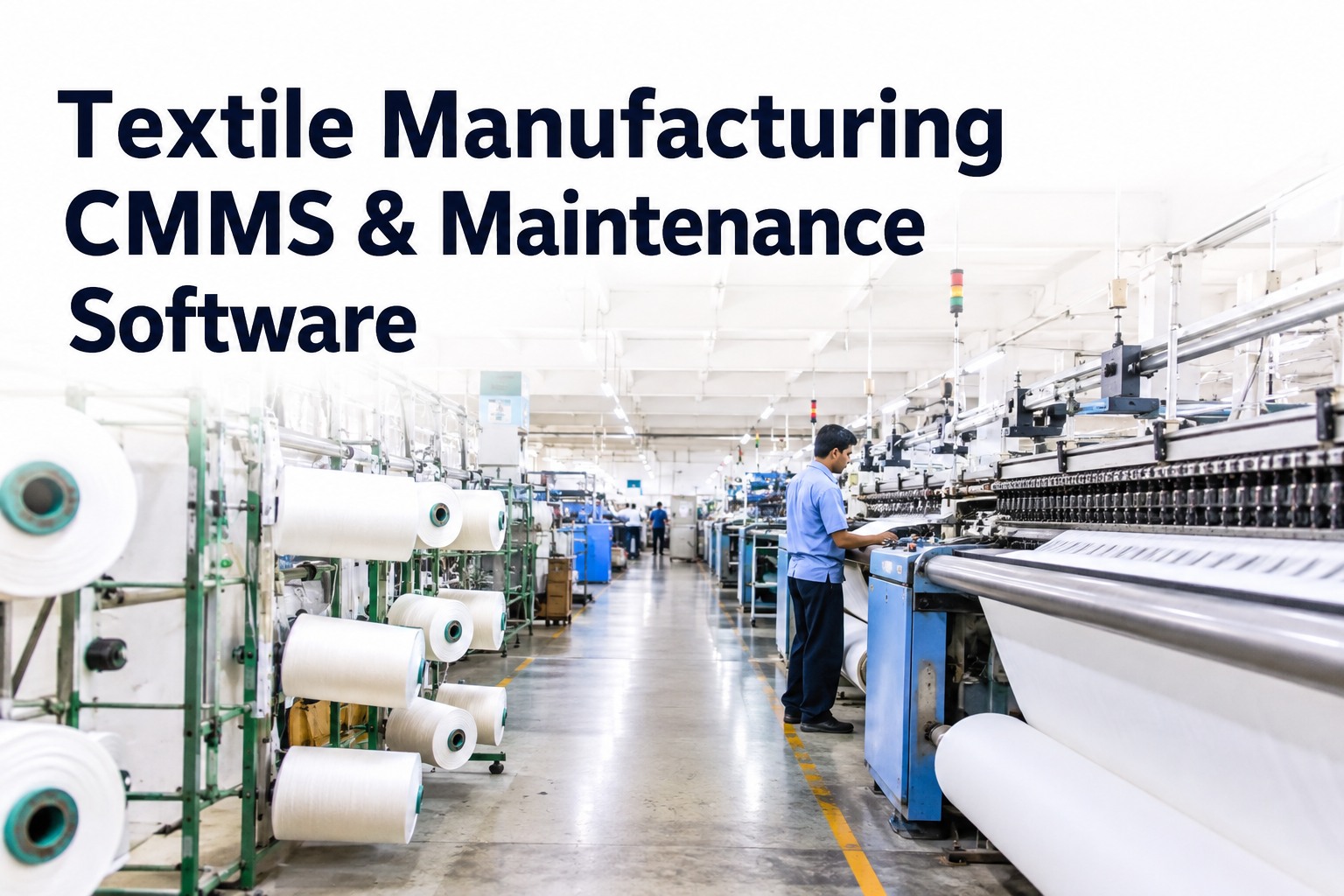
Textile mills lose money in ways most other manufacturers don't. The visible loss is the broken loom, the tripped dyeing vessel, the stalled finishing line. The invisible one is the roll of downgraded cloth that shipped before anyone noticed — because a poorly maintained machine degrades quality long before it stops. Oxmaint gives textile teams one CMMS covering spinning, weaving, knitting, dyeing and finishing — PPM aligned to production cycles, condition triggers where sensors exist, and defect traceback linking quality issues to specific machine positions. Book a demo to see textile CMMS in action.
8-15%
of annual revenue lost to unplanned downtime and quality defects in typical textile mills (ITMF)
30-50%
reduction in unplanned downtime for mills shifting from reactive to planned + condition-based maintenance
60-70%
of a textile mill's total energy consumed in dyeing and finishing — maintenance discipline is an energy lever
The Six Stages of Textile Production — And Where Maintenance Fails
A textile mill isn't one process — it's a chain of distinct production stages, each with its own asset base, its own failure modes and its own cost-of-downtime profile. A CMMS that treats "the mill" as a single entity misses the fact that a spinning-frame bearing warning and a jet-dyeing temperature-control fault demand completely different response workflows. Oxmaint models the plant by production stage, with distinct asset hierarchies and PPM libraries per stage.
Textile Production — Stage-by-Stage Maintenance Map
From fibre bale to inspected roll, with the failure modes that drive downtime at each stage
01
Fibre & Opening
Bale openers · blowroom · cards · draw frames
Wire clothing wear · lint buildup · belt slip
02
Spinning
Ring frames · rotors · spindles · travellers · drafting rollers
Spindle vibration · roller wear · yarn breaks
03
Weaving / Knitting
Rapier / air-jet looms · circular & flat-bed knitting · heddles · shed
Weft break · heddle misalignment · shuttle mechanism wear
04
Dyeing
Jet dyeing · jigger · beam · pumps · heat exchangers
Temperature drift · pH control · pump seal failure
05
Finishing
Stenter · calender · sanforising · coating · dryers
Pad-pressure drift · dryer temperature · alignment
06
Inspection & Roll-Up
Inspection frames · rolling · packing · humidification
Sensor drift · humidity control · roll-tension issues
Where Downtime Actually Costs the Most
Not every stage carries equal downtime cost. A weaving shed stoppage typically dominates the loss profile — one loom-bank failure disrupts the entire downstream finishing schedule, and single-incident cost can run to five figures in lost output, expedited parts and overtime. Oxmaint ranks assets by criticality against production-hour value so PPM and predictive investment concentrates where margin protection is highest.
Typical Downtime Cost Profile by Stage
Illustrative — actual figures vary by mill size, product mix and market
Weaving / Knitting
Highest
Getting PPM discipline right on weaving and dyeing typically delivers the fastest ROI. Sign up free to configure your mill's asset hierarchy in the first session.
The Quality Defect Trap — And How CMMS Data Solves It
Textile maintenance has a unique failure mode: the machine keeps running while quality quietly degrades. A worn heddle causes warp thread misalignment. A dirty shuttle mechanism creates skip weaves. Inadequate lubrication raises bearing temperature. A drifting pH probe sends a dye bath off-shade. None of these stops the machine — but every one of them puts defect into the roll. The link from defect back to machine position, back to maintenance history, is what turns quality assurance from a lagging indicator into a preventive one.
Defect → Machine → Maintenance History
Defect logged
QA flags a skip-weave pattern on a specific roll from Loom Bank 4.
Machine linked
CMMS traces the roll ID to Loom 27 running at the time of production.
History reviewed
Loom 27's PPM history shows shuttle-mechanism cleaning overdue by 12 days.
Pattern surfaced
Cross-check reveals 3 other looms with same overdue task — batch PPM raised.
See Defect Traceback and Loom-Level PPM Live
Walk through the asset hierarchy, defect-to-machine traceback, PPM library and predictive triggers — mapped to your specific mill layout. Thirty minutes with the Oxmaint team.
The Signals That Precede a Textile Failure
Predictive maintenance in textiles doesn't require exotic sensors. What it needs is discipline to connect the signals already available — motor current on drives, vibration on spinning frames, temperature on dyeing systems, weft-break counters on looms — to the specific failure modes that historically drive downtime. Oxmaint absorbs these signals wherever they exist and links them directly to work-order triggers.
Spindle vibration
Spinning
Vibration amplitude climb on ring-frame spindles signals bearing wear 3-6 weeks before failure. Position-level trending identifies which specific spindles need attention.
Weft break rate
Weaving
Rising break counts per shift on individual looms flag heddle misalignment, shed timing or yarn-tension issues before quality defects accumulate.
Motor current signature
Drives
MCSA on main drives detects rising harmonic content, bearing wear and load imbalance weeks before mechanical failure — no shutdown required for measurement.
Dye bath temperature
Dyeing
Drift in bath temperature or pH beyond recipe tolerance triggers immediate operator alert plus PPM work order against the affected control loop.
Bearing temperature
Rotating assets
Thermistor or IR-thermometer trending on high-value bearings — stenter chains, calender rolls, pump seals — catches lubrication and load faults early.
Compressed-air demand
Utilities
Rising air consumption per production hour signals leaks, failing valves or filter degradation across the utility system — a common hidden energy cost.
Expert Perspective — Why Maintenance Is Really Quality Assurance
In most industries, maintenance and quality assurance are separate departments with separate KPIs. In textiles they are the same discipline seen from two angles. A worn heddle isn't a maintenance issue that will one day become a quality issue — it's a live quality issue right now that hasn't been detected yet. Mills that treat their CMMS as the quality-defect prevention system, not just the breakdown-prevention system, consistently outperform on both fabric first-quality rate and cost-per-metre. It's the same investment producing two returns.
Position-level tracking
Every spindle, every loom position tracked individually. Aggregate data hides the specific positions producing defects — position-level visibility surfaces them.
Lubrication routes on mobile
Structured lubrication routes signed off on mobile with photo evidence. Missed lubrication is one of the single largest sources of premature bearing failure.
Energy-linked maintenance
Dyeing and finishing consume 60-70% of mill energy. Well-maintained heat exchangers, pumps and compressors deliver energy savings directly to margin.
Micro-stop capture
Sub-5-minute stoppages don't hit the major downtime report but destroy OEE. CMMS captures them and patterns surface root causes for permanent fixes.
Who Uses Oxmaint in Textile Manufacturing
The platform is used by the roles that live with textile reliability outcomes: maintenance managers running PPM libraries across spinning, weaving, dyeing and finishing lines, reliability engineers building condition-based programmes on high-value looms and dyeing systems, quality managers using defect-to-machine traceback to prevent repeat quality escapes, engineering directors reporting OEE and cost-per-metre against maintenance investment, and HSE managers keeping PUWER, LOLER, PSSR and (for chemical-heavy dye houses) DSEAR compliance evidence audit-ready across UK manufacturing sites. Each role sees the same underlying data filtered to their view — backlog dashboard, defect traceback view, PPM compliance report or audit evidence pack. Sign up free to configure roles for your mill team.
Getting a Textile Deployment Live
Rolling out a new CMMS on a running textile plant isn't a "big bang" project — production continuity dominates every decision. Existing asset registers import from spreadsheets, legacy CMMS exports and OEM manuals in the first weeks. PPM templates are configured per production stage (spinning / weaving / dyeing / finishing) and per specific machine type. Sensor integration is added where instrumentation already exists, expanded as coverage grows. Most single-site deployments move from initial scoping to live PPM inside 45-90 days, with the first predictive-catch event typically inside the second month of continuous condition data. Sign up free to start scoping your mill, or book a walkthrough to see live UK mill deployments.
One CMMS for the Whole Mill — Fibre to Finished Roll
Oxmaint gives textile operators structured PPM, defect traceback, condition-based triggers and complete maintenance history against every machine and position — from bale opener to inspection frame, in a single system.
Frequently Asked Questions
Does Oxmaint work if we don't have sensor coverage across the mill?
Yes. The core CMMS runs structured PPM against calendar and runtime-hour intervals regardless of sensor availability — that alone typically delivers substantial reliability improvement over spreadsheet-based scheduling. Where sensors exist (weft-break counters on looms, motor current on drives, temperature and pH on dyeing systems, vibration on spinning frames), those signals feed condition-based work-order triggers that supplement the PPM baseline. Sensor coverage typically grows over time and the CMMS scales with it — no rip-and-replace as instrumentation expands.
Can it track individual loom positions and spindles?
Yes. Every loom position, spindle, drafting roller or dyeing vessel can be tracked as a discrete asset with its own PPM history, failure record and parts consumption. This position-level granularity is what makes defect traceback effective — a quality issue on a specific roll traces to the specific machine position that produced it, and that position's maintenance history explains the defect. Aggregate machine-level tracking is available where position-level detail isn't required, so mills configure the granularity to match their operational reality.
Does it handle UK regulatory maintenance for pressure systems and lifting equipment?
Yes. PSSR written schemes of examination for steam boilers, dye vessels and pressure receivers, LOLER 6-month thorough examinations for lifts and hoists, PUWER work-equipment inspection regimes, and DSEAR-relevant maintenance for chemical-heavy dye houses are all supported. Statutory intervals, competent-person sign-off, and audit-pack export for HSE or insurer inspection are built into the workflow. One system covers the everyday PPM programme and the UK regulatory discipline without duplication.
How does the CMMS help reduce energy cost in dyeing and finishing?
Dyeing and finishing consume 60-70% of a typical mill's energy — most of it in heating water and drying fabric. Well-maintained heat exchangers, steam traps, insulation, pumps and dryer heating elements directly reduce that consumption. Oxmaint tracks utility-consumption metrics against maintenance completion, so the impact of specific PPM tasks (heat exchanger cleaning, steam trap replacement, dryer heating element service) on energy cost becomes visible. Energy-linked maintenance is a growing focus area for UK mills operating under net-zero and ESG reporting commitments.
What integrations does Oxmaint support in textile environments?
Standard integrations include ERP systems (SAP, Microsoft Dynamics) for parts and financials, production monitoring platforms (Uster, Loepfe, Barco Vision) for machine data and downtime capture, PLC/SCADA systems for dyeing recipe and process data, and permanent vibration monitoring platforms for direct condition-based triggering. RESTful APIs and OPC-UA support enable custom integrations with in-house production systems. Integration is scoped during deployment so the mill runs against one authoritative maintenance record rather than a stack of disconnected tools.