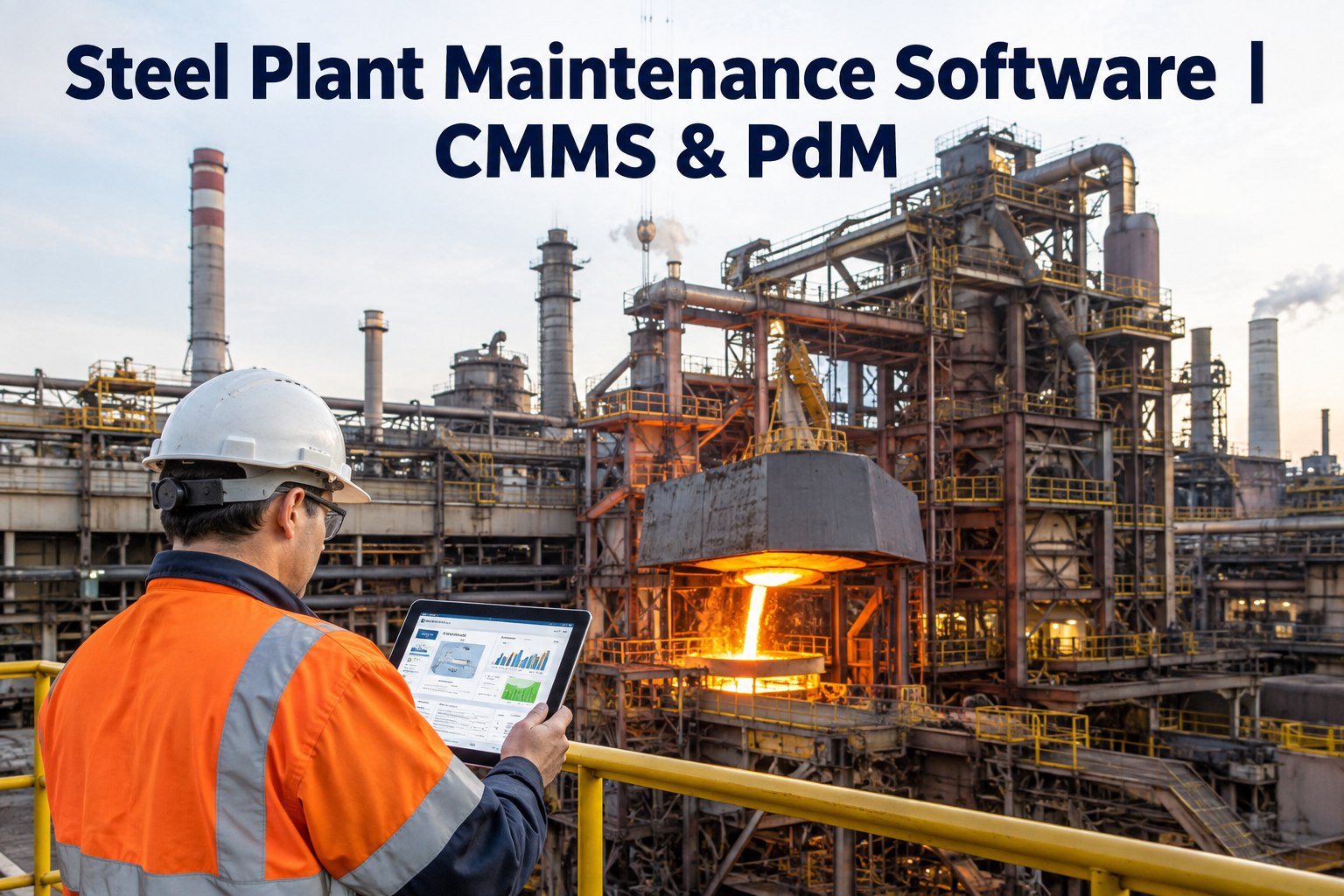
A single unplanned blast furnace stoppage can cost well over £1m in lost hot metal, emergency labour and cascading delays through the BOS converter, caster and rolling mill. A caster breakout costs £400k-£800k. A rolling mill bearing seizure at 2am costs £1.2m in downtime before sunrise. Steel plants run some of the most punishing equipment in industrial manufacturing at temperatures where a missed inspection turns into a shell overheat within hours. Oxmaint gives UK steelmakers one platform for maintenance across furnaces, casters and mills. Book a demo to see steel plant workflows in action.
UK STEELMAKING · WHY ONE PLATFORM MATTERS
Furnace to finishing mill — a single failure cascades through every downstream asset within hours
£1.2m+
Cost per hour of unplanned integrated mill downtime (industry average)
55-65%
Share of maintenance activity that remains reactive at the average steel plant
15-20yr
Blast furnace campaign life target — 5-10% shortfall = £50-200m unplanned reline
The Steelmaking Chain — Where Maintenance Actually Happens
Steelmaking is not a single process — it's an interlocked chain of continuous assets running 24/7 for years. A stoppage anywhere in the chain cascades downstream within hours. Blast furnace goes down and the BOS starves inside four hours. BOS stops and the ladle metallurgy sits waiting. Caster halts and the reheat furnace bleeds energy. Rolling mill trips and the whole coil schedule collapses. This is why steel maintenance can't be run per-asset — it has to be planned across the entire chain, with visibility of every critical asset's condition at once.
1
Ironmaking
Blast Furnace · Stoves · Blowers · Tuyeres
Hot metal production at 1,500°C. Campaign life 15-20 years between relines.
Failure signal: stave cooler flow drop, hot spots on shell
▶
2
Steelmaking
BOS Converter · EAF · Ladle · Tundish
Hot metal → steel. Refractory tracked per-heat, not per-calendar-day.
Failure signal: refractory wear rate, tap-to-tap variance
▶
3
Casting
Continuous Caster · Mould · Segments · Torch Cut
Steel to slab/bloom. Mould copper wear per-heat drives resurfacing.
Failure signal: mould thermocouple pattern, friction trend
▶
4
Rolling
Reheat Furnace · Hot Mill · Cold Mill · Coiler
Slab to strip/coil. Bearings, drives, chocks tracked per-tonnage.
Failure signal: vibration signature, roll bite motor current
Heat-Count vs Calendar-Based Maintenance — The Steel-Specific Discipline
Every other industry schedules maintenance by calendar or runtime hours. Steel schedules refractory by heat count — the number of tap cycles a vessel has completed since its last reline. A BOS vessel rated for 3,500 heats doesn't fail at month-24; it fails somewhere between heat 3,200 and 3,700 depending on slag chemistry, thermal cycling and tramp element load. Calendar-based scheduling either wastes weeks of remaining campaign life or catches the vessel mid-heat, forcing an emergency reline that costs millions. Heat-count-based CMMS scheduling is the discipline that separates plants running full 15-20 year BF campaigns from plants running 12-14 year campaigns with emergency intervention.
BOS Vessel #1
Design 3,500 heats · Current 2,840
EAF Roof #A
Design 400 heats · Current 372
Ladle #7
Design 120 heats · Current 118
Tundish #3
Design 25 heats · Current 8
Downtime Cost Cascade — Why One Asset Failure Becomes Four Cost Buckets
When a steel plant asset fails, the direct repair bill is often the smallest part of the cost. The cascading impact through the interlocked production chain is what makes steel downtime so expensive. The stack below shows how a single blast furnace stave leak — a £0 fix if caught in time via flow-rate trending — compounds through the chain if it isn't.
DIRECT
Repair labour & parts
£150k - £400k
PRODUCTION
Lost hot metal (9-day blowdown)
£8.5m - £11m
CASCADE
BOS · caster · mill idle time
£2.5m - £4m
REFRACTORY
Emergency reline & thermal shock damage
£1.2m - £1.8m
Typical total impact of one preventable BF stave failure
£12m - £17m
The stave leak was detectable 11 days earlier via routine flow-rate trending — a £0 fix that became a £12m loss. Sign up free to catch failure signals before they cascade.
See Steel Plant Maintenance Live
Walk through heat-count-based refractory tracking, cascading-failure visibility across the steelmaking chain, condition monitoring on BF blowers and rolling mill bearings, and DCS/PLC integration with Siemens, ABB and Rockwell — configured against your UK steel plant. Thirty minutes with the Oxmaint team.
Critical Failure Modes — What Steel CMMS Actually Has to Track
Steel plants share a defined set of high-consequence failure modes across the major asset classes. Every one of them sends detectable early warnings — vibration signature shifts, thermal anomalies, flow-rate drift, motor current variance — days or weeks before catastrophic failure. The value of a steel-configured CMMS is knowing what signal to watch on which asset, and routing that signal to a work order before it becomes an emergency.
Blast Furnace
Stave cooler leak · tuyere burnout · hearth breakthrough
Cooling flow rate, shell thermocouple, acoustic emission
BOS / EAF
Refractory wear · electrode breakage · transformer failure
Vessel shell temp, tap-to-tap variance, power quality data
Continuous Caster
Mould copper wear · breakout · segment roller bearing
Mould thermocouple pattern, friction trend, vibration signature
Rolling Mill
Bearing seizure · roll chock wear · AGC cylinder failure
Vibration signature, drive motor current, hydraulic pressure
Turbomachinery
Blower failure · O2 compressor trip · steam turbine
Bently Nevada vibration monitoring, thrust bearing temp
Every failure signal flows into the same work-order workflow with routing rules per asset criticality. Sign up free to configure failure-signal alerts on your critical assets.
Expert Perspective — Why Steel Maintenance Fails Differently to Every Other Industry
"
Every other industry, when maintenance goes wrong, you lose production. In steel, when maintenance goes wrong you lose the campaign. A blast furnace forced into unplanned blowdown doesn't just stop — it triggers refractory thermal shock, thousands of tonnes of banked hot metal go to scrap, restart takes 24-72 hours, and the cascading impact through the BOS, caster and mill compounds every hour. That's why steel maintenance is fundamentally different: you're not just protecting equipment, you're protecting the campaign life you already spent millions to establish. The plants that get this right run 18-year BF campaigns and integrated mill maintenance costs falling year-on-year. The plants that don't run 14-year campaigns with emergency reline bills that dwarf any CMMS investment several times over.
01
Heat-count PM triggers
Refractory tracked per-heat, not per-calendar-day. Vessel-by-vessel campaign visibility with intervention windows.
02
Cascading-failure view
One failure surfaces its downstream impact across the interlocked chain — BF, BOS, caster, mill all visible at once.
03
DCS/PLC integration
Siemens, ABB, Rockwell historian data feeds directly into failure prediction. No re-instrumentation.
04
Campaign-planning horizon
12+ month reline planning window with refractory procurement, engineering and production coordination in one place.
Who Uses Oxmaint in UK & European Steel
The platform is used across the specific operational roles that own steel plant maintenance: maintenance managers running site-wide programmes across the ironmaking-to-rolling chain, reliability engineers configuring condition thresholds on critical rotating equipment, refractory engineers managing campaign lifecycle across BF, BOS, EAF and ladle populations, mechanical engineering teams planning shutdown and turnaround windows, electrical engineers tracking transformer and drive condition, operations managers coordinating maintenance against production commitments, and plant managers reporting maintenance cost per tonne against internal benchmarks. Each role sees the same asset data filtered to their view — heat-count queue, condition alerts, cascading-impact map or cost-per-tonne dashboard. Sign up free to give your steel team one platform.
Getting Steel Plant Maintenance Live
Deployment starts with importing your asset register — furnaces, converters, casters, mills, ladles, cranes, conveyors — and current PM calendar. Refractory campaign data (heats-to-date per vessel) migrates from existing tracking; campaign targets configure per vessel type. DCS/PLC historian data ingests via OPC-UA, MODBUS or direct API from Siemens, ABB, Rockwell and Honeywell platforms — most steel plants already have the sensor infrastructure, so integration rather than instrumentation is the primary task. Wireless vibration sensors deploy on critical rotating equipment (BF blowers, rolling mill drives) inside the first month. Most sites see cascading-failure visibility and heat-count tracking live within 60 days; full predictive coverage across critical assets typically inside two quarters. Book a walkthrough to see live UK steel deployments.
Turn Steel Plant Maintenance Into a Campaign-Life Investment
Oxmaint gives UK steelmakers one platform for maintenance across the ironmaking-to-rolling chain — heat-count refractory tracking, cascading-failure visibility, DCS/PLC integration and predictive condition monitoring on the assets where campaign life gets won or lost.
Frequently Asked Questions
What is steel plant maintenance software and why does steel need a specialised CMMS?
Steel plant maintenance software is a CMMS configured for the specific operational reality of integrated and EAF steelmaking — heat-count-based refractory scheduling, cascading-failure visibility across the interlocked ironmaking-to-rolling chain, integration with DCS/PLC historians (Siemens, ABB, Rockwell), and predictive condition monitoring on critical rotating equipment. Generic CMMS platforms don't handle refractory campaign tracking, don't map cascading downstream impact when an upstream asset fails, and don't integrate cleanly with the sensor infrastructure UK steel plants already have. The value is domain-specific — you're not just managing work orders, you're protecting campaign life.
Does Oxmaint work for both BOS integrated and EAF mini-mill routes?
Yes. Oxmaint supports both routes with route-appropriate asset templates and PM scheduling logic. BOS integrated plants get blast furnace, BOS converter, ladle metallurgy and continuous caster templates with heat-count refractory tracking; EAF mini-mills get electric arc furnace, ladle and caster templates with electrode consumption tracking, roof refractory heat counts and transformer condition monitoring. Both routes share the downstream caster and rolling mill maintenance workflows. Configuration per site is handled during onboarding based on the actual asset population.
Can Oxmaint integrate with our existing DCS and historian systems?
Yes. Most UK steel plants already have DCS/PLC systems (Siemens, ABB, Rockwell, GE, Honeywell), historian platforms (OSIsoft PI, AVEVA, GE Proficy) and vibration monitoring (Bently Nevada, SKF, Emerson) installed on critical equipment. Oxmaint's integration layer supports OPC-UA, MODBUS and direct API connections to pull condition data from these existing systems — the integration task is connecting existing sensor infrastructure to the maintenance workflow, not installing new hardware from scratch. Wireless sensors are supplied for critical rotating equipment not yet instrumented.
How does heat-count refractory tracking actually work?
Every refractory asset — BF hearth, BOS vessel lining, EAF roof and sidewalls, ladle, tundish — has a design campaign life expressed in heats (tap cycles). Oxmaint tracks current heat count per vessel against the design target, calculates wear rate from slag chemistry exposure and thermal cycling data, and projects the intervention window. When a vessel approaches 90-95% of design campaign, the system generates the reline planning workflow — 12+ month lead time on refractory procurement, engineering design, production outage coordination. This is fundamentally different from calendar-based PM: the trigger is production activity, not elapsed time.
How quickly can a UK steel plant expect to see downtime reduction?
Cascading-failure visibility and heat-count tracking typically go live within 60 days and start delivering value immediately — refractory campaigns extend to design life, and downstream cascading incidents drop as upstream failures get caught earlier. Predictive coverage across critical rotating assets takes longer to establish — rolling mill bearings and BF blowers require 8-12 weeks of baseline data before ML models become accurate. Documented deployments across integrated steel show 30-50% unplanned downtime reduction within the first year on critical assets, with maintenance cost per tonne falling measurably from year two as campaign discipline compounds.