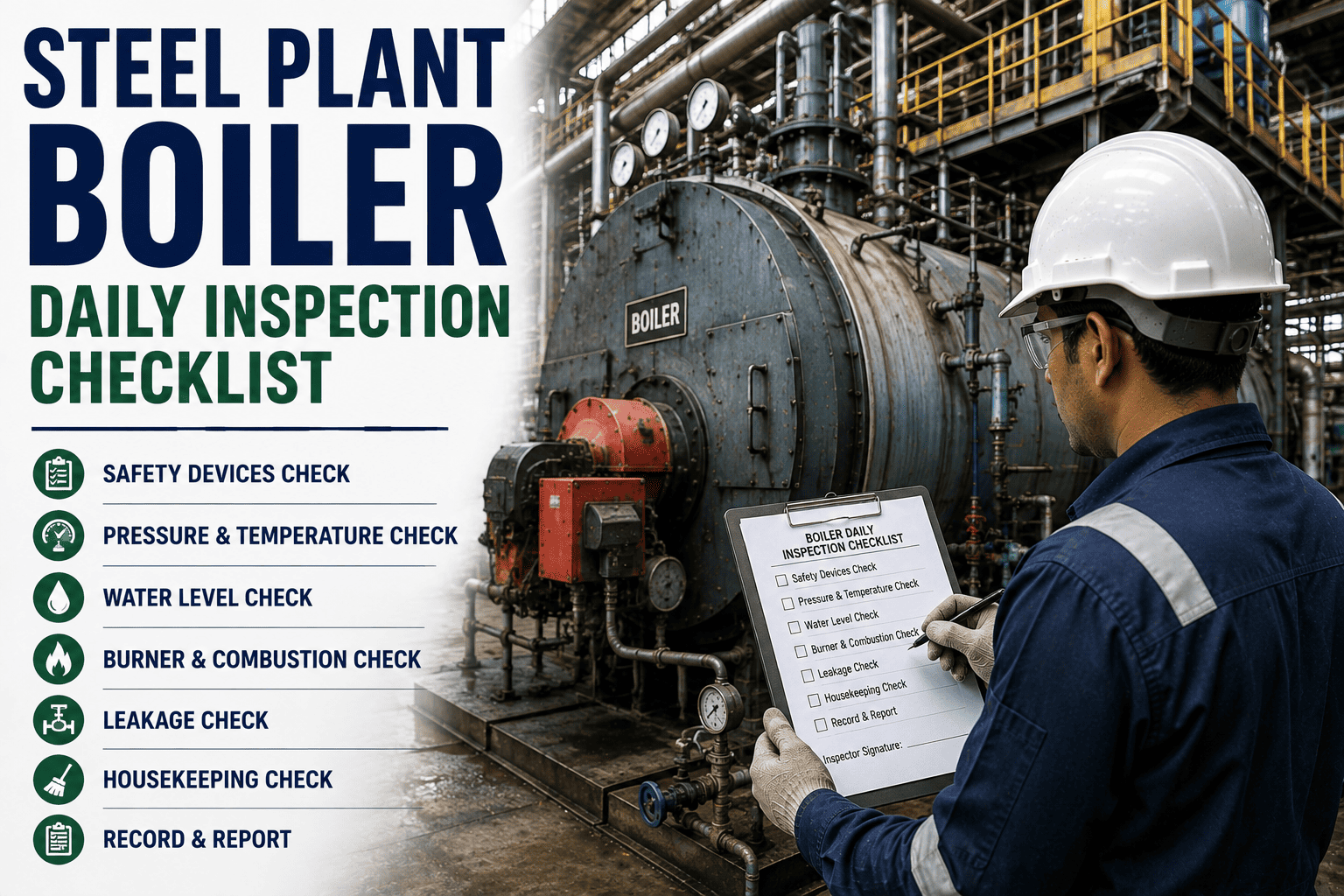
A steel plant boiler runs continuously, feeding steam to reheat furnaces, power turbines, and process lines that can't tolerate an unplanned trip. Most boiler failures don't start as a dramatic event, they start as a drum level nobody double-checked, a blowdown that got skipped on a busy shift, or a TDS reading that drifted for a week before anyone noticed. A daily checklist run the same way every shift is what catches that drift before it becomes a tube failure. Sign up to turn every shift's readings into a logged, time-stamped record with operator sign-off built in.
Why It Matters
A reading that only exists in an operator's memory has no value in an audit or an outage investigation. Drum level, pressure, blowdown, and water chemistry all need to be logged every shift, not just checked, so drift shows up as a trend long before it shows up as a trip or a tube leak.
Six Checks Every Shift Depends On
Drum Level
Local gauge glass and remote indication must agree, no discrepancy accepted
Operating Pressure
Held within setpoint band, any excursion logged with time and cause
Bottom Blowdown
Performed per schedule to clear sludge, duration and time logged
Water Chemistry
pH near 10.5-11.5 and TDS within programme target range
Burner Flame
Stable and consistent in color, yellow or sooty flame means poor combustion
Low-Water Cutoff
Burner must shut off the moment water reaches the cutoff point
The Daily Walkdown Checklist
Drum level cross-checked: gauge glass reading compared against the remote or DCS indication before the shift proceeds
Bottom blowdown performed: valve opened fully for a few seconds at low pressure, never left running longer than the boiler's rated limit
pH and TDS tested: boiler water sampled and compared against the water treatment programme's target range
Low-water cutoff trip tested: blowdown valve opened on the cutoff switch while firing, confirming the burner shuts off, this is the single most critical daily check
Full perimeter walked: visual and audible check of the boiler body, piping, and valves for leaks, weeping, or unusual noise
Operator sign-off logged: every reading and action recorded against name, time, and shift, not left on a loose sheet
Stop Losing Boiler Logs To A Clipboard
OxMaint turns the daily boiler walkdown into a digital checklist with operator sign-off, flags any reading outside programme target, and fires a work order the moment something needs attention. Sign up for a free trial to run it on your own boiler, or book a demo to see it configured for your plant.
Check, What Good Looks Like & What To Do If Not
| Check |
What Good Looks Like |
If Out Of Range |
| Drum Level |
Local and remote readings match, within normal band |
Investigate feedwater regulator immediately |
| Water pH |
Roughly 10.5-11.5 for most steam boilers |
Adjust chemical dosing, retest before next reading |
| TDS |
Within the water treatment programme's target range |
Increase blowdown frequency until back in range |
| Burner Flame |
Stable, consistent color and shape |
Report for combustion adjustment, do not ignore |
The Takeaway
None of these six checks takes more than a few minutes on their own, the discipline is doing every one, every shift, and logging the result instead of trusting memory. That daily habit is what turns a boiler from a source of surprise trips into a piece of equipment you can trust to run.
Frequently Asked Questions
Q
What's the single most important daily boiler check?
Testing the low-water cutoff by opening the blowdown valve on the cutoff switch while the burner is firing and confirming it trips. A cutoff that fails to stop the burner when water drops too low is the fastest path to a dry-firing incident, so this check comes before almost anything else on the walkdown.
Q
Why does blowdown matter if TDS already looks fine?
Blowdown removes settled sludge from the bottom of the drum, not just dissolved solids in the water column. Skipping it because a TDS reading looks acceptable still lets sludge build up, and that buildup is what eventually insulates heating surfaces and pushes metal temperatures into a dangerous range.
Q
Why insist on operator sign-off for every reading?
A logged reading with a name, time, and shift attached is evidence a check actually happened and gives you a trend to compare against. A reading that only lived in someone's memory can't be reviewed after the fact, and it holds no weight in an outage investigation or a regulatory audit.
Turn Every Boiler Shift Into A Complete, Logged Record
OxMaint digitizes the daily boiler checklist, tracks pH, TDS, and pressure readings against your water treatment targets, and captures operator sign-off automatically. Sign up for a free trial to run it on your own boiler, or book a demo to see it configured for your plant.