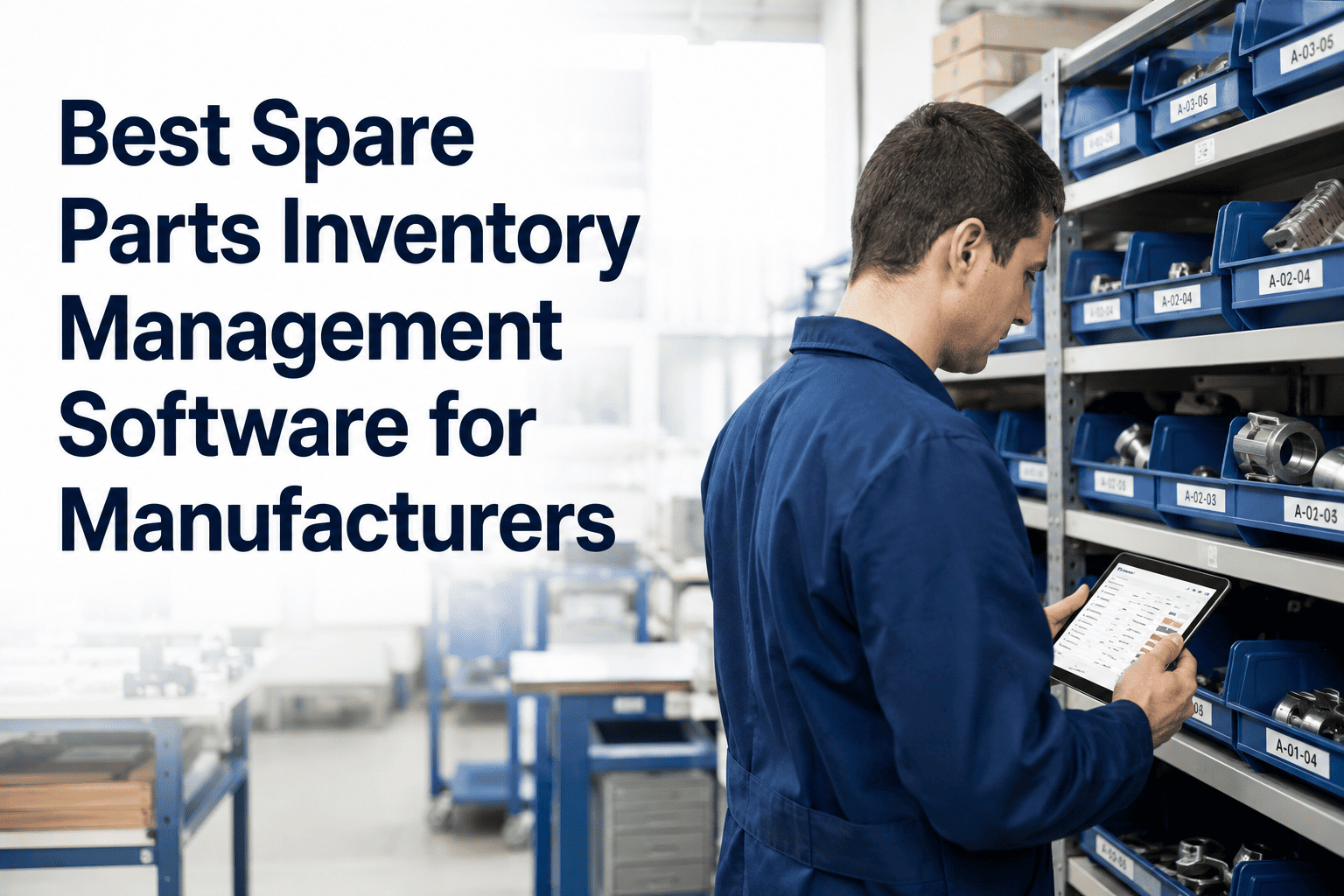
Best Spare Parts Inventory Management Software for Manufacturers
By Mark strong on May 28, 2026
Your storeroom is full. Your production line just stopped anyway. A critical bearing — one that costs $40 — was out of stock. Meanwhile, $180,000 worth of parts that have not moved in three years are occupying shelf space two rows away. This is not a storage problem. It is an intelligence problem. Start your free trial on OxMaint and replace gut-feel stocking with data-driven spare parts inventory that actually matches your maintenance reality.
Manufacturing MRO Intelligence
Best Spare Parts Inventory Management Software for Manufacturers
The right part, at the right quantity, at the right time — without the stockouts, emergency orders, or dead stock that drain your maintenance budget.
23%
of all unplanned downtime events are directly caused by unavailable spare parts
40–50%
of total maintenance spend goes to MRO inventory — the single largest controllable cost
15–25%
of storeroom inventory at most plants is obsolete — capital locked in parts tied to retired assets
5x
Emergency orders cost 3–5x more than planned procurement when reorder logic fails
The Spare Parts Paradox Costing Manufacturers Millions
Overstocked and understocked at the same time — it sounds impossible, but 32% of maintenance teams report experiencing exactly this. Without a system connecting part criticality to consumption patterns, reorder logic, and work order history, every stock decision is a guess. The consequences compound silently until the line stops.
The Overstocking Problem
20–30%
of inventory value lost annually to warehousing, obsolescence & capital cost
Low-value consumables reordered on instinct, not data
Parts for retired equipment never removed from the register
Working capital tied up on shelves instead of productive assets
Average performer spends 5.2% of asset value on MRO vs. 3.5% for best-in-class — a 48% premium with no reliability benefit
VS
The Understocking Problem
$thousands
per hour lost when a production line stops waiting for one missing part
Critical spares not flagged — treated same as consumables
Reorder points set by memory, not lead time and failure data
Stockouts discovered only when a technician reaches an empty shelf mid-repair
Emergency purchases at 3–5x the planned cost — charged to the maintenance budget
What Spare Parts Inventory Software Actually Does
Inventory software for manufacturers is not a digital version of a spreadsheet. It connects your parts storeroom to your asset register, work order history, PM schedules, and supplier lead times — and uses that connection to make stocking decisions automatically. Book a demo to see how OxMaint links every spare part to the assets and maintenance tasks that actually consume it.
ABC-VED Criticality Classification
Parts are segmented by value (A/B/C) and operational criticality (Vital/Essential/Desirable). Critical spares get tighter stock controls and higher fill rate targets than low-value consumables — automatically.
Automatic Reorder Triggers
Reorder points are calculated from lead time, usage rate, and safety stock formulas — not guesswork. When stock drops below the calculated minimum, a purchase request fires automatically to the right supplier.
Work Order Parts Linkage
Every part consumed on a work order is logged against the asset that needed it. Over time, this builds actual consumption data per asset — replacing assumed demand with measured demand.
Supplier Lead Time Tracking
Supplier performance data is logged against every purchase — actual vs. committed lead time, fill rate, and quality. Reorder calculations update automatically when supplier reliability changes.
Obsolescence Detection
Parts that have not moved within a configurable window — and are not linked to any active asset or upcoming PM — are flagged for review. Stop funding inventory that serves retired equipment.
Multi-Site Storeroom Visibility
View stock levels across all locations from one dashboard. Transfer parts between sites before raising an external purchase order — reducing duplicate emergency buys across a manufacturing network.
Stop Running Your Storeroom on Instinct
OxMaint connects spare parts inventory to asset criticality, work order consumption, PM schedules, and supplier lead times — giving your team the intelligence to stock exactly what you need, when you need it. Sign up free or book a demo to see the difference data-driven stocking makes.
How OxMaint Handles the Full Spare Parts Lifecycle
01
Part Intake & Classification
Each part enters the system with a unique ID, linked assets, criticality tier, unit cost, and storeroom location. Barcode and QR scanning supported for fast physical stocktaking and issue recording.
02
Reorder Point Calculation
Safety stock and reorder points are calculated using actual consumption history and supplier lead times — not fixed schedules. Settings update automatically as usage patterns change.
03
Work Order Consumption Tracking
When a technician closes a work order, parts used are recorded against the asset. Stock on hand adjusts automatically. No separate stock transaction required — consumption is captured at the source.
04
Automated Purchase Request
When stock falls below the reorder point, OxMaint generates a draft purchase request pre-populated with the preferred supplier, last unit price, and required quantity. Procurement reviews and approves — not creates from scratch.
05
Continuous Inventory Optimisation
Monthly reports surface slow-moving stock, parts with zero linked assets, high emergency order rates, and supplier performance gaps. Every report is a decision — stock level adjustments, supplier reviews, or obsolescence disposals.
Key MRO Inventory KPIs You Should Be Tracking
Most manufacturing plants track production KPIs with precision and MRO inventory KPIs not at all. These five metrics tell you whether your spare parts program is working — and where the leaks are. Sign up for OxMaint and get a live dashboard for all of them from day one.
Stockout Rate
Alarm threshold: above 5%
Percentage of part requests that cannot be fulfilled from existing stock. Above 5% signals that critical parts are regularly unavailable when maintenance needs them. Track separately for A-class parts.
Inventory Turns
Healthy range: 1.0 – 3.0x annually
Total cost of parts issued divided by average inventory value. Turns below 1.5 indicate dead stock that should be reviewed for disposal or redistribution.
Emergency Order Rate
Cost penalty: 3–5x planned rate
Percentage of purchase orders raised as emergency or expedited orders. A high rate directly signals that reorder points are set too low or not triggering correctly — fixable with accurate safety stock logic.
Carrying Cost Ratio
Typical range: 20–30% of value/yr
Annual cost of holding inventory as a percentage of total inventory value — includes warehousing, insurance, obsolescence, and capital cost. Most plants hold more inventory than this analysis justifies.
Obsolete Stock %
Industry average: 15–25% of storeroom
Proportion of inventory with no linked active asset or movement in the past 12–24 months. Reviewing this KPI annually surfaces storeroom waste that funds nothing but shelf space.
Supplier Fill Rate
Target: 95%+ for critical suppliers
Percentage of purchase orders delivered complete, on time. Low supplier fill rates require higher safety stock buffers — tracking this KPI justifies supplier renegotiation or dual-sourcing decisions.
Spare Parts Software vs. Spreadsheets vs. Basic ERP
Capability
Spreadsheets
Basic ERP
OxMaint CMMS
Automatic reorder triggers
No
Manual setup
Automatic
Linked to work order consumption
No
No
Yes — native
Asset criticality classification
No
Limited
ABC-VED built-in
Obsolescence detection
Manual only
Reporting only
Automated flags
Mobile storeroom access
No
Limited
Full mobile + offline
Multi-site inventory transfers
No
Complex setup
One-click transfer
PM schedule parts pre-reservation
No
No
Yes — automated
Built for Manufacturers. Not Generic Warehouses.
OxMaint spare parts management connects your storeroom directly to your asset register, PM schedules, and work order history. Automatic reorder triggers. ABC-VED criticality classification. Obsolescence detection. Multi-site visibility. All in a CMMS built for plant maintenance teams — not logistics operators. Sign up free in minutes, or book a demo to see it running on assets like yours.
How is spare parts software different from a general inventory system?
General inventory systems track stock movements. Spare parts software built for manufacturing connects stock levels to asset criticality, work order demand, PM schedules, and equipment failure history. That connection is what enables intelligent reorder logic — stocking critical spares at higher fill rates while letting non-critical consumables run leaner, based on the actual cost of a stockout per asset class.
What is ABC-VED analysis and why does it matter for MRO?
ABC classifies parts by unit value (A = high, C = low). VED classifies by operational impact (Vital = production stops without it, Essential = major disruption, Desirable = minor inconvenience). Combining both gives you a matrix where a low-cost but Vital part (e.g. a $12 seal on a critical pump) gets higher stock priority than an expensive but Desirable part. Without this framework, stock decisions are made on cost alone — which gets the priorities backwards.
Can OxMaint handle spare parts across multiple plant locations?
Yes. OxMaint provides a consolidated view of stock levels across all sites from a single dashboard. Technicians can check if a part is available at another location before raising an external purchase order — reducing duplicate emergency buys across a manufacturing network. Inter-site transfers are logged automatically, maintaining accurate stock records at each location.
How quickly can we migrate existing spare parts data into OxMaint?
OxMaint supports bulk import from spreadsheets (CSV/Excel) for part catalogues, stock levels, supplier data, and asset links. Most single-site implementations complete data migration in under two weeks. Multi-site operations with large part catalogues typically take three to five weeks, including data cleaning and criticality classification configuration.
Does OxMaint integrate with our existing ERP or procurement system?
OxMaint integrates with major ERP and procurement platforms via REST API and pre-built connectors. Purchase requests generated in OxMaint can flow directly to your procurement approval workflow — eliminating double-entry and ensuring that every maintenance-driven purchase is tracked against the correct asset and cost centre.