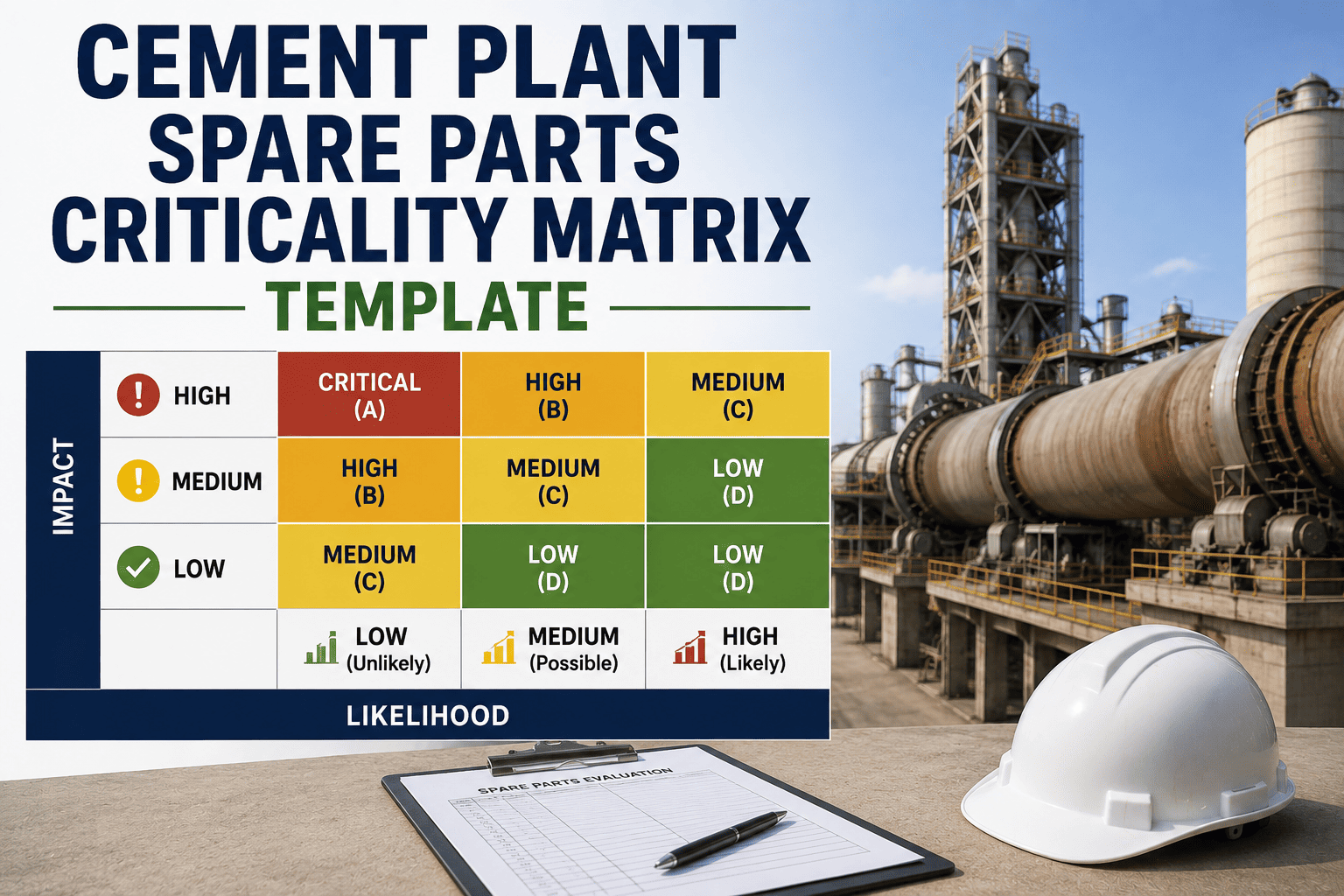
The ID fan bearing fails on a Tuesday night, and the storeroom has three of them sitting on a shelf. Three weeks later, a gearbox on the same line seizes, and the replacement is an eight-week lead item nobody flagged as critical. Both are spare parts. Only one got treated like it mattered. A spare parts criticality matrix fixes this by ranking every stocked item against how badly its failure hurts production, so inventory dollars go toward the parts that actually cause downtime. This page covers how to build a criticality matrix for a cement plant's MRO inventory and includes a free downloadable template. Sign up to run your criticality matrix inside a CMMS.
The Problem With Treating All Spares The Same
Most storerooms grow by habit, not by design. Whatever got ordered after the last failure stays on the shelf, whether or not that part could ever cause a shutdown again. Meanwhile a genuinely critical part with a long lead time sits at zero stock because nobody ranked it that way. Without a criticality matrix, inventory spend and actual production risk have almost nothing to do with each other.
What A Criticality Matrix Gets You
Right Parts Stocked
Inventory weighted toward parts that actually cause downtime if missing
Lower Carrying Cost
Low-risk parts get trimmed instead of tying up capital on the shelf
Fewer Stockouts
Long lead-time critical parts get reorder points before they hit zero
The Four Criticality Tiers
Tier 1 · Critical
High Failure Impact, Long Lead Time
Kiln shell drive gears, main ID fan bearings, girth gear segments. Stops production line-wide and takes weeks to source. Always stocked, always safety-stocked above minimum.
Tier 2 · Essential
High Impact, Shorter Lead Time
Conveyor motors, VFDs, common pump seals. Failure still stops output but the part can be sourced fast enough that a smaller buffer stock is enough.
Tier 3 · Supportive
Moderate Impact, Local Workaround Exists
Sensors, filters, standard bearings on redundant equipment. A failure slows things down or triggers a workaround rather than a full stop. Stock light, reorder on trigger.
Tier 4 · Non-Critical
Low Impact, Readily Available
Fasteners, generic gaskets, common consumables. Cheap and quick to source locally. Order as needed rather than holding on the shelf.
Stop Guessing Which Parts Deserve Shelf Space
Oxmaint lets you rank every stocked item by criticality, set reorder points that match actual production risk, and see stockout exposure before it becomes a shutdown. Sign up for a free trial to build your matrix, or book a demo to see spare parts planning inside a live CMMS.
What Belongs In The Matrix
| Field |
What It Covers |
| Equipment linkage |
Which asset the part serves, and whether that asset has redundancy |
| Failure impact |
Production stopped, slowed, or unaffected if the part fails without a spare |
| Lead time |
Days to source a replacement from the supplier if stock runs out |
| Criticality tier |
The resulting rank, from Critical down to Non-Critical, driving stock policy |
| Reorder point |
Minimum stock level that triggers a purchase order, set by tier |
Why The Matrix Belongs In A CMMS
A criticality ranking in a spreadsheet stays a snapshot from the day someone built it. Inside a CMMS, each part links to the equipment it serves, reorder points trigger automatically at the threshold set by its tier, and stock levels update in real time as parts get issued, so the ranking stays accurate as the plant changes.
Frequently Asked Questions
Q
What decides whether a part is Tier 1 critical?
The combination of failure impact and lead time. A part that stops the whole line and takes weeks to replace is critical even if it rarely fails, because there's no room to react once it does.
Q
How often should the matrix be reviewed?
Twice a year at minimum, and after any major equipment change. New redundancy, a retired line, or a supplier lead time shift can move a part between tiers.
Q
Can reorder points be set automatically by tier?
Yes, inside a CMMS like Oxmaint each tier can carry its own default reorder rule, so newly classified parts inherit a sensible stock policy instead of starting at zero.
Make Every Spare Part Earn Its Shelf Space
Oxmaint turns this criticality matrix into a live CMMS ranking, with reorder points, lead times, and stock levels tracked against every part's actual production risk. Sign up for a free trial to build your matrix, or book a demo to walk through spare parts planning on a real cement plant inventory.