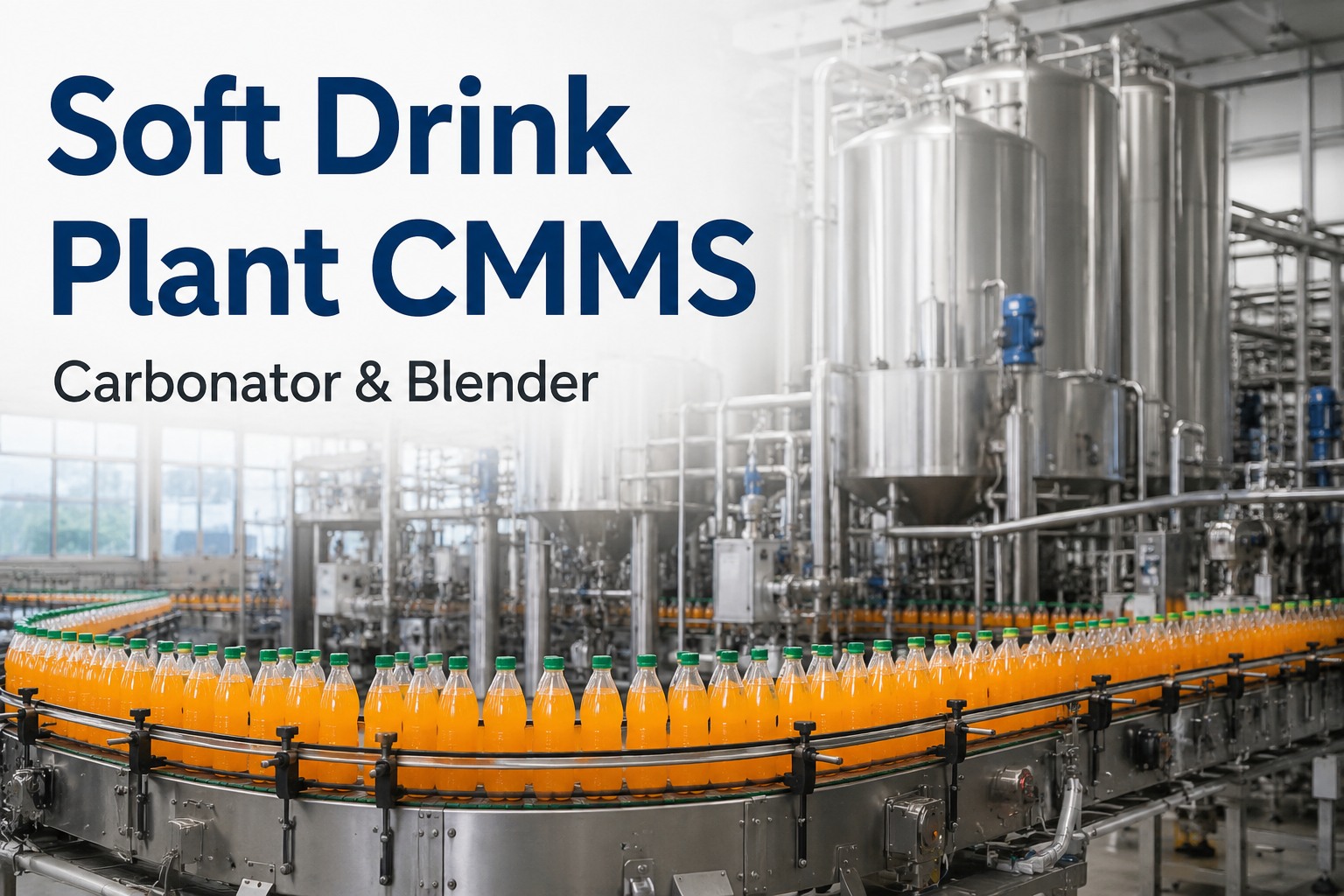
A single hour of unplanned filler downtime on a modern soft drink line costs between £15,000 and £35,000. But downtime is not the biggest problem. The bigger problem is what you cannot see — a filler valve wearing past tolerance and opening a cross-contamination pathway, a carbonator pressure regulator drifting, a CIP cycle running with the wrong chemical concentration and nobody knowing until a positive ATP swab three days later. An soft drink plant CMMS demo — book a free Oxmaint walkthrough shows the workflow live.
The CIP Cycle
Clean-in-Place: Where Beverage Maintenance and Food Safety Meet
Every phase records four parameters — every deviation raises a work order
01
Pre-rinse
Flush product residue with mains water
Temp30°C
Flow180 L/min
Time5 min
Chem—
02
Caustic wash
Remove organic soils · fats and proteins
Temp75°C
Flow200 L/min
Time15 min
Chem2.0% NaOH
03
Intermediate rinse
Remove caustic residue before acid
Temp40°C
Flow180 L/min
Time7 min
Chem—
04
Acid wash
Remove mineral scale · sanitise surfaces
Temp65°C
Flow200 L/min
Time10 min
Chem1.5% HNO₃
05
Final rinse
Potable water flush · conductivity verified
TempAmbient
Flow180 L/min
Time8 min
Chem—
The Real Cost of a Filler Hour
Filler downtime is the boardroom number in every soft drink plant. A modern rotary counter-pressure filler running 60,000 containers per hour is the plant's revenue engine — and the moment it stops, the entire downstream cascade stalls. What makes filler maintenance uniquely demanding is that the equipment is simultaneously mechanical (rotary indexing, valve mechanisms), pressure-critical (counter-pressure fill without foam eruption), and food-safety-critical (every valve is a potential contamination pathway). Teams new to per-valve tracking can sign up free to explore the filler asset structure before configuring their lines.
One Filler Hour — What It Actually Costs
Typical per-hour cost of unplanned filler downtime
£15k – £35k
Modern rotary filler, 60,000 containers/hour
Lost production output
55%
Ingredient + rework loss
20%
Compliance and rework labour
15%
Downstream disruption
10%
The CO₂ Safety Gauge Nobody Should Ignore
Carbonator maintenance is not only a quality issue — it is a safety issue. CO₂ leaks in enclosed plant areas create asphyxiation hazards, and pressure drops on the carbonator loop are often the first indicator. Most CMMS platforms treat carbonation as a quality parameter monitored in the lab and ignore the safety signal entirely. Coffee, water and soft drink plants that lost operators to CO₂ incidents almost always had the pressure signal available and unmonitored. To see how CO₂ pressure alerts feed directly into a maintenance workflow, book a free demo of the CO₂ safety loop.
CO₂ Loop Pressure — Safety Escalation Zones
What each pressure reading means for maintenance and safety
4.5 – 5.2 bar
Nominal
Carbonation target range. Product spec met. No action required.
3.8 – 4.5 bar
Investigate
Pressure regulator drift or seal degradation. Inspection WO auto-issued.
Below 3.5 bar
Leak suspected
Escalated safety response. Area ventilation check. Line stop pending leak isolation.
Filler Valve Wear Is a Cross-Contamination Story
Every valve on a rotary counter-pressure filler is a potential contamination pathway. Seal wear, seat erosion, and snift valve fatigue do not just cause fill variation and CO₂ loss — they can create allergen carry-over from the previous run into the current one. A filler that just switched from a lemon-flavoured product to an unflavoured sparkling water needs to have every valve verified, or the "unflavoured" run may ship carrying a declarable allergen residue. Teams evaluating filler valve tracking in a live workspace can book a free demo of the filler valve module.
Rotary Filler Valve — Wear Cascade
Wear mode
Fill valve seal degradation
→
Immediate
Fill volume variance · CO₂ loss during fill
→
Downstream risk
Foaming reject · underfill giveaway · flat product
Wear mode
Valve seat erosion
→
Immediate
Residue carry-over between SKUs
→
Downstream risk
Allergen cross-contamination · recall exposure
Wear mode
Snift valve fatigue
→
Immediate
Pressure release timing off · foam eruption on release
→
Downstream risk
Cap seal failure · leakage in transit
Wear mode
Centring bell wear
→
Immediate
Bottle misalignment during counter-pressure phase
→
Downstream risk
Bottle breakage · line stop for glass containment
See a Live Beverage Plant Workspace
Watch a 30-minute demo of Oxmaint configured for carbonators, syrup rooms, fillers, and CIP — with machine-verified records and CO₂ safety alerts built in.
Changeover: Where the Hours Actually Go
SKU changeover on a beverage line is a series of coordinated maintenance activities — syrup line flush, filler CIP mini-cycle, bottle changeover, cap format swap, label roll change — executed in sequence under time pressure. When PMs and changeover tasks are managed in separate systems, the technician juggles two work streams and both suffer. Beverage plants that integrate PM and changeover into one work order stream reduce average changeover time by 25 to 40 percent, per documented industry patterns.
SKU Changeover — Separate Systems vs Integrated
Before
PM and changeover in separate systems
85 min
Average changeover time
Technician switches between two systems
Changeover tasks conflict with scheduled PMs
Missed tasks discovered mid-run
After
One unified work-order stream
55 min
Average changeover time
Single ordered task list per changeover
PMs pre-scheduled inside the changeover window
Every task signed off before line restart
Expert Perspective: The CIP Record Is the Audit Record
In every beverage plant audit I run, the first question is the same: show me the CIP records for the last 90 days. Not the plan — the actual machine-verified records. Temperature at every phase. Chemical concentration measured, not assumed. Contact time to the second. Conductivity of the final rinse. If those records live in the CIP controller and never make it into the maintenance system, you have two systems of record and neither is trusted. The plants that pass every audit hold CIP verification records inside the same platform as the asset PMs, linked to the production run that ran next.
CIP
Machine-verified records
Temperature, chemical concentration, contact time, flow rate captured automatically per phase — not typed after the fact.
CO₂
Pressure as safety signal
Carbonator loop pressure drops feed the safety escalation loop directly — not just the quality dashboard.
Valve
Every filler head tracked
60-head filler carries 60 individual asset records. Cycle count, inspection cadence, and wear history per valve.
UK Soft Drink Context: HFSS, Sugar Tax, and Cost Pressure
UK soft drink manufacturers operate under an unusually complex commercial pressure set. HFSS restrictions have driven reformulation across the category, meaning most plants now run mixed portfolios of standard and low-sugar variants with more frequent syrup room changeovers. The Soft Drinks Industry Levy has compressed margins, making OEE improvements directly bottom-line visible. And BRCGS certification sits over the top as the retail baseline. A CMMS that treats CIP evidence and CO₂ safety alongside maintenance — as one integrated system, not three — changes both the audit story and the plant economics. To scope this against your UK operation, book a free demo scoped to BRCGS and UK beverage requirements.
01
Reformulation and mixed portfolios
HFSS-driven reformulation means more SKUs, more syrup room changeovers, more CIP cycles. Each one is a documentation event.
02
BRCGS + retailer audits
Retailer supplier audits stack on top of BRCGS certification. Traceable CIP and maintenance evidence, filtered per audit scope, removes reconstruction risk.
03
Energy on refrigeration + CIP
Carbonation temperature and CIP heating are top plant energy lines. Maintenance efficiency on chillers and heat exchangers is boardroom-visible.
A Realistic Rollout for a Soft Drink Plant
A beverage CMMS rollout should follow the risk. CIP first — because that is where audit and food safety concentrate. Filler and carbonator second — because that is where the revenue engine lives. Utilities and packaging third — because these support the hot zones. A phased approach captures CIP compliance value inside the first month, before wider rollout.
Weeks 1–4
CIP + syrup room
CIP cycle records ingested from controller
Phase parameter thresholds configured
Syrup room asset register loaded
Changeover procedures merged with PMs
Weeks 5–8
Filler + carbonator
Per-valve records on rotary filler
Cycle-count PM triggers configured
CO₂ loop pressure monitoring live
Safety escalation workflow enabled
Weeks 9–12
Utilities + audit
Chiller, compressed air, boiler PMs
Pasteuriser hold-time monitoring
Metal detector calibration cadence
BRCGS evidence packs configured
Bring CIP, Carbonation and Filler Records Onto One Screen
Let Oxmaint show you a beverage plant workspace configured for your carbonators, fillers, syrup rooms and CIP — with machine-verified records and audit-ready evidence.
Frequently Asked Questions
Can Oxmaint ingest machine-verified CIP records from the CIP controller?
Yes. CIP cycle parameters — temperature, chemical concentration, contact time, flow rate — are ingested per phase directly from the CIP controller via API. Each phase is validated against configured thresholds, deviations automatically raise work orders, and the full cycle record is retained against the affected line assets. During BRCGS or retailer audits, the last 90 days of CIP evidence can be exported filtered by line, product, or date range without a reconstruction exercise.
How does the CMMS handle CO₂ safety pressure monitoring?
Carbonator loop pressure is held as a monitored parameter with configured escalation zones — nominal, investigate, leak-suspected. Pressure drops below the investigate threshold auto-generate an inspection work order routed to the responsible technician. Drops below the leak-suspected threshold trigger a safety escalation workflow including area ventilation verification and pending line stop authorisation, with the full event history retained for HSE and internal safety audit purposes.
Are filler valves tracked individually or as a single asset?
Individually. A 60-head rotary filler holds 60 individual valve records, each with its own cycle counter, inspection cadence, and wear history. When a valve approaches its inspection threshold, a work order is raised against that specific valve. This allows targeted intervention rather than blanket rebuild, and creates an evidence chain that maps back to specific vehicles in the event of a quality investigation or allergen cross-contamination inquiry.
Can we integrate SKU changeover with PM in one work-order stream?
Yes — and this is one of the highest-value integrations for beverage plants. Syrup room flush, filler mini-CIP, bottle changeover, cap format swap, label roll change, and PM tasks scheduled inside the changeover window all appear as an ordered task list per changeover event. The technician works from a single stream, every task is signed off before line restart, and typical changeover time reduces 25 to 40 percent per documented industry patterns.
Does the platform support BRCGS Food Safety issue 9 evidence for beverage plants?
Yes. CIP verification records, calibration certificates for critical measurement equipment (fill height sensors, metal detectors, thermometers, conductivity meters), allergen changeover controls, pest control records, and PM completion evidence are all captured as scheduled work orders with completion sign-off. Evidence packs can be filtered per BRCGS clause for the annual audit and per retailer scope for own-label supplier audits.