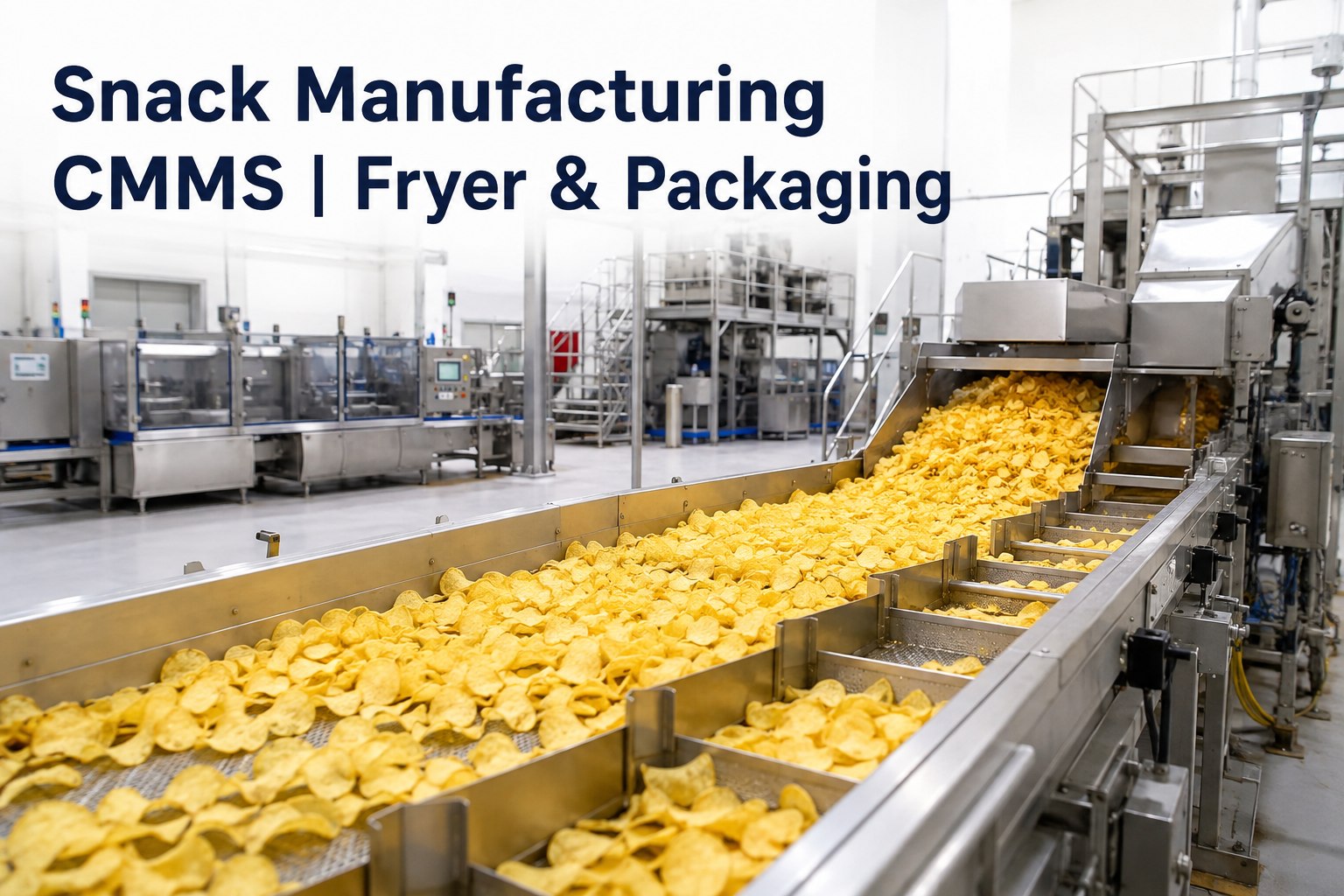
A crisps line running 24/7 loses more revenue to slow drips than to catastrophic failures. Two percent yield lost to a drifting weigher. Fifteen minutes lost per changeover because PMs and format changes were never combined. A quarter of a shift lost when fryer oil polar compounds went out of spec unnoticed. These small leaks add up to double-digit OEE loss every week. An snack manufacturing CMMS demo — book a free Oxmaint walkthrough shows how fryer, seasoning, extrusion and packaging live on one platform.
The OEE Leak Map
Where a Typical Snack Line Actually Loses Its Day
Nameplate 100% down to net 72% — every point of loss traced to an asset category
Nameplate throughput
100%
Losses across the shift
Unplanned downtimeFryer, packaging
−8%
ChangeoverCase packer, labeller, format
−6%
Minor stopsConveyor jams, sensor alarms
−5%
Speed lossSeasoning drum drift, extruder SME
−4%
Quality rejectsColour ΔE, oil, moisture
−3%
Weigher giveawayMultihead calibration drift
−2%
Net result
Net OEE — what actually ships
72%
Every one of these losses has a maintenance signature. A CMMS built for snack lines catches them before they compound.
The Fryer Oil Clock Runs Faster Than the Calendar
Continuous fryers are the beating heart of a crisps plant, and fryer oil is the single most maintenance-sensitive material in the whole operation. Total polar compounds rise, colour darkens, viscosity thickens, and free fatty acids climb — all continuously, under production load, across every shift. If your CMMS only tracks the fryer as an asset and ignores the oil as a monitored parameter, you are missing the leading indicator of both product quality and equipment life. Teams new to holding oil chemistry as a monitored condition can sign up free to explore the oil monitoring workflow before extending it across the plant.
Fryer Oil Degradation — Across a Production Week
Total Polar Compounds (TPC) vs fry hours, with intervention windows
A
Tuesday · TPC 18%
First filter interval. Filtration flow verified. Top-up scheduled.
B
Thursday · TPC 24%
Trend flagged. Filter change WO auto-issued. Colour ΔE watched.
C
Friday PM · TPC 27%
Partial oil dump scheduled for weekend break. Full dump avoided.
Predictive Wins That Actually Move OEE
Predictive maintenance in snack plants is not a science experiment. Modern predictive OEE deployments on fryers, seasoning drums, extruders and packaging lines are producing repeatable, short-payback wins across the industry. The pattern is consistent — a signal fires 20 to 90 minutes before a failure or quality event, the supervisor intervenes, and the saved production pays back the sensor and integration cost inside six months. To see how these signals feed into work orders in a live workspace, book a free demo of the predictive OEE view.
Predictive Signal → Supervisor Action → Payback
Fryer
47 min ahead
Heat exchanger differential trend flagged
Supervisor intervened. 90 min production saved.
Payback: 4 months
Seasoning drum
30 min ahead
Drum speed drift detected
Adjusted before quality loss. OEE lift +13% in 6 weeks.
Payback: 3 months
Extruder
90 min ahead
Specific mechanical energy drift forecast
Maintenance scheduled during changeover. No unplanned stop.
Payback: 5 months
Weigher
35 min ahead
Giveaway drift predicted
Auto-target adjusted. 2.1% yield recovered.
Payback: 3 months
Oven
20 min ahead
Moisture variation detected
Oven speed adjusted. Quality rejects cut 64%.
Payback: 4 months
Fryer colour
25 min ahead
Colour ΔE drift forecast
Auto-fryer adjustment. 340 lbs scrap prevented.
Payback: 4 months
Allergen Changeover: The Risk Grid Every UK Plant Runs
UK snack plants running mixed lines — one line producing a peanut-containing product, another running a "may contain" gluten-free line — carry a compliance risk that maintenance sits at the heart of. Every changeover triggers a wash-down, sanitation, and verification protocol. If the CMMS treats changeovers as separate from maintenance, the two sets of tasks are executed by different people from different systems, and the audit trail is fragmented. FSA and BRCGS auditors will find the gaps.
Allergen Changeover Risk Matrix
Wash-down effort required for common line-product transitions
From ↓ / To →
Standard salted
Cheese-flavoured
Peanut-coated
Gluten-free
Standard salted
Minimal
Wash-down
Full sanitation
Full sanitation
Cheese-flavoured
Wash-down
Minimal
Full sanitation
Full sanitation
Peanut-coated
Full sanitation
Full sanitation
Minimal
Not permitted
Gluten-free
Wash-down
Wash-down
Not permitted
Minimal
Oxmaint schedules the correct wash-down protocol automatically per transition and blocks any transition marked "Not permitted."
See a Snack Plant Workspace Configured for Your Lines
Watch how one Oxmaint workspace handles fryer oil monitoring, allergen changeover automation, packaging PM, and BRCGS-ready records — all in a 30-minute demo.
Packaging Line Maintenance: Where the Real Hours Go
Case packers and labellers generate more unplanned downtime and more changeover time than any other asset class in a snack plant. Format changes, label roll transitions, film feed alignment, and case-erector jams accumulate faster than any single failure. Suppliers that integrate PM and changeover into one work-order stream reduce changeover time by 30 to 60 percent — a documented pattern across the food packaging industry. Teams evaluating this integration approach can book a free demo of the unified PM + changeover workflow.
Packaging Asset Downtime — Where the Hours Actually Go
Vertical form-fill-seal
Film feed, seal jaws, dating
Multihead weigher
Bucket calibration, giveaway
Case packer
Format changes, magazine feed
Labeller
Roll changes, sensor alignment
Metal detector / X-ray
Calibration, reject bin
Palletiser
Layer pattern, gripper
Relative downtime intensity per asset class · Case packers and VFFS lead the losses on most crisps lines
Expert Perspective: Fryer Oil Is a Monitored Parameter
The most under-utilised source of maintenance signal in a crisps plant is fryer oil chemistry. Total polar compounds, free fatty acids, and colour tell you almost everything you need to know about the state of your heat exchanger, your filtration system, and your product quality — hours before any of those show up as a defect or a stop. Plants that hold oil parameters as monitored conditions inside the CMMS, alongside asset condition, run consistently higher OEE and lose less oil per tonne of finished product.
Oil
Chemistry as condition
TPC, FFA, colour and viscosity held as monitored parameters. Threshold breaches trigger work orders automatically.
Loop
Quality reject to asset root cause
Every reject at end-of-line is written back to the responsible asset window, closing the maintenance feedback loop.
Wash
Changeover is maintenance
Allergen wash-downs run inside the same work-order stream as PMs. Audit evidence is one document set, not two.
UK Snack Plant Context: BRCGS, FSA and Cost Pressure
UK snack manufacturers sit inside one of the tightest food-safety and audit environments in the world. BRCGS Food Safety issue 9 requires documented preventive maintenance evidence, calibration records for all critical measurement equipment, and traceable changeover controls. The FSA and local authority environmental health inspections apply on top. Simultaneously, energy costs on continuous fryers and ovens have moved maintenance efficiency from a technical concern into a boardroom cost line. A CMMS that treats compliance evidence and energy-critical asset condition as core outputs, not afterthoughts, changes the plant economics. To scope this against your UK operation, book a free demo aligned to BRCGS issue 9 requirements.
01
BRCGS issue 9 evidence
Documented PM, calibration certificates, allergen changeover controls, and pest control records — all discoverable in one platform for the annual audit.
02
Energy on continuous fryers
Fryer burner efficiency and heat recovery are now boardroom-visible cost lines. Combustion tuning cadence sits inside the maintenance KPI set.
03
Own-label and OEM audits
UK snack co-manufacturers pack for multiple retailers, each running their own supplier audit. One evidence backbone, filtered per customer, avoids the reconstruction scramble.
A Realistic Rollout Sequence for a Snack Plant
A snack plant CMMS rollout works best when it follows the OEE hierarchy — fry line first because that is where quality risk concentrates, packaging second because that is where the hours actually leak, then utilities and support. Teams see value from the fryer integration inside the first month, before the packaging integration comes online.
Weeks 1–4
Fry line + oil
Fryer, blancher, de-oiler asset register
Oil parameters set as monitored conditions
Filter change + oil dump cadences configured
Colour ΔE and moisture feedback linked
Weeks 5–8
Packaging + changeover
VFFS, weigher, case packer, labeller PMs
Changeover procedures merged with PM stream
Allergen wash-down matrix configured
Metal detector calibration cadence live
Weeks 9–12
Utilities + audit
Steam, compressed air, chilled water PMs
Pest control records integrated
BRCGS issue 9 evidence pack configured
OEE dashboards per line live
Turn Small OEE Leaks Into Recovered Production
Let Oxmaint show you a snack plant workspace configured for your fryer, seasoning, extrusion and packaging assets — with maintenance and changeover in one workflow.
Can Oxmaint monitor fryer oil parameters alongside asset maintenance?
Yes. Total polar compounds, free fatty acids, colour, and viscosity are held as monitored parameters against the fryer asset record, with target envelopes configured per product. Threshold breaches trigger escalated work orders — filter change, partial oil dump, or full dump — routed to the correct technician. The full oil history is retained per fryer and per campaign, satisfying both BRCGS traceability and internal quality investigation needs.
How does the platform handle allergen changeover controls?
A changeover matrix is configured per line, mapping every product-to-product transition to the correct wash-down and sanitation protocol. When production plans a transition, the CMMS auto-generates the required work orders in the correct sequence, blocks transitions marked "not permitted" (for example peanut to gluten-free on the same equipment without full sanitation), and retains the sign-off evidence for BRCGS and FSA audit purposes.
Can we integrate PM and changeover into a single workflow?
Yes — and this is one of the highest-value integrations. Case packer format changes, labeller roll swaps, and filler cleaning are all treated as work orders in the same stream as PMs. The technician sees a single ordered list for each shift, changeover time reduces 30 to 60 percent per the documented industry pattern, and every intervention is captured against the asset for audit and OEE analysis.
Does the CMMS support BRCGS issue 9 evidence requirements?
Yes. Preventive maintenance completion evidence, calibration certificates for critical measurement equipment (weighers, metal detectors, thermometers), allergen changeover controls, and pest control records are all captured as scheduled work orders with completion evidence. Evidence packs can be filtered per BRCGS clause for the annual audit, and per retailer for own-label customer audits, without a reconstruction exercise.
What is a realistic implementation timeline for a UK snack plant?
A phased 90-day rollout typically works well. Weeks 1–4 focus on the fry line and oil parameter integration — the highest-quality-risk area. Weeks 5–8 add packaging PMs merged with changeover procedures and the allergen wash-down matrix. Weeks 9–12 close with utilities, pest control records, and full BRCGS-ready audit evidence configuration. Teams see quality and yield benefit from the fryer integration within the first month.