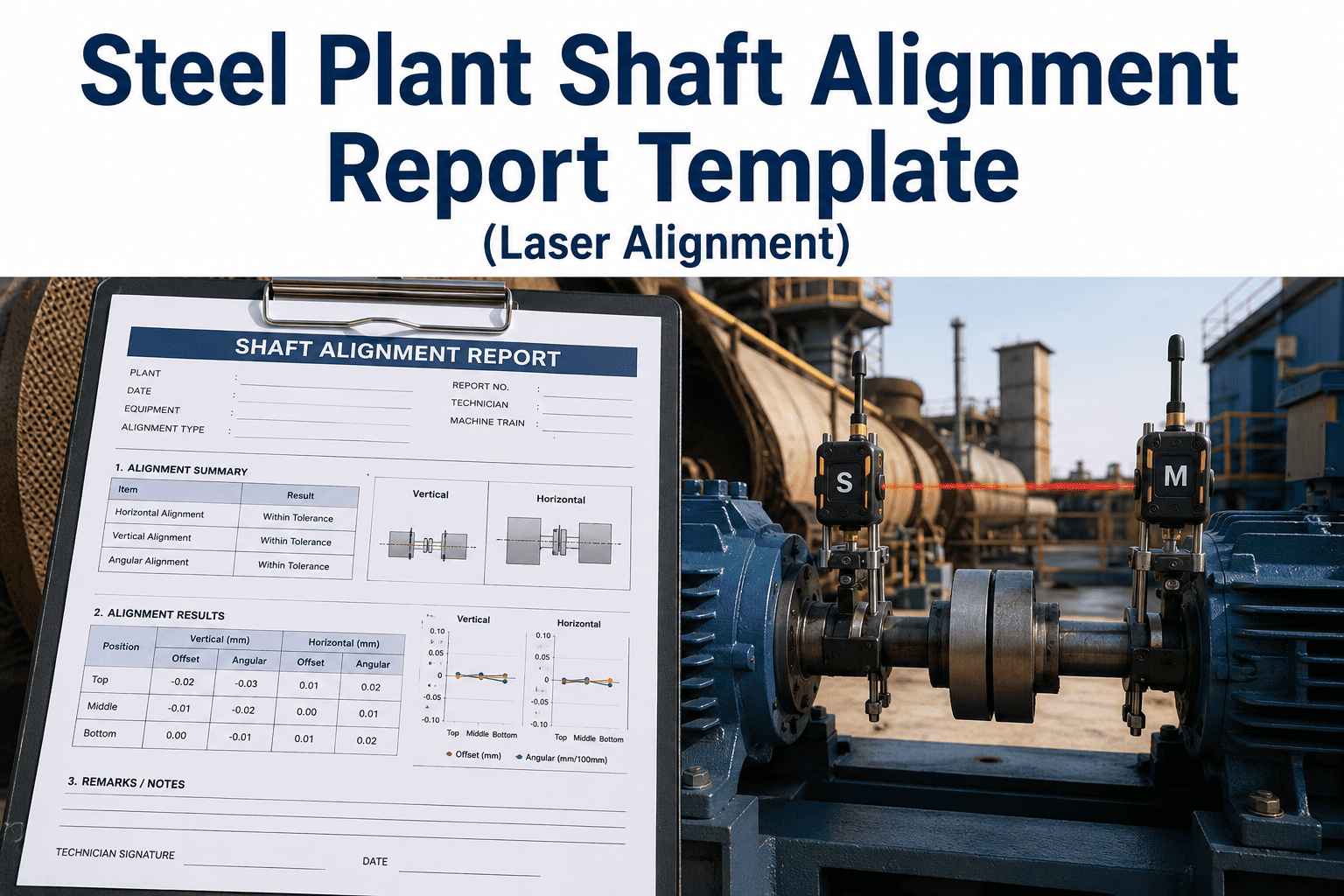
A motor and pump coupling can pass a visual check and still run 0.15mm off angular alignment, quietly loading the bearings and seals until a coupling fails mid-shift. Roughly 50% of rotating equipment bearing and seal failures in a steel plant trace back to misalignment that a laser alignment report would have caught before the first startup. This template lays out exactly what belongs in an alignment record — readings, soft foot correction, thermal growth compensation, and tolerance bands — across rolling mill motors, pump sets, and fan drives. Sign up for a free trial or book a demo to see how Oxmaint turns alignment records straight into verified, closed-out work orders.
50%
of bearing and seal failures in a steel plant trace back to misalignment an alignment report would have caught
0.05mm
typical tolerance band for precision coupling alignment on critical rolling mill drives
3-5x
longer coupling and bearing life reported on drives aligned and documented to tolerance versus eyeballed installs
$150-400
typical cost of a laser alignment job, versus the cost of an unplanned coupling or bearing failure
Why a Missing Alignment Report Costs More Than the Job
An alignment job without a documented report gives no proof it was done to tolerance, no baseline for the next technician, and no record for the CMMS to close against.
01
Soft Foot Skipped Before Alignment
Alignment readings taken before soft foot is corrected produce numbers that look good on the laser but shift once bolts are torqued.
02
No Thermal Growth Compensation
Cold alignment on a motor and pump set that runs hot leaves the coupling misaligned the moment the equipment reaches operating temperature.
03
Final Readings Never Recorded
The job gets done, but without a saved report there's no proof the shaft was left within tolerance, only a technician's word for it.
04
Report Never Reaches the CMMS
Alignment data sits in the laser tool's memory or a printed sheet, disconnected from the work order it was meant to close.
Turn a completed alignment job into a closed, verified work order
See how Oxmaint attaches laser alignment reports directly to the asset record and work order history.
Alignment Tolerance by Drive Speed and Criticality
Not every coupling needs precision-grade tolerance. The acceptable band should match the drive's operating speed and how costly a failure would be.
P
Precision — High-Speed Drives
Turbo blowers and high-RPM auxiliary drives requiring tight angular and offset tolerance to prevent premature bearing wear.
S
Standard — Mill and Pump Drives
Rolling mill motor couplings and process pump sets aligned to manufacturer-standard offset and angularity limits.
A
Acceptable — Low-Speed Auxiliaries
Conveyor drives and low-RPM fans where a wider tolerance band is acceptable without shortening service life meaningfully.
R
Re-check — Post-Repair or Thermal Cycle
Any drive freshly repaired, foundation-shimmed, or running a first thermal cycle, flagged for a follow-up alignment check.
Building the Report: A Four-Step Workflow
1
Correct Soft Foot First
Check and shim each foot before taking a single alignment reading, since soft foot invalidates every measurement taken after it.
Soft foot check
Shim correction
Bolt torque record
▼
2
Capture Laser Readings
Record horizontal and vertical offset and angularity at coupling with the laser system, before any shim adjustment is made.
Offset readings
Angularity readings
Coupling gap
▼
3
Apply Thermal Growth Compensation
Offset the cold alignment target based on the equipment's expected thermal growth so it lands on target once running hot.
Growth calculation
Cold target offset
Operating temp check
▼
✓
Record Final Readings and Sign Off
Save the final laser readout against tolerance, attach it to the asset record, and close the CMMS work order.
Final tolerance check
Report attachment
Work order closure
What Belongs in Every Alignment Report
Asset ID and Coupling Details
Motor, pump, or drive clearly tagged with coupling type and size, matching the CMMS asset record exactly.
Soft Foot Correction Log
Readings at each foot before and after shimming, confirming the base was flat before alignment began.
Initial and Final Laser Readings
Horizontal and vertical offset and angularity captured both before correction and at final sign-off.
Thermal Growth Calculation
Cold alignment target adjusted for expected thermal growth, documented alongside the operating temperature it's based on.
Tolerance Band Applied
Acceptable offset and angularity limits specified by drive speed and criticality, not a single blanket number.
CMMS Attachment and Sign-Off
Final report attached to the asset record and work order, with technician sign-off closing the job.
Stop losing alignment reports to printed sheets
Oxmaint attaches laser alignment PDFs and readings directly to the asset history and work order.
Book a Demo
Undocumented Alignment vs. Report-Backed Alignment
Undocumented Alignment
Soft foot skipped or checked without recording the readings
Cold alignment done with no thermal growth compensation
Final readings never saved, only a technician's verbal confirmation
No report attached to the asset, work order closed on trust alone
Coupling and bearing failures recur with no record to diagnose why
Report-Backed Alignment
Soft foot corrected and logged before any alignment reading is taken
Thermal growth calculated and applied to the cold alignment target
Initial and final laser readings saved against a documented tolerance
Report attached to the asset record and work order automatically
Alignment history available for every future technician on that drive
Where Alignment Jobs Break Down
| Alignment Problem |
Root Cause |
Fix |
| Readings look good but shift after bolting down |
Soft foot not corrected before alignment readings were taken |
Soft foot check and shim correction logged before any laser reading |
| Coupling wears fast once equipment is running |
Cold alignment with no thermal growth compensation applied |
Thermal growth calculated and built into the cold alignment target |
| No proof the job was done to tolerance |
Final laser readings never saved or attached to the asset |
Final readout captured and attached to the CMMS work order on close |
| Next technician repeats the same diagnosis |
No alignment history exists on the asset record |
Every alignment report stored against the asset for future reference |
| Wrong tolerance applied to a high-speed drive |
Same tolerance band used regardless of drive speed or criticality |
Tolerance band matched to drive speed and criticality tier before the job starts |
How Oxmaint Connects Your Alignment Report to Work Orders
An alignment job is only as good as the record left behind it. Oxmaint attaches laser alignment reports, readings, and technician sign-off directly to the asset record, whether the data comes from a laser alignment tool or a manual entry. Sign up to connect your alignment records to a live maintenance workflow.
Tolerance Tracking by Drive Type
Alignment tolerance bands maintained automatically by drive speed and criticality, from precision high-speed drives to low-speed auxiliaries.
Report Attachment and Sign-Off
Final laser readings and technician sign-off attached directly to the work order, closing the job with a verifiable record.
Flexible Data Integration
Alignment readings imported via CSV, REST API, or direct upload from common laser alignment tools.
Alignment History by Asset
Every report stored against the asset record, giving the next technician a full history instead of a blank start.
Turn Your Alignment Job Into a Verified Record
Oxmaint connects rolling mill, pump, and fan drive alignment data to a documented, CMMS-linked work order workflow.
Frequently Asked Questions
Which steel plant drives should get a documented alignment report?
Start with the highest-criticality couplings — rolling mill main motor drives, process pump sets, and high-speed blower drives — since these carry the highest cost when misalignment shortens bearing or coupling life.
Why does soft foot matter before taking alignment readings?
A machine base that rocks on its feet will shift once the hold-down bolts are torqued, so any alignment reading taken before soft foot is corrected can look accurate on the laser and still be wrong once the equipment is bolted down.
Does thermal growth really change alignment tolerance?
Yes. Motors and pumps that run hot expand as they reach operating temperature, so a cold alignment done without compensating for that growth can leave the coupling misaligned the moment the equipment is up to temperature.
Can Oxmaint store reports from any laser alignment tool?
Yes. Oxmaint accepts alignment reports and readings through REST API, CSV import, or direct file upload, so reports from any laser alignment system attach to the same asset record and work order.