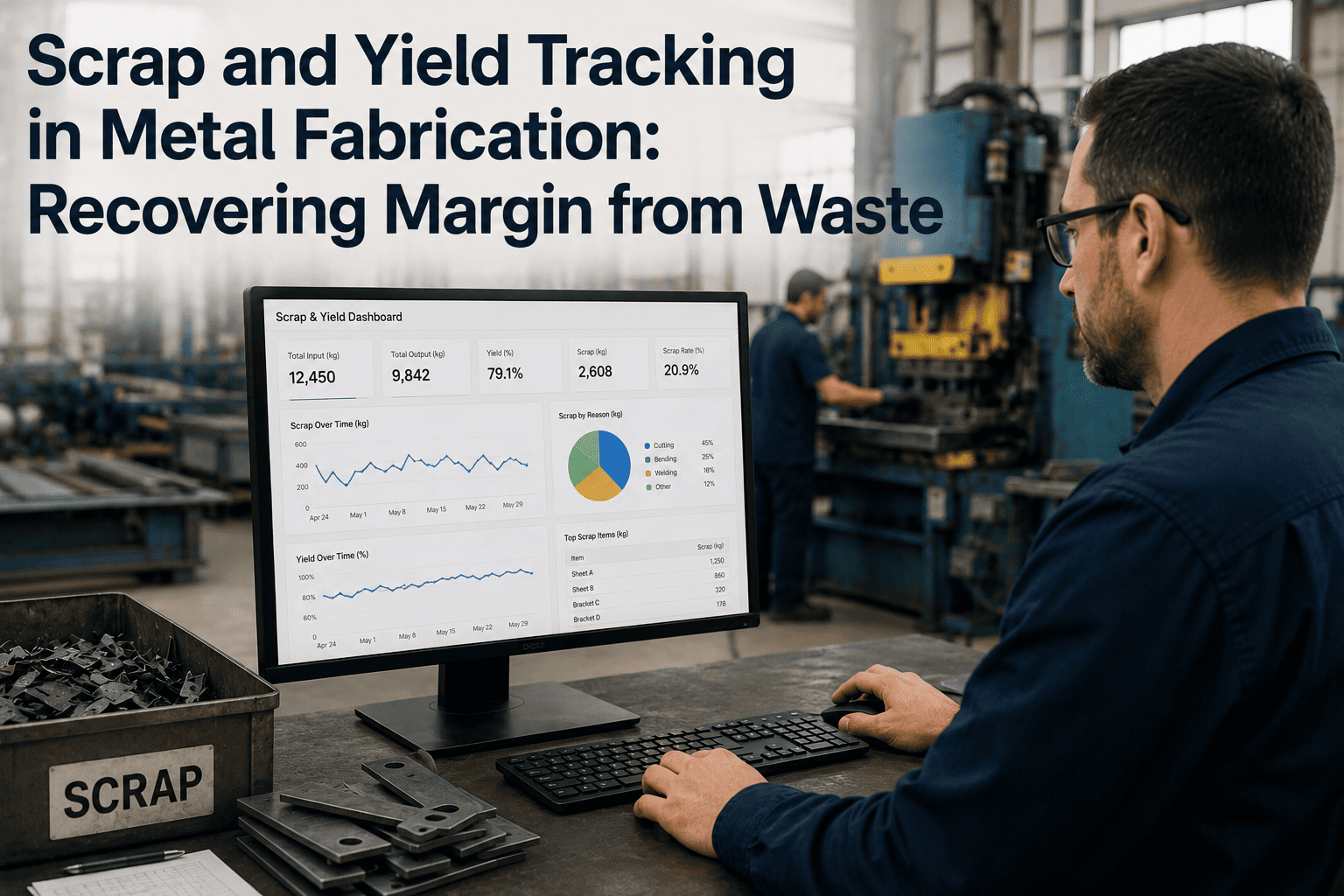
The scrap bin at final inspection is only the visible fraction. The parts that fail mid-process and get quietly re-cut without paperwork never make it into anyone's scrap report — and neither does the re-run that pushes the next job late, forcing its own quality shortcuts under expedite pressure. Most fabricators measuring scrap honestly for the first time find the real number is higher than they expected, and the real cost is 3 to 5 times the material value once machine time, labor, and schedule disruption are counted.
See Scrap By Job, Machine, and Operator — Automatically
Every scrapped part logged and tagged at the source, so the real scrap rate stops hiding behind the visible fraction.
The Real Cost of Scrap Nobody Measures
Scrap rate looks simple on paper — unusable units divided by total units produced. What that formula hides is everything that happened before the defect was caught: material cost, machine time already spent, labor already applied, and the capacity that job consumed while it was still on the machine. Add the schedule disruption from re-running it, and most shops discover their true scrap cost is several times the number in the scrap bin.
Three Patterns Behind Most Fabrication Scrap
Unvalidated Programs
A CNC program that hasn't been checked against the current part revision quietly cuts to the wrong geometry.
Material Variability
Stock that varies from spec doesn't show up until a part is already cut, by which point it's too late to adjust.
Small-Batch Setup Errors
A thorough first-article check is hard to justify against a five-piece batch, so setup errors slip through.
Tool Wear Drift
Dimensions drift gradually as an insert wears, degrading quality well before the tool looks obviously worn out.
What Scrap By Job, Machine, and Operator Reveals
| Dimension | What It Reveals | Corrective Action |
|---|---|---|
| By job / part number | Which programs or part families run consistently high scrap | Program revalidation, first-article review |
| By machine | A specific machine drifting out of tolerance over time | Calibration check, tool offset review |
| By operator | Setup or handling patterns specific to an individual or shift | Targeted retraining, standard work review |
| By material batch | Incoming stock variability from a specific supplier or heat | Supplier quality review, tighter acceptance criteria |
From Scrap Bin To Root Cause
Weigh & Log
Every scrapped part is logged at the point of rejection, including in-process re-cuts, not just final inspection failures.
Tag The Source
Each entry is tagged by job, machine, operator, and material batch, not left as an unattributed total.
Build The Pareto
A few weeks of tagged data usually shows two or three sources behind most of the scrap value.
Correct & Verify
A specific corrective action is applied to the top source, and yield is checked afterward to confirm it worked.
Find Out Which Job, Machine, or Batch Is Costing You Margin
Scrap tracked and tagged automatically at the source, with a Pareto that shows exactly where to act first.
How OxMaint Tracks Scrap and Yield
Scrap Logged By Job, Machine, Operator
Every rejection is tagged at the source instead of rolling up into one unattributed monthly total.
First-Time Yield Dashboard
Yield is tracked live per line and part family, surfacing drift before it becomes a costly pattern.
Scrap Cost Rollup
Material, time, and rework cost are combined per scrap event, showing the true cost, not just the material value.
Corrective Action Tracking
A confirmed root cause routes into a tracked action, with yield checked afterward to confirm it actually helped.
Every kilogram of scrap is margin that already left the building once, and is about to leave again in the recycling truck. Sign up free to see your scrap tracked by job, machine, and operator instead of one number on a monthly report.
Frequently Asked Questions
What's a good scrap rate for a metal fabrication shop?
Industry benchmarking puts the average around 1.4% of sales, with top-quartile shops holding scrap and rework below 1.0%.
Why is scrap tracking by machine more useful than a single plant-wide number?
A plant-wide total hides which specific machine, program, or operator is driving the majority of the loss, so it can't point to a fix — breaking scrap down by source usually shows two or three causes behind most of it.
Does the resale value of scrap metal offset the cost of producing it?
Rarely — scrap resale value depends on material type and market price, but it almost never comes close to covering the labor, machine time, and material already invested in the part before it was scrapped.
How much can scrap actually be reduced with better tracking?
Shops using real-time, source-tagged scrap data alongside shop-floor signals have reported scrap reductions in the range of 20 to 30%, largely by catching problems mid-run instead of at final inspection.
Should setup scrap on small batches be tracked separately from in-process scrap?
Yes — setup scrap on small batches behaves differently from in-process drift, and separating the two prevents a few unavoidable first-article losses from masking a real process problem.
Recover The Margin Sitting In Your Scrap Bin
Scrap and yield tracking by job, machine, and operator — see exactly where to act first and prove the fix worked.