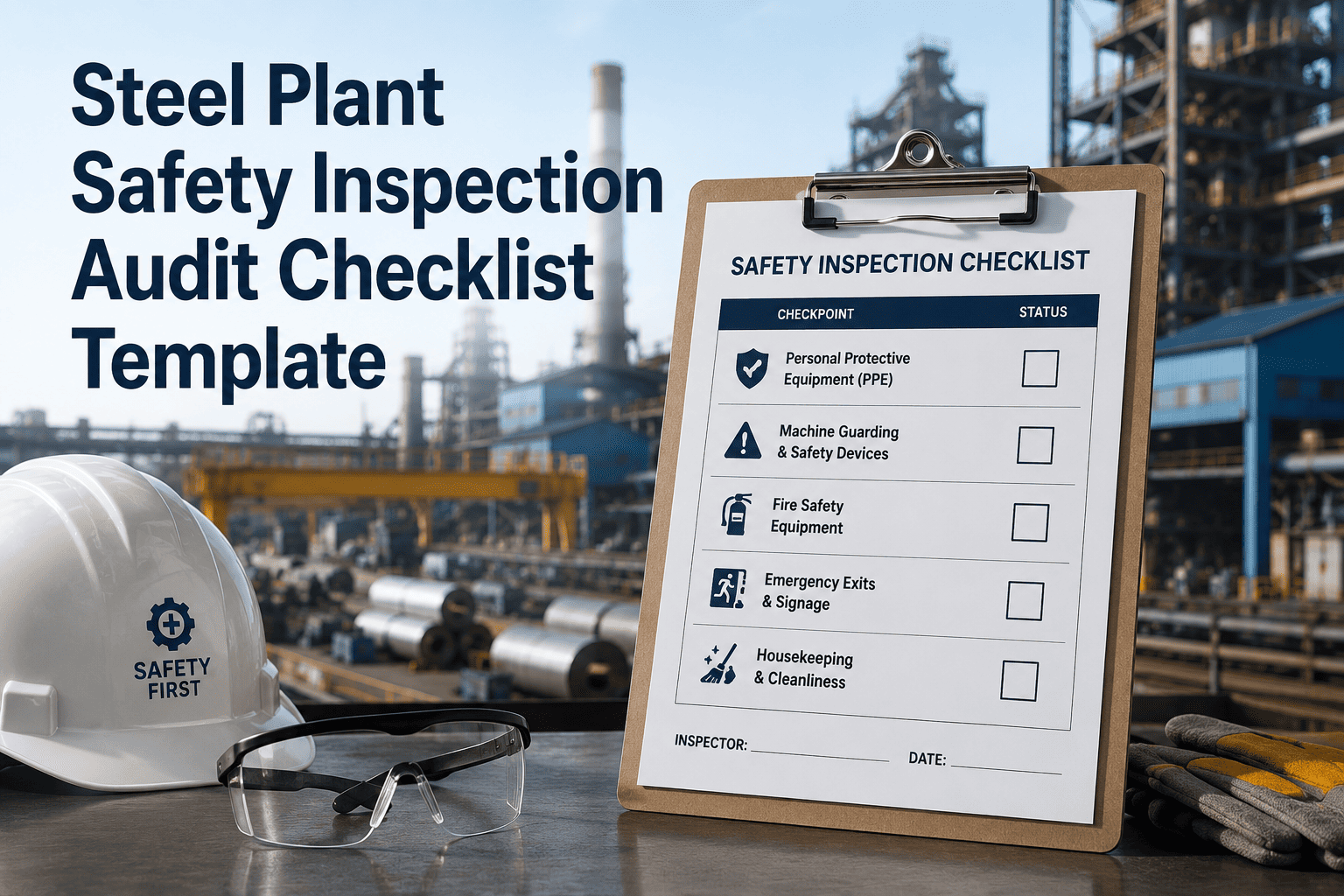
A safety audit that only checks whether an inspection happened misses the part that actually prevents incidents — whether the findings from that inspection ever got fixed. Most steel plants can produce a stack of completed inspection forms and still have open corrective actions from three months ago sitting untouched. This guide breaks down what a complete safety inspection audit needs to cover, and gives you a ready-to-use checklist built around workplace inspections, compliance audits, corrective action tracking, and permit verification. Start your free trial on Oxmaint or book a live demo to see how steel plants run safety audits as a tracked digital workflow.
44%
of corrective actions from safety inspections are never verified as closed
31%
of workplace inspections skip areas outside the standard walkthrough route
2.6x
longer resolution time for findings tracked on paper instead of digitally
92%
audit-readiness achievable with a structured, digitally tracked inspection process
The 4 Gaps That Undermine Safety Audits
Before an inspection checklist can be trusted, it helps to know where the process usually breaks. These four gaps show up across steel plant safety programs of every size.
01
Incomplete Area Coverage
Inspections follow the same familiar route each time, leaving storage areas, mezzanines, and rarely used equipment unchecked.
02
Findings Logged, Never Closed
A hazard gets written down during the walkthrough, but no one confirms the corrective action was actually completed.
03
Permits Not Cross-Checked
Work permits in the area aren't verified against the inspection, so expired or missing permits go unnoticed.
04
No Centralized Audit Trail
Inspection records live across paper forms and spreadsheets, so a full audit history takes days to assemble.
Track every finding from inspection to verified closure
Oxmaint links inspections, corrective actions, and permit checks directly to one audit record.
How a Safety Inspection Audit Should Flow
An audit that holds up under scrutiny moves through a defined sequence, with every finding tracked from discovery through verified closure.
1
Schedule & Assign Inspection
A recurring inspection is assigned to a qualified inspector, covering the full area, not just the standard route.
Full area assigned
Recurring schedule
Qualified inspector
▼
2
Conduct Inspection & Log Findings
Each hazard or non-compliance is logged with photo evidence and location, instead of a general pass or fail note.
Photo evidence
Location tagged
Findings logged
▼
3
Corrective Action Assignment
Every finding is converted into a corrective action with an owner and due date, not left as an open note.
Owner assigned
Due date set
Linked to finding
▼
✓
Verification & Audit Closure
A second check confirms the corrective action was completed before the finding is marked closed on the audit record.
Closure verified
Audit logged
Record archived
Safety Inspection Audit Readiness: The Checklist
Before an inspection is treated as complete, these six items should be verified and signed off. If any box is open, the audit isn't finished.
Full Area Coverage Confirmed
The inspection route includes storage, mezzanines, and rarely accessed equipment, not just the main floor.
Findings Logged With Evidence
Each hazard is recorded with a photo and location, giving the corrective action clear context.
Corrective Action Assigned With Due Date
Every finding has a named owner and a deadline, not just a description of the problem.
Permits Verified Against the Area
Active work permits in the inspected zone are checked for validity during the walkthrough.
Closure Independently Verified
A second person confirms the corrective action was completed before the finding is closed.
Audit Record Centrally Stored
The full inspection, findings, and closures are logged in one searchable record for future audits.
Before vs. After: Running Safety Inspection Audits
Without a Structured Audit Process
Inspection route repeats the same familiar path each time
Findings written on paper with no follow-up tracking
Work permits in the area not checked during inspection
Corrective actions closed on trust, without verification
Audit history scattered across forms and spreadsheets
With Oxmaint-Backed Audit Process
Full area coverage assigned and tracked for every inspection
Every finding logged with photo evidence and location
Permits cross-checked automatically against the inspected zone
Corrective actions closed only after independent verification
Complete digital audit trail ready for any compliance review
Where Safety Audits Break Down
| Audit Problem |
Root Cause |
Fix |
| Hazard reappears in the same area repeatedly |
The corrective action was logged but never verified as actually closed |
Independent closure verification required before a finding is marked resolved |
| Inspection misses a hazardous area entirely |
The walkthrough route only covers the same familiar path each time |
Full area assignment enforced, including storage and mezzanine zones |
| Expired permit found during an external audit |
Work permits in the area weren't cross-checked during the inspection |
Permit validity check built directly into the inspection workflow |
| Corrective action sits open for months |
No owner or due date was assigned when the finding was logged |
Every finding auto-converts to an action with an owner and deadline |
| Audit history takes days to assemble |
Inspection records are split across paper forms and spreadsheets |
Centralized digital record searchable by date, area, or inspector |
How Oxmaint Powers Safety Inspection Audits
Steel plants running inspections on paper are trusting that every finding gets remembered and every permit gets checked. Oxmaint connects inspection scheduling, findings, corrective actions, and permit verification into one audit record. Start for free and turn your next safety inspection into a fully tracked digital audit.
Digital Inspection Checklists
Full area coverage is assigned and tracked, with photo evidence required for every logged finding.
Corrective Action Tracking
Every finding converts into an action with an owner and due date, visible until it's verified closed.
Permit Cross-Checks
Active work permits in the inspected area are verified automatically during the inspection workflow.
Independent Closure Verification
A finding can't be marked resolved until a second person confirms the fix was actually completed.
Work Order-Linked Findings
Corrective actions requiring maintenance work are linked directly to a tracked work order.
Full Digital Audit Trail
Every inspection, finding, and closure is logged and searchable for any compliance or HSE audit.
Stop Filing Findings. Start Closing Them.
Oxmaint gives steel plant safety teams a digital inspection and audit process linking workplace checks, corrective actions, permits, and verified closure — so every hazard found is a hazard fixed. Sign up for free or book a demo to see it in action.
Frequently Asked Questions
What should a steel plant safety inspection checklist include?
A complete checklist covers full area coverage beyond the standard route, findings logged with photo evidence, corrective actions with an assigned owner and due date, permit verification for the inspected zone, and independent confirmation before a finding is closed.
Why do corrective actions need independent verification before closure?
A finding marked closed by the same person who logged it can be closed prematurely or based on an assumption rather than a confirmed fix. A second, independent check ensures the hazard was actually resolved before the record is closed.
How often should workplace safety inspections be conducted?
Frequency depends on site risk level and regulatory requirements, but the key principle is a recurring, scheduled inspection rather than an ad hoc walkthrough, so every area gets covered on a predictable cycle.
Can Oxmaint link safety inspection findings to work orders?
Yes. When a finding requires maintenance work, Oxmaint links it directly to a tracked work order, so the corrective action and the repair stay connected in one system.