A girth gear rarely gives much warning before it fails. Backlash creeps up, tooth surfaces start pitting, and then one torque spike under a loaded start can propagate a crack across multiple teeth, turning a $200,000 lubrication oversight into a multi-week production stop. The difference between a girth gear campaign that lasts 15-20 years and one replaced at 6-8 years usually comes down to three things: lubrication coverage, backlash discipline, and alignment. Start a free trial to see how Oxmaint keeps all three consistently executed.
15-20 Yrs
Girth gear campaign life achievable with consistent lubrication, alignment, and backlash monitoring
$800K-2M
Typical cost and downtime impact of an unplanned girth gear failure and replacement
0.5-1.0mm
Typical acceptable backlash variation around the gear circumference, per manufacturer spec
$50-150K
Cost of a full inching drive replacement, plus the production loss from losing it mid-shutdown
Why Girth Gear Failures Rarely Give a Second Chance
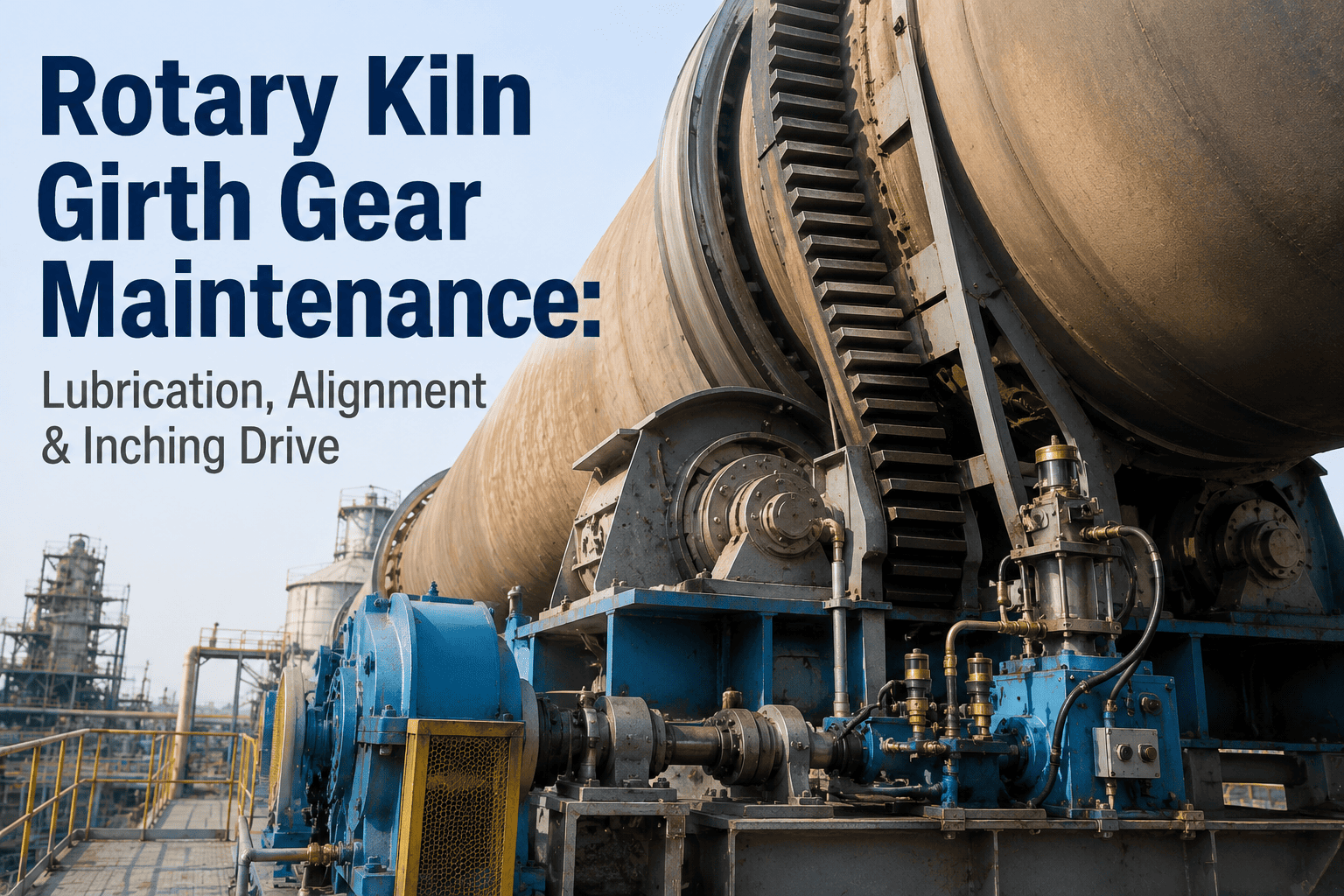
The girth gear is the largest and most expensive power transmission part on the kiln, a single forged steel ring transferring drive torque across millions of revolutions a year. Backlash increases quietly, tooth surfaces pit under repeated contact stress, and by the time vibration or noise becomes obvious, a crack may already be propagating across several teeth.
Three Ways to Measure Backlash in the Field
| Method |
How It Works |
Precision Level |
| Dial indicator |
Pinion is rotated back and forth without turning the girth gear, total movement equals backlash |
Highest, preferred for baseline records |
| Feeler gauge |
Gauge inserted between tooth flanks at the pitch line, measuring maximum thickness that fits |
Moderate, quick field check |
| Soft lead wire |
Wire placed between mating teeth, gear mesh rotated slowly, flattened wire thickness is measured |
Simple, less precise than a dial indicator |
Backlash Trends, Not Just Backlash Readings
Oxmaint logs every backlash reading against the as-commissioned baseline, tracks wear velocity, and projects when the action threshold will be reached, so a slow drift never turns into a surprise crack. Sign up for a free trial to see it against your own girth gear data, or book a demo and we'll walk through your drive maintenance program.
The Girth Gear Maintenance Schedule
| Task |
Frequency |
Trigger for Extra Check |
| Spray lubrication verification |
Daily coverage check |
Any visible dry patch or contamination |
| Backlash measurement |
Every 3 months, at 4 points around the gear |
After any shock load, unusual noise, or axis change |
| Vibration analysis |
Quarterly |
Abnormal drive noise or torque event flagged on start |
Main Drive Care vs Inching Drive Care
Main Drive
Backlash logged against baseline at four circumferential points
Gear-to-pinion contact checked across at least 80% of face width
Tooth surfaces cleaned and inspected for pitting or wear
Inching Drive
Auto-activation on power failure tested at every planned shutdown
Slow rotation function verified to prevent shell dead spots and refractory damage
Chain, sprocket, or coupling wear checked before each extended stop
How Oxmaint Supports Girth Gear Reliability
Oxmaint schedules lubrication coverage checks, backlash rounds, and inching drive tests as mobile work orders, with technician name, reading value, and timestamp captured against each component. When wear velocity trends toward the action threshold, the system flags it before the next shutdown gets planned around it. Book a demo to see it mapped against your own kiln drive train.
Frequently Asked Questions
Q
What causes premature girth gear failure?
Inadequate spray lubrication coverage, backlash left outside the specified range allowing metal-to-metal contact, misalignment creating cyclic bending loads, and water or dust contaminating the lubricant are the primary causes. Most of these are catchable with routine checks long before a tooth actually cracks.
Q
How often should backlash actually be measured?
At minimum every three months, at four points around the gear circumference, logged against the as-commissioned baseline. Extra checks are worth doing immediately after any shock load event, unusual drive noise, or a change in kiln axis alignment.
Q
Why does the inching drive matter as much as the main drive?
The inching drive rotates the kiln slowly during shutdown to prevent thermal distortion and preserve the refractory lining, activating automatically if main drive power fails. Losing it mid-shutdown risks shell dead spots and refractory damage, and replacing one runs $50,000 to $150,000 plus lost production time.
Q
What backlash tolerance should a healthy girth gear stay within?
Backlash variation around the gear circumference commonly should not exceed 0.5 to 1.0mm, depending on the gear module and manufacturer specification. Tooth contact should also span at least 80% of the face width to avoid concentrated wear on one edge.
Give Your Girth Gear the Full 15-20 Year Campaign
Oxmaint gives cement plant reliability teams scheduled lubrication checks, backlash trending, and inching drive verification in one platform, tied directly to your kiln drive train. Sign up for a free trial to explore it yourself, or book a demo and we'll walk through it against your own gear data.