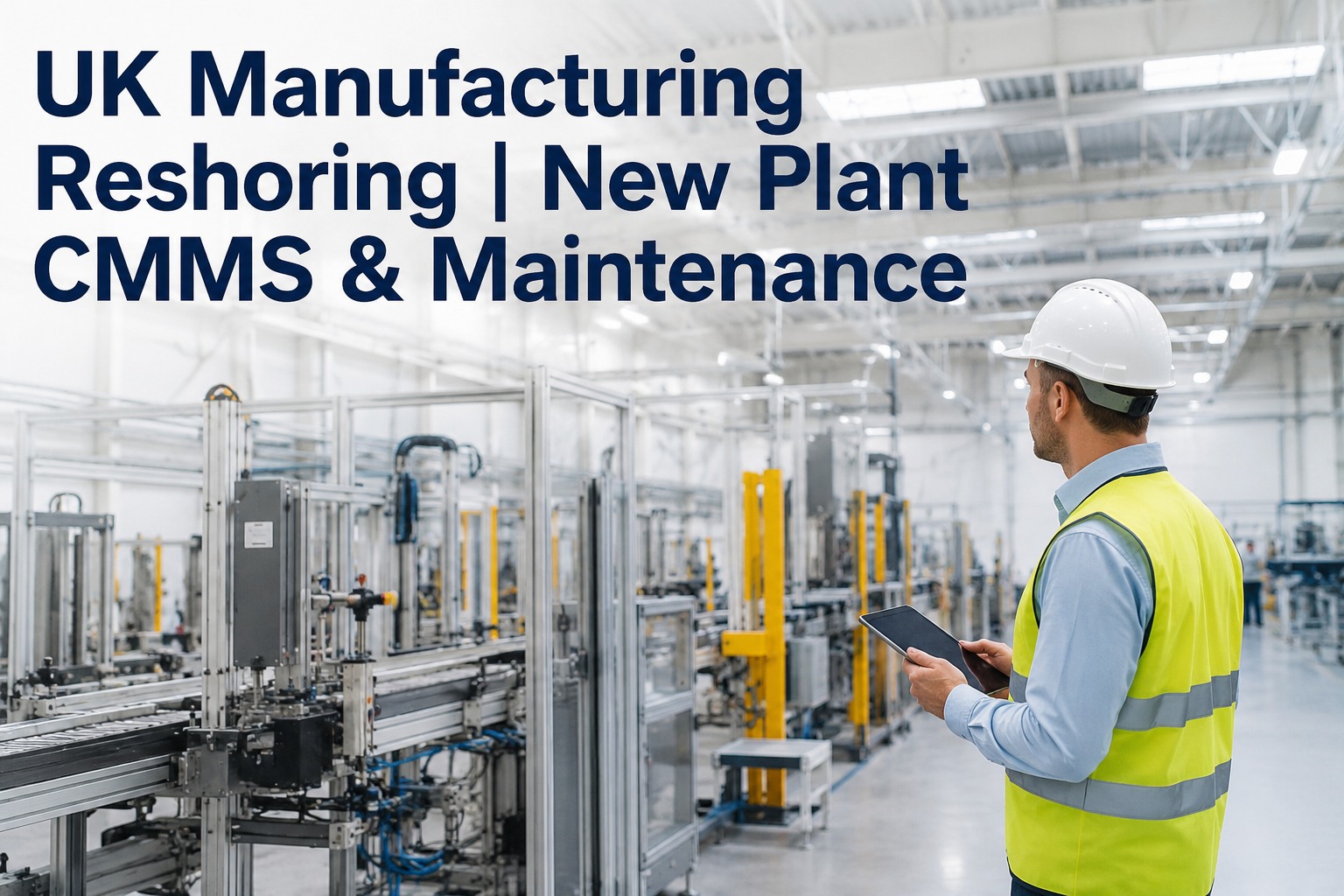
Reshoring is one of the few moments in a manufacturing operation's life where maintenance gets to start from a blank page. Every existing UK plant runs some inheritance of legacy CMMS, spreadsheet workarounds and PPM cycles that were "the way we have always done it". A new plant has none of that baggage. The question isn't whether to build maintenance discipline in — it's whether to build it in during commissioning while it's cheap, or bolt it on eighteen months later. Book a demo to see new-plant workflows in action.
◆ UK RESHORING · GREENFIELD PLANTS · DAY-ONE MAINTENANCE
A new UK plant is one moment to build reliability in — before reactive work becomes cultural.
Every asset registered, every PPM scheduled, every spare parted, every reliability KPI baselined — from commissioning, not eighteen months in.
GREENFIELD BUILD CALENDAR · T-MINUS TO FIRST PRODUCTION
15mo
Typical CMMS build window · Design through ramp
3-5×
Cheaper to build in vs bolt on in Year 2
£0
Legacy data migration on a greenfield plant
The Maturity Trap — Why Year-Two Retrofits Cost So Much More
The economics of building maintenance systems into a greenfield plant are genuinely different from retrofitting them into an operating plant. During commissioning, asset data comes from vendors as digital handover packs, PPM schedules come from OEM manuals, spares lists come from the equipment specifications and BOMs. Twelve months later, that same information has to be reconstructed from paper manuals in filing cabinets, physical asset surveys and tribal knowledge. Sign up free to structure vendor handover data into your CMMS from day one.
BUILD-IN vs BOLT-ON · SAME OUTCOME, DIFFERENT COST
Where the Money Actually Goes
✓ BUILD-IN (Commissioning)
Asset data from vendor handover packs · Digital · Structured
PPM schedules from OEM manuals · Direct import · Pre-loaded
Spares BOMs from equipment specs · Consistent · Complete
Warranty periods captured cleanly · Cost recovery built in
Team trained during commissioning downtime · No production hit
Reliability baseline from cycle zero · Trend analysis works
Cost: Weeks of engineering time during a scheduled phase
✕ BOLT-ON (Year 2)
Asset survey by walking the plant · Physical audit · Slow
PPM schedules reconstructed from paper manuals · Gap-ridden
Spares list from stock counting · Missing critical items
Warranty windows already expired · Money left on table
Training on running plant · Production disrupted
18 months of reactive work already cultural · Hard to reverse
Cost: 3-5× the build-in cost + cultural retrofit
The Reliability Maturity Pyramid — What Level You Start At Matters
Reliability maturity models describe the journey from purely reactive maintenance through to a genuinely predictive operation. Existing UK plants usually start at Level 1 or 2 and grind slowly upward against the weight of legacy operating patterns. A new plant can choose to start at Level 3 or higher — with proper PPM discipline in place from the first shift — which is a structural advantage no amount of Year-3 change management can replicate. Book a demo to see how greenfield deployments target Level 3+ from day one.
05
Optimised · AI-Assisted
Data-driven asset lifecycle decisions · AI-supported failure prediction · Continuous improvement loop closed
Aspirational
04
Predictive · Condition-Based
Vibration, temperature, oil analysis integrated · Condition-based work triggers · Failure prevention over reaction
Year 2-3 target
03
Proactive · Planned
Structured PPM disciplined against manufacturer schedules · Reliability KPIs tracked · Root cause on major events
GREENFIELD DAY-ONE TARGET
02
Preventive · Calendar-Based
Time-based servicing on major assets · Basic work order tracking · Some PPM discipline · Reactive fills the gaps
Most UK plants sit here
01
Reactive · Run-to-Failure
No PPM discipline · Fix-on-break culture · No asset history · Spreadsheets and tribal knowledge · Every day a fire
Avoid at all costs
Ten Foundational Decisions to Make Before First Production
Every greenfield plant makes ten fundamental decisions during the CMMS build window that shape maintenance for the next decade. Get them right during commissioning and they're invisible from Year 2 onward. Get them wrong and every technician, every planner and every reliability engineer will fight the system for years. The list below is what any senior UK plant engineer looking back on a reshoring project would tell you to lock in early.
01
Asset hierarchy design
Site → Area → Line → Machine → Component structure that mirrors how production actually thinks · Cannot be retrofitted easily
02
Criticality classification
A/B/C or 1-5 scale applied per asset · Drives PPM depth, spare-holding levels, and response SLA · Baseline from vendor risk data
03
Failure mode library
Controlled defect vocabulary per asset class · Enables meaningful failure analytics from cycle 1 · Free-text defect logging is where reliability data goes to die
04
PPM cycle logic
Hours / cycles / calendar / condition triggers per asset · Direct from OEM manuals during handover · Not later reconstruction
05
Spare parts BOMs
Per-asset parts list with criticality tags · Direct from equipment specs · Min/max reorder levels baselined against MTBF data
06
Warranty capture
Every asset carries warranty start, expiry and OEM contact · Structural cost recovery through Year 1 · Money on the table otherwise
07
Work order lifecycle
Request → plan → schedule → execute → close → analyse · Templated per work type · Consistency from cycle 1 shift 1
08
Mobile-first execution
Technicians work on tablets at the machine · No paper handoff · No end-of-shift data entry catch-up · Standard from day one
09
KPI baseline
MTBF, MTTR, PPM compliance, schedule attainment measured from month 1 · Trend analysis works because zero was cleanly captured
10
Integration boundaries
ERP, MES, BMS, condition monitoring integration mapped in commissioning · Costs a fraction now vs Year 2 API retrofit
◆ NEW-PLANT MAINTENANCE DEMO
See the Full Greenfield Setup in 30 Minutes
Vendor-handover asset data workflow, PPM template configuration from OEM manuals, BOM and spare parts structural setup, warranty-tracking chain, KPI baselining from cycle 1 and mobile technician deployment for new-plant operations.
Day-One vs Year-Two — What the Difference Looks Like
The concrete difference between building maintenance in and bolting it on shows up most clearly when you compare two identical plants: one commissioned with CMMS discipline in place, and one where the system got added after the operation had been running for eighteen months. The gap is real, measurable, and largely unrecoverable. Sign up free to make sure your reshoring project lands in the left-hand column.
✓ CMMS FROM CYCLE ONE
Asset register completeness
100%
PPM compliance · Month 3
95%+
Warranty cost recovery
Structural
Cultural default
Proactive
✕ CMMS ADDED YEAR 2
Asset register completeness
60-75%
PPM compliance · Month 3
40-60%
Warranty cost recovery
Mostly lost
MTBF trend from
Month 24+
Cultural default
Reactive
Expert Perspective — Why UK Reshoring Is a Reliability Opportunity
"
Anyone who has spent a career in UK plant engineering knows the pattern. A greenfield plant opens with enormous optimism about "doing things right this time". Six months in, production pressure hits, some equipment starts breaking in ways the team hasn't seen before, spare parts are ordered reactively because the BOMs weren't fully captured during commissioning, and by month 12 the plant is running exactly the same firefighting culture that everyone said they'd avoid. The reshoring wave now going through UK manufacturing is a genuine opportunity to break that cycle — but only for the operators who treat CMMS build as a commissioning workstream rather than a Year-2 project. The vendor data is available in structured digital form during handover; the OEM PPM schedules come out of the manuals; the technicians can be trained during natural commissioning downtime; the warranty windows haven't yet expired. Twelve months later, every single one of those things costs three to five times more and delivers a fraction of the benefit. This isn't about maintenance software; it's about which cultural default the new plant hardens into. Get it right in the build phase and reliability discipline becomes permanent. Get it wrong and the reactive habits become embedded within eighteen months — and much harder to reverse than to prevent.
— UK Reshoring & Greenfield Manufacturing Practice
01
Vendor-handover integration
Digital asset data, PPM schedules and spares BOMs ingested directly from OEM handover packs during commissioning.
02
Warranty cost recovery
Every asset carries warranty periods with alerts before expiry · Structural claim management protects Year-1 recovery.
03
Level 3 from day one
Proactive planned maintenance discipline in place from cycle 1 · No reactive default to reverse later.
04
Baseline KPI capture
MTBF, MTTR, schedule attainment measured from month 1 so trend analysis works when it matters.
Who Uses Oxmaint for UK Greenfield & Reshored Plants
The platform is used by the UK teams delivering new manufacturing capacity: reshoring project directors bringing production back from Asia and Eastern Europe, greenfield programme managers commissioning new automotive component plants, food and beverage manufacturers building new UK facilities to shorten supply chains, life sciences and pharmaceutical operators standing up new GMP-compliant sites, semiconductor and precision-engineering start-ups launching first UK plants, energy transition manufacturers building new battery, EV component and hydrogen equipment plants, and defence-industrial base contractors expanding UK sovereign manufacturing capacity.
Getting Greenfield Maintenance Live Before First Production
Deployment fits naturally alongside the commissioning workstream. Asset register imports from vendor handover packs as equipment is installed. PPM templates load from OEM manuals during factory acceptance testing. Spare parts BOMs configure per asset from equipment specifications. Warranty periods capture cleanly with alert workflow. Failure mode library structures to the plant's asset classes. Mobile deployment reaches technicians during commissioning training. KPI baselines set for month 1 measurement. Integration to ERP, MES and BMS scopes during system commissioning rather than as a retrofit. Most UK greenfield plants have their CMMS live and populated before first production, with reliability discipline in place from cycle 1. Sign up free to scope your greenfield CMMS build.
◆ RESHORE. REBUILD. RE-ENGINEER RELIABILITY.
One Plant. Built Right. From Cycle One.
Oxmaint gives UK reshoring and greenfield operators the full commissioning-integrated CMMS build — vendor-handover asset registers, OEM-loaded PPM templates, structural warranty capture, Level-3 discipline from day one and reliability KPIs baselined from month 1.
Frequently Asked Questions
What does reshoring mean for maintenance strategy?
Reshoring — bringing UK manufacturing capacity back from overseas — creates a rare opportunity to build maintenance discipline from a blank page. Existing UK plants inherit years of accumulated compromise (partial asset registers, spreadsheet workarounds, inconsistent PPM cycles, tribal knowledge). A new or reshored plant has none of that legacy. The strategic decision is whether to build a proper CMMS foundation during the commissioning phase — when vendor data is digital, OEM manuals are fresh, warranty periods haven't expired, and there's no production disruption cost — or to bolt it on eighteen months later when everything costs 3-5 times more and cultural reactive habits have already embedded. Reshoring is a moment to skip the maturity trap that most UK plants have spent decades struggling to escape.
When in the greenfield build should we deploy the CMMS?
CMMS deployment runs as a workstream alongside the physical commissioning, typically spanning the last 12-15 months before first production. Asset register import starts as equipment vendors deliver structured handover packs. PPM template configuration happens during factory acceptance testing when OEM engineers are on site. Spare parts BOMs load from equipment specifications. Warranty periods capture at the point of asset handover. Mobile deployment to technicians happens during commissioning training when their attention is available. Integration to ERP, MES and BMS scopes as those systems commission. The pattern that fails is treating CMMS as a Year-1 project after production starts — by then vendor data has to be re-created manually, warranty periods have partially expired, and reactive habits have started to embed.
Why does building in during commissioning cost less than retrofitting?
The cost gap is dramatic and predictable. During commissioning, asset data arrives from vendors in structured digital form (BIM models, equipment specs, PPM schedules, spare parts lists) and drops directly into the CMMS. Retrofitting requires walking the plant to physically survey assets, reconstructing PPM schedules from paper manuals in filing cabinets, cross-referencing tribal knowledge, and often re-scoping equipment integrations that vendors originally offered free. Warranty windows are still open during commissioning so cost recovery works structurally; twelve to eighteen months later most warranties have expired. Technicians can be trained during natural commissioning downtime with no production impact; retrofitting means training on a running plant with production disruption. The rule of thumb from UK plant engineering practice is 3-5× cost differential — not counting the harder-to-quantify cultural cost of eighteen months of reactive habits becoming embedded.
What sectors are actively reshoring UK manufacturing?
Several sectors are driving current UK reshoring investment. Automotive component manufacturers building new capacity closer to UK OEM assembly plants. Food and beverage producers shortening supply chains and improving carbon footprints. Life sciences and pharmaceutical operators standing up new UK GMP-compliant sites for supply security. Semiconductor packaging and precision-engineering operations returning capability that had migrated to Asia. Energy transition manufacturers building UK plants for batteries, EV components, hydrogen electrolysers and heat-pump equipment. Defence-industrial base contractors expanding sovereign UK production capacity. Each sector has its own regulatory and technical particulars, but they all share the same one-time opportunity to build reliability discipline from a clean slate rather than inheriting the maturity debt that constrains most existing UK plants.
How long does deployment typically take for a UK greenfield plant?
CMMS deployment on a UK greenfield or reshored plant runs concurrent with commissioning rather than as a separate post-production project. Typical shape: asset register configuration and vendor-handover ingestion during T-9 to T-3 months (as equipment arrives); PPM template configuration during T-6 to T-1 months (as OEM engineers commission equipment); spare parts BOMs and warranty capture through T-3 to T-0 months; mobile deployment and technician training during T-2 to T-0 months (aligned with commissioning training); KPI baselining and integration go-live at T-0 or T+1. The whole workstream fits inside the last 12-15 months of the physical build. By first production the CMMS is live, populated, integrated with adjacent systems, and delivering Level-3 proactive maintenance discipline from cycle 1 — rather than being bolted on eighteen months later at 3-5× the cost.