Most reliability engineers are running a five-tool circus: FMEA in one spreadsheet, RCM logic trees in a PDF, Weibull curves in statistical software, and root cause analysis scattered across email threads and whiteboard photos. None of it talks to your maintenance data. UK manufacturers lose an average of £1.36 million per hour of unplanned downtime, yet the engineering work meant to prevent it often lives nowhere near the CMMS that runs daily maintenance. Book a free demo to unify your reliability toolkit and see what changes when it all lives in one place.
The Reliability Engineer's Reality Check
How many separate tools does your reliability programme actually run on?
Scattered Today
FMEA Spreadsheet
RCM Logic Tree PDF
Weibull Statistics Tool
RCA Whiteboard Notes
CMMS Work Orders
Five sources of truth. Zero shared data. Insights that never reach the shop floor.
Unified in OxMaint
Reliability Platform
FMEARCMWeibullRCAWork Orders
One dataset. Every analysis connected to live asset and maintenance history.
Why Reliability Programmes Stall Before They Scale
Ask most plant reliability engineers where their FMEA data lives six months after the workshop, and the honest answer is usually "somewhere on a shared drive." Research shows that 82% of asset failures follow random, non-age-related patterns that time-based preventive maintenance cannot catch — exactly the class of failure RCM, Weibull analysis and structured RCA are built to address. When reliability engineering sits apart from the CMMS, plants default to generic calendar-based tasks instead of the consequence-driven strategy their own analysis recommended. Curious what your own asset data would show? Sign up free and run a criticality check on your top asset.
Why "Time-Based" Maintenance Misses Most Failures
82%of asset failures are random, not age-related — Weibull,and condition data catch these, fixed calendars don't
25–35%maintenance cost reduction reported by plants running structured RCM correctly
70–75%fewer breakdown events when RCM-selected tasks are actually tracked to completion
One Platform, Four Connected Reliability Workflows
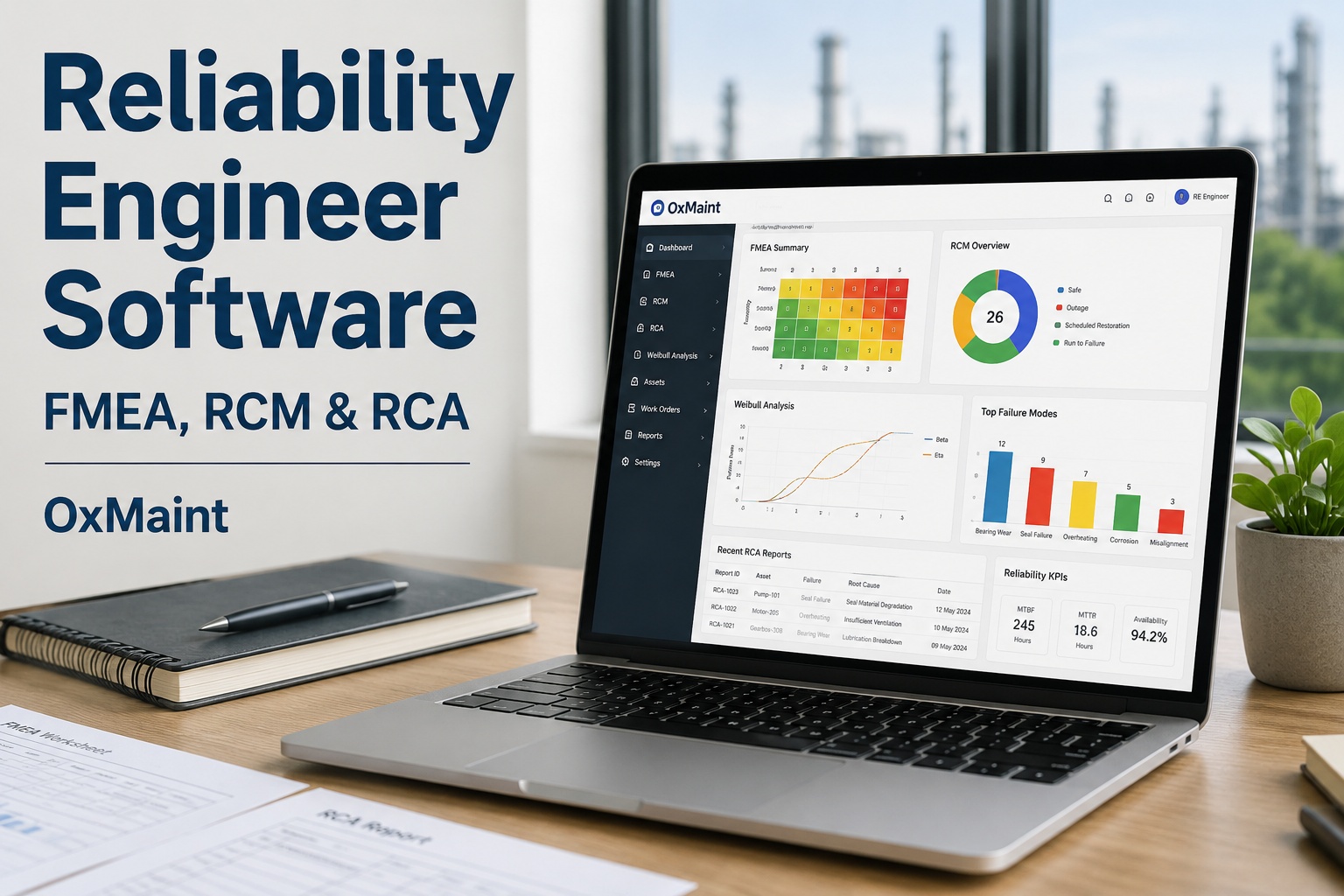
OxMaint brings FMEA, RCM decision logic, Weibull-based life data analysis, and root cause analysis into the same system that runs your work orders — so an engineering conclusion becomes a maintenance task automatically, not a follow-up email that never gets sent. Reliability leads ready to move off spreadsheets can Sign up free and build your first FMEA in minutes.
The Reliability Engineer's Toolkit
FMEA
Structured failure mode, effect and criticality worksheets with automatic Risk Priority Number ranking
RCM Decision Logic
SAE JA1011-aligned worksheets that recommend condition-based, time-based or run-to-failure tasks
Weibull Life Analysis
Failure-rate curves and remaining useful life estimates built from real work order and asset history
Root Cause Analysis
Fishbone and 5-Why templates linked directly to the failed asset and its full maintenance record
Closing the Gap Between Analysis and Action
The gap between "we identified the failure mode" and "a technician actually fixed it" is where most reliability programmes leak value. OxMaint closes that gap by connecting every reliability output directly to the work order queue — so criticality scores, RCM task recommendations and RCA corrective actions become scheduled, trackable maintenance work automatically.
From Engineering Insight to Scheduled Work Order
Reliability Data in Action
How one analysis becomes maintenance that actually happens
1
FMEA Identifies Risk
Critical failure mode ranked by severity, occurrence and detectability
2
RCM Selects the Task
Condition-based, scheduled or run-to-failure strategy chosen by decision logic
3
Weibull Sets Timing
Life data analysis defines the optimal interval or trigger point
4
Work Order Generated
Task, parts and technician scheduled directly in the CMMS
5
RCA Closes the Loop
Any recurring failure feeds root cause analysis back into the FMEA
See Your Reliability Data Connected, Live
Watch FMEA, RCM and Weibull outputs flow straight into real work orders in a 30-minute walkthrough built around your assets.
Expert Perspective: Why Connected Reliability Data Wins
Reliability-Centered Maintenance is only as good as the data feeding it and the follow-through that comes after it. Plants that treat RCM as a one-off workshop deliverable see the recommendations gather dust. Plants that connect RCM, FMEA and Weibull analysis to daily work order execution are the ones reporting real reductions in breakdown events — because the analysis keeps updating itself against what's actually happening on the floor.
Living Analysis, Not a Static Report
As operating context changes — new shift patterns, ageing assets — failure modes shift too. Connected data lets RCM stay current instead of expiring the day the workshop ends.
Right Task, Right Asset, Right Time
Random-pattern failures need condition monitoring, not calendar dates. Blending Weibull outputs with RCM logic stops both over-maintenance and missed failures.
Closed-Loop Root Cause Analysis
Recurring failures automatically resurface in FMEA reviews, so corrective actions actually reduce future risk scores instead of being filed and forgotten.
Where to Start Your Rollout
Standardising a reliability programme doesn't mean ripping out your existing CMMS or retraining engineers on new statistical methods. It means giving FMEA, RCM, Weibull analysis and RCA a shared home connected to the asset data you already collect. Start with your highest-criticality asset class and let RCM and Weibull outputs generate real work orders. Teams evaluating a switch can Sign up free and import an existing FMEA to see how quickly it connects.
Why UK Reliability Teams Are Making the Switch
Reliability teams across UK manufacturing are moving from disconnected spreadsheets towards a single platform where engineering insight and maintenance execution reinforce each other. The result is a reliability programme that improves itself over time instead of one rebuilt from scratch every few years. Still running RCM workshops that end in a PDF nobody reopens? Book a free demo to see the connected alternative.
Frequently Asked Questions
What is reliability engineering software and why does it matter?
Reliability engineering software unifies methods like FMEA, RCM, Weibull life data analysis and root cause analysis into a single connected platform. Rather than running each analysis in a separate spreadsheet or statistical tool, engineers work from shared asset and failure data, and the conclusions of one analysis — such as a critical failure mode identified in FMEA — flow directly into maintenance scheduling. This matters because disconnected analysis rarely survives contact with the shop floor: recommendations get filed away instead of becoming scheduled work.
How is RCM different from standard preventive maintenance?
Preventive maintenance applies fixed calendar or usage-based schedules to all assets uniformly. Reliability-Centred Maintenance instead asks what each asset does, how it can fail, and what the consequence of that failure is, then selects the most cost-effective response — which may be condition-based monitoring, a scheduled task, or a deliberate run-to-failure decision. Because roughly 82% of failures follow random, non-age-related patterns, RCM typically outperforms calendar-only preventive maintenance for critical, complex assets.
Do I need a statistics background to use Weibull analysis in OxMaint?
No. OxMaint builds Weibull failure curves and remaining useful life estimates directly from your existing work order and asset history, presenting the results as clear failure-rate trends and recommended intervals rather than raw statistical output. Reliability engineers who want to inspect the underlying distributions and parameters can still do so, but day-to-day maintenance planning doesn't require manually running the analysis.
Can OxMaint replace our existing FMEA spreadsheets without losing historical data?
Yes. Existing FMEA worksheets, criticality rankings and failure mode libraries can be imported into OxMaint and linked to the corresponding assets already in your CMMS. From that point forward, new risk scores, RCM task recommendations and RCA findings are captured in the same connected record, so historical work isn't lost and future analysis builds on it rather than starting over.
How quickly can a reliability team see results after switching to a connected platform?
Most teams see the first tangible result — an FMEA-driven work order actually completed rather than shelved — within the first few weeks of rollout, once a critical asset class is set up. Broader gains, including the 25–35% maintenance cost reductions and meaningfully fewer breakdown events reported by mature RCM programmes, typically build over several months as more asset classes are brought onto the platform and Weibull data accumulates enough history to sharpen interval recommendations.
Turn Reliability Engineering Into Maintenance That Happens
Unify FMEA, RCM, Weibull and RCA with your live maintenance data. See exactly how it works for your assets in a free 30-minute walkthrough.