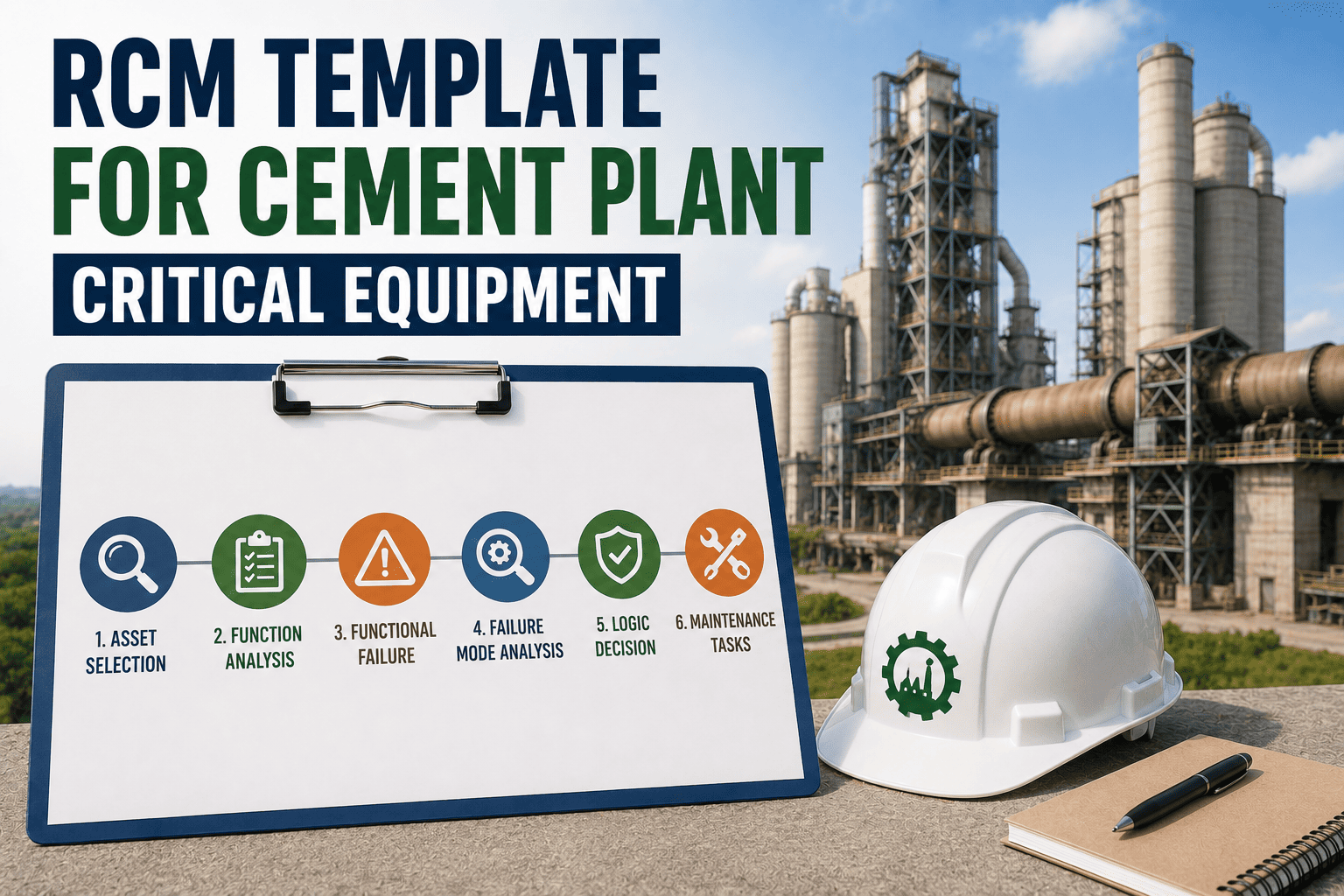
Reliability-Centered Maintenance (RCM) is a structured methodology used to identify the most appropriate maintenance strategies for critical equipment. In a cement plant, where downtime costs are astronomical, implementing an RCM template ensures that every maintenance task adds value. Instead of blindly performing preventive maintenance, RCM focuses on preserving system function and mitigating specific failure modes. To see how this methodology integrates with modern software, you can sign up for a free trial or book a demo with OxMaint today.
The 7 Core Questions of RCM
A robust RCM template is built around answering seven critical questions to determine the optimal maintenance strategy for your cement plant assets.
1. Functions
What are the primary and secondary functions of the asset in its operating context?
2. Functional Failures
How can the asset fail to fulfill its intended functions?
3. Failure Modes
What specific events cause each functional failure?
4. Failure Effects
What happens when each failure mode occurs?
5. Failure Consequences
How does the failure impact safety, operations, and the environment?
6. Proactive Tasks
Can a preventive maintenance task prevent or mitigate the failure?
7. Default Actions
If no proactive task exists, what should be done (e.g., run-to-failure)?
Result
A tailored, cost-effective maintenance strategy for every critical asset.
RCM Decision Logic Matrix
Once the failure modes and consequences are identified, the RCM template applies a strict decision logic to determine the right maintenance strategy. This ensures you are not wasting resources on ineffective preventive maintenance tasks.
Safety Consequence
If failure affects safety or environment, a proactive task is mandatory. If none exists, the asset must be modified.
Operational Consequence
If failure impacts production, a proactive task is chosen if it reduces risk to an acceptable level.
Non-Operational
If failure has no direct operational impact, a proactive task is applied only if it costs less than the repair.
Integrating RCM with Maintenance Management Software
Completing an RCM template is only the first step. To be effective, these strategies must be integrated into your daily operations. Maintenance planning software like OxMaint bridges the gap between reliability engineering and the maintenance floor. When your RCM template dictates a condition-based monitoring task for a rotary kiln, that task is automatically scheduled in the CMMS. When an inspection identifies a potential failure, a work order is instantly generated. To modernize your critical equipment maintenance, you can sign up for a free trial or book a demo to see the platform.
Implement RCM and Protect Critical Assets
Stop guessing which maintenance tasks matter. OxMaint helps you apply RCM principles to your daily workflows, ensuring your cement plant equipment runs reliably. Sign up for a free trial or book a demo to see our asset management software in action.