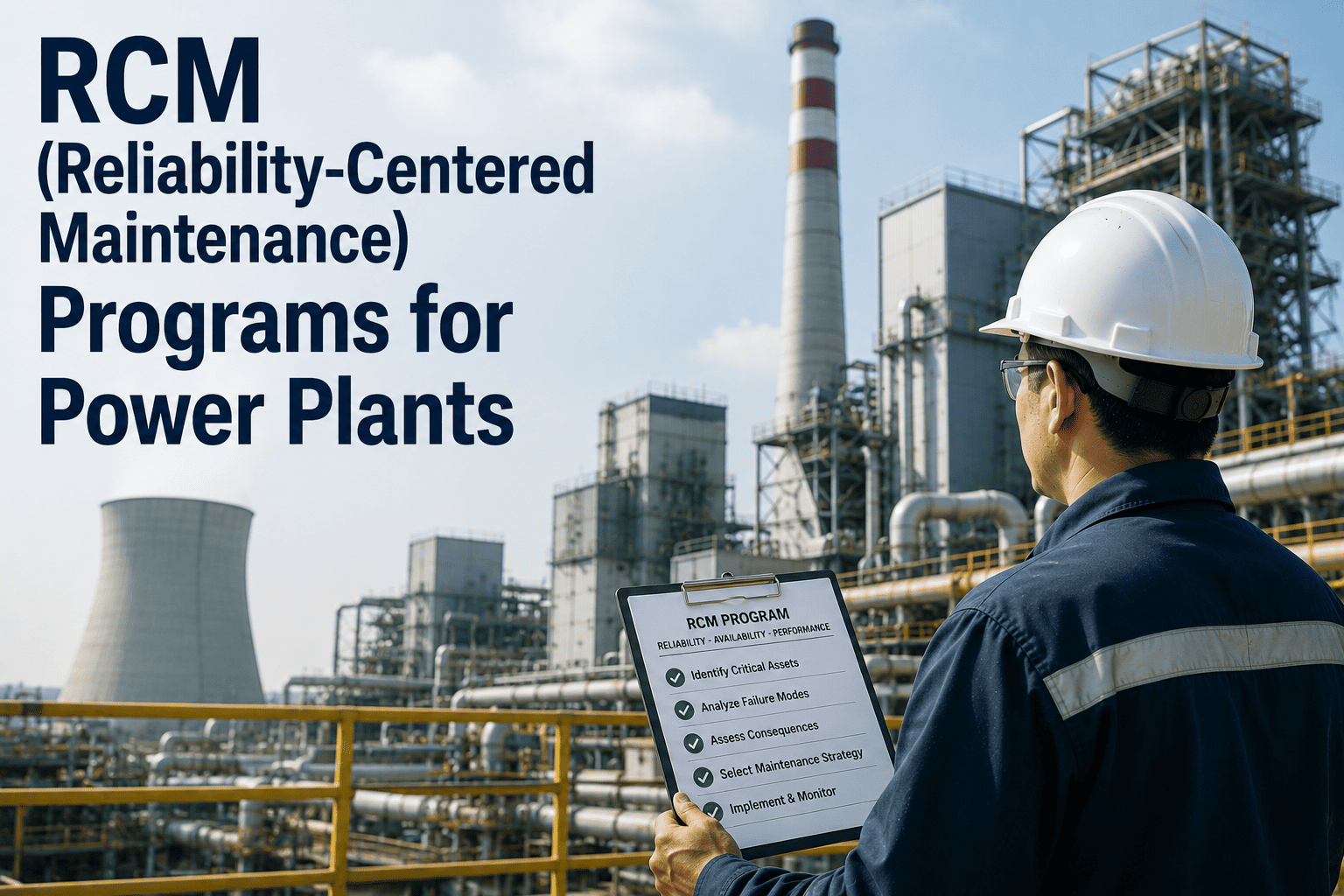
Most maintenance programs ask "what should we do to this equipment." RCM asks a different question first: "what is this equipment actually supposed to do, and what happens if it stops doing it." That single shift is why reliability-centered maintenance produces fewer, better-targeted tasks instead of a blanket time-based schedule applied to everything. Sign up to carry an RCM analysis from function through failure mode to a scheduled task, with every decision recorded against the asset in your CMMS.
Why It Matters
A plant that time-bases every task treats a hidden failure the same as a nuisance one, and spends the same effort on a redundant pump as on a single point of failure. RCM exists to stop that waste — it forces every task back to a specific failure mode and its actual consequence, so safety-critical failures get proactive tasks, non-critical ones get run-to-failure, and nothing gets maintained just because it always has been.
The RCM Logic In Five Questions
Every RCM analysis, regardless of which asset it's applied to, works through the same sequence of questions before a single task gets scheduled.
Function
What is this asset supposed to do, under what performance standard, in normal operation?
Failure Mode
What specific event causes it to stop performing that function to standard?
Effect
What actually happens when that failure occurs — what's felt on the unit, the process, and the crew?
Consequence
How serious is that effect — safety, environmental, operational, or barely noticeable?
Task
Given that consequence, what's the most effective response — proactive task, redesign, or run-to-failure?
Matching Task Type To Failure Consequence
The consequence category a failure falls into decides what kind of task is even worth assigning to it — this is the step most time-based programs skip entirely, applying the same inspection interval regardless of what's actually at stake.
| Consequence Category |
What It Means |
Typical Task Response |
| Safety Or Environmental |
Failure could injure someone or cause a release |
Proactive task mandatory, or redesign if no effective task exists |
| Operational |
Failure reduces or stops generation output |
Proactive task justified if its cost is below the output loss |
| Non-Operational |
Failure only costs the repair itself, nothing more |
Run-to-failure, unless repair cost alone justifies prevention |
| Hidden Failure |
A protective device fails silently, unnoticed until needed |
Scheduled function test to confirm it still works |
Carry Every RCM Decision Into A Scheduled Task
Oxmaint links each function, failure mode, and consequence decision to the asset it belongs to and generates the resulting task directly as a maintenance plan, so the analysis doesn't stop at the workshop. Sign up for a free trial to run it on your own units, or book a demo to see it built around your systems.
Where RCM Programs Stall After The Workshop
Analysis Never Becomes A Task List
Function and failure mode decisions get documented but never turned into scheduled maintenance plans
Old Time-Based Tasks Left In Place
The RCM study runs alongside the legacy PM schedule instead of replacing it
Hidden Failures Not Tracked Separately
Protective devices treated like normal equipment instead of getting dedicated function tests
No Record Of Why A Task Exists
A task appears on the schedule with no link back to the failure mode that justified it
Consequence Categories Never Revisited
A failure classified as non-operational years ago stays that way after the system around it changed
No Owner For Ongoing Review
Nobody assigned to update the analysis as equipment, operating patterns, or failure history change
Frequently Asked Questions
Q
How is RCM different from a standard preventive maintenance program?
Preventive maintenance schedules tasks on a fixed interval regardless of consequence. RCM starts from the asset's function, works out what failing that function actually costs, and only assigns a proactive task where the consequence justifies it — otherwise it deliberately allows run-to-failure.
Q
Why do hidden failures get treated differently in RCM?
A hidden failure, like a standby protective relay, gives no warning on its own — the crew only discovers it's failed when it's needed and doesn't work. RCM assigns these a scheduled function test specifically to reveal that silent failure before it matters.
Q
Does an RCM study need to be repeated once it's done?
Not repeated from scratch, but it needs an owner who revisits consequence classifications as equipment, operating patterns, or failure history change — an analysis frozen at its original workshop date drifts out of step with the plant it describes.
Give Every Maintenance Task A Documented Reason
Oxmaint keeps function, failure mode, consequence, and task decisions attached to the asset they were written for, so your RCM program stays a living reliability plan instead of a workshop report. Sign up for a free trial to run it on your own plant, or book a demo to see it configured for your team.