The R-410A era is over. Since January 1, 2025, the EPA's AIM Act has banned production of new R-410A equipment — and every commercial HVAC decision from this point forward involves one of three A2L low-GWP refrigerants: R-454B, R-32, or R-1234yf. Choosing the wrong path means equipment incompatibility, compliance exposure, and technician shortages. Choosing right means locking in energy savings and regulatory confidence through the 2030s. Sign up free on OxMaint to register your HVAC assets by refrigerant type and build a compliance-ready portfolio before transition pressures peak.
Track Every HVAC Asset by Refrigerant Type in OxMaint
Register chillers, RTUs, and VRF systems by refrigerant type. Auto-assign A2L inspection checklists, track technician certifications, and stay audit-ready — all in one CMMS built for commercial facilities.
Why the Refrigerant Decision Matters More Than Ever
The AIM Act doesn't just phase out R-410A — it sets up cascading compliance milestones through 2036. Facility managers who pick equipment today are locking in refrigerant commitments that span the entire asset lifecycle. A rooftop unit installed in 2026 will still be operating in 2041. The refrigerant inside it determines service costs, technician availability, and regulatory exposure for that entire period. Book a demo to see how OxMaint manages A2L compliance records across multi-site portfolios.
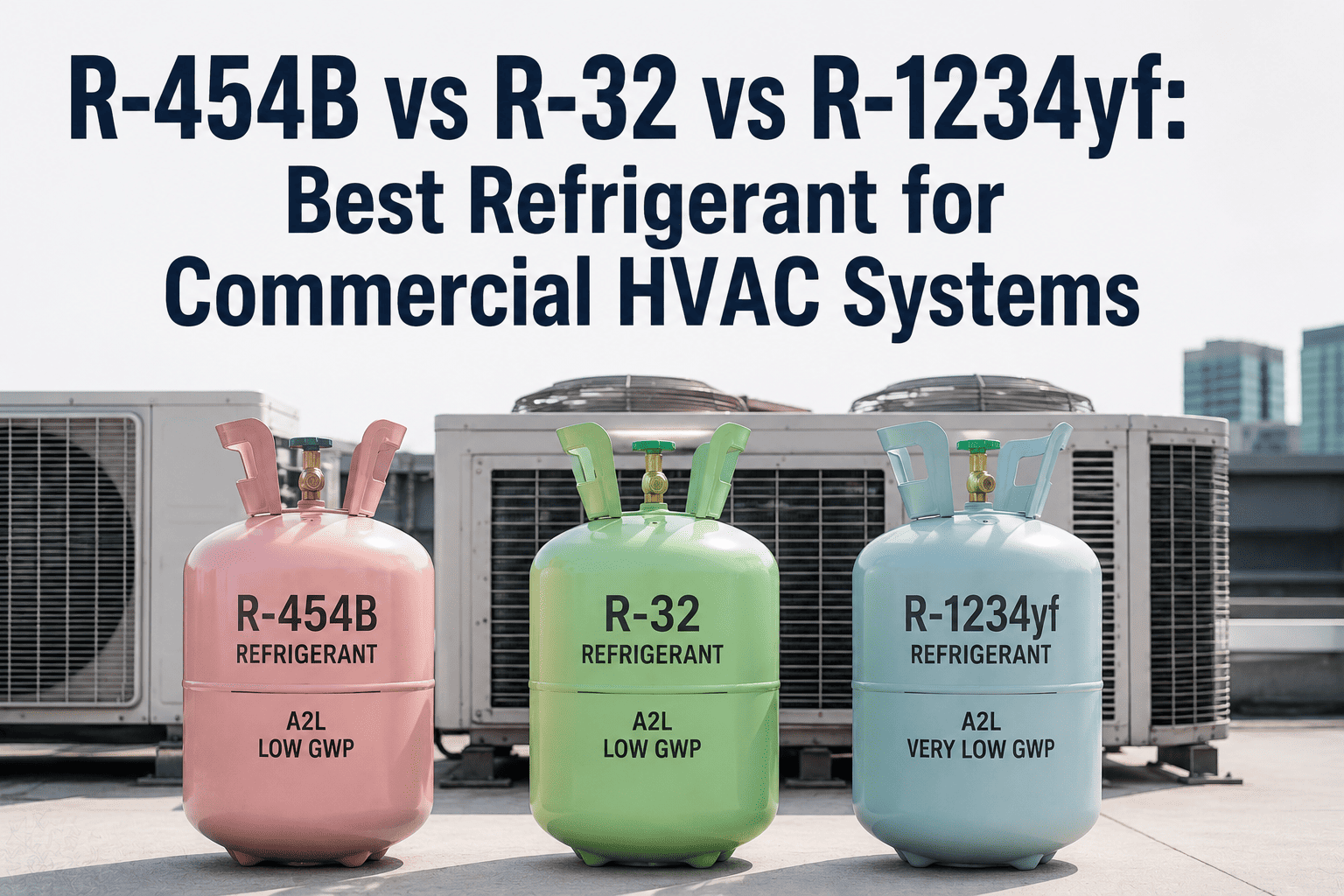
The Three Contenders at a Glance
R-454B
Also known as Puron Advance / Opteon XP40
A zeotropic blend of 68.9% R-32 and 31.1% R-1234yf. Engineered to mirror R-410A operating pressures — making it the preferred drop-in-design choice for U.S. manufacturers including Carrier, Trane, and Lennox. GWP of 466 clears the EPA's 700 threshold with margin.
R-32
Single-component HFC (difluoromethane)
A pure-component refrigerant used globally in mini-splits and VRF systems since 2012. GWP of 675 — higher than R-454B but 68% below R-410A. Favored by Daikin, Mitsubishi, and LG. No fractionation risk during servicing, but operates at higher discharge temperatures.
R-1234yf
HFO — hydrofluoroolefin
Near-zero GWP of just 4 — the most climate-friendly of the three. Commercial HVAC adoption is largely limited to centrifugal chillers and specialized low-pressure systems. Cost is typically 3–5x higher than R-32, limiting its use to applications where GWP compliance mandates it.
Head-to-Head Comparison
| Property | R-454B | R-32 | R-1234yf |
|---|---|---|---|
| GWP | 466 | 675 | 4 |
| Safety Classification | A2L (mildly flammable) | A2L (mildly flammable) | A2L (mildly flammable) |
| Composition | Blend (R-32 + R-1234yf) | Single-component | Single-component |
| Pressure Profile vs R-410A | Near-identical | Slightly higher | Significantly lower |
| Energy Efficiency Gain | 5–10% over R-410A | Up to 12% over R-410A | Comparable to R-410A |
| Primary Commercial Use | RTUs, large splits, VRF | Mini-splits, VRF | Centrifugal chillers |
| Relative Refrigerant Cost | Moderate | Lower | 3–5x higher |
| U.S. Manufacturer Adoption | Carrier, Trane, Lennox | Daikin, Mitsubishi, LG | Specialized OEMs only |
| Fractionation Risk | Yes (blend) | None (pure) | None (pure) |
| EPA AIM Act Compliant | Yes (through 2036+) | Yes (through 2036+) | Yes — exceeds requirements |
Performance Deep Dive
Energy Efficiency
R-32 leads on raw efficiency — its higher volumetric capacity means smaller charges achieve the same cooling, and commercial VRF systems see up to 12% energy savings over R-410A in large-scale environments. R-454B delivers 5–10% gains and lower discharge temperatures, which reduces long-term compressor stress. New systems on either refrigerant typically recover their cost premium within 5–7 years through energy savings alone.
Safety and Handling
All three carry A2L classification — mildly flammable, low toxicity. A2L handling requires updated leak detection sensors, A2L-rated recovery equipment, and technician certification under ASHRAE 15 and IEC 60335. The key difference: R-454B and R-32 require very similar safety protocols, while R-1234yf's lower pressure profile demands different tooling entirely. Facilities must update their PM checklists and contractor qualification requirements for every A2L asset.
Serviceability and Cost
R-32 is a pure compound — no fractionation during partial charge recovery, which simplifies field service. R-454B is a zeotropic blend, meaning composition can shift if charge is only partially recovered, requiring careful handling. R-1234yf's per-kilogram cost is 3–5x higher than R-32, making it non-competitive for most commercial equipment. R-32 mini-split system installations average around $3,500 vs $4,000 for comparable R-454B central systems.
Which Refrigerant for Which Application
- Commercial rooftop units (RTUs) above 20kW
- Large split systems replacing R-410A equipment
- Buildings with existing R-410A infrastructure
- Applications where OEM support from Carrier, Trane, or Lennox is required
63% of U.S. contractors prefer R-454B for whole-building systems (2025 survey)
- VRF (Variable Refrigerant Flow) systems
- Ductless mini-split zones and office fit-outs
- Smaller commercial applications under 20kW
- Buildings using Daikin, Mitsubishi, or LG equipment
Over 160 million R-32 units installed worldwide by 2026 — deep service network
- Centrifugal chillers requiring near-zero GWP compliance
- Applications under strict regional GWP mandates below 500
- Facilities pursuing LEED or sustainability certification targets
- Where future-proofing against tighter GWP thresholds is the priority
Cost premium limits adoption except where mandated by regulation or certification
Regulatory Timeline: What Facilities Must Track
EPA bans manufacturing of new R-410A residential and light commercial equipment
All new equipment must use refrigerants with GWP below 700
New split systems installed in buildings must use sub-700 GWP refrigerant
Distributor inventory of R-410A equipment clears market
Large commercial systems face compliance milestones under AIM Act phasedown
R-410A reclaimed supply tightens — prices already 3x 2022 levels
R-454B and R-32 remain qualified for new equipment manufacture through at least 2036
Further GWP tightening may advantage R-454B and R-1234yf long-term
The Maintenance Dimension: What Changes with A2L
Switching to any A2L refrigerant isn't just a procurement decision — it rewrites your preventive maintenance program. Facilities that fail to update their CMMS records, technician qualifications, and inspection protocols are creating silent compliance liability. Sign up free on OxMaint to tag every HVAC asset by refrigerant type and auto-generate the correct A2L PM checklist.
Updated Leak Detection Requirements
A2L systems require certified leak detection sensors capable of triggering system shutdown on detection. Quarterly sensor calibration checks must be added to every PM schedule — a task that does not exist for R-410A systems.
Technician Certification Tracking
ASHRAE 15 compliance for A2L systems requires technicians with updated certifications. Every work order on an A2L asset must be assigned only to qualified technicians. OxMaint tracks technician certifications and flags assignment mismatches before dispatch.
Refrigerant-Specific PM Checklists
R-454B blend fractionation checks, R-32 discharge temperature monitoring, and R-1234yf low-pressure calibration each require distinct inspection steps. A single generic HVAC checklist no longer covers a mixed-refrigerant portfolio.
Refrigerant Inventory and GWP Records
EPA Section 608 and state-level regulations increasingly require documented refrigerant charge records per asset. Facilities managing R-410A legacy systems alongside new A2L equipment need separate tracking — or one CMMS that handles both without confusion.
Performance Benchmarks: A2L-Managed Facilities vs Unmanaged
| Metric | Unmanaged Transition | CMMS-Managed A2L Program | Benefit |
|---|---|---|---|
| Compliance Audit Readiness | Scattered records, manual lookup | Per-asset refrigerant logs, audit export | Hours saved per audit cycle |
| Unplanned Downtime from Leaks | Detected late, reactive repair | Sensor-triggered PM + early detection | 60–70% reduction in reactive calls |
| Technician Dispatch Errors | Uncertified tech assigned A2L work | Cert-based auto-assignment in CMMS | Zero certification mismatches |
| Energy Cost Trajectory | No baseline tracking post-transition | Pre/post energy comparison per asset | Proves ROI of A2L upgrade |
| PM Completion Rate | 65–75% on generic checklists | 90–98% on refrigerant-specific schedules | 25–30 point gain |
How OxMaint Manages Your A2L Refrigerant Transition
Tag Every Asset by Refrigerant Type
Register each HVAC unit with its refrigerant type — R-454B, R-32, R-1234yf, or legacy R-410A. Filter your entire portfolio by refrigerant to see compliance exposure at a glance.
Auto-Assign Refrigerant-Specific Checklists
OxMaint auto-selects the correct inspection checklist based on refrigerant type. R-454B blend checks, R-32 temperature protocols, and A2L leak sensor calibrations — each asset gets the right PM, automatically.
Technician Certification Matching
Work orders for A2L assets are only assignable to technicians with valid A2L certifications in OxMaint. Certification expiry alerts prevent compliance gaps before they become audit findings.
Refrigerant Charge and GWP Reporting
Track refrigerant charge weight, GWP impact, and leak event history per asset. Export audit-ready reports for EPA Section 608 compliance and corporate sustainability reporting.
Frequently Asked Questions
Can R-454B or R-32 be used in existing R-410A systems?
No. Both R-454B and R-32 require new OEM-designed equipment. They are not field retrofits for existing R-410A systems. The refrigerant chemistry, compressor specifications, and expansion valve designs differ enough that retrofitting is not manufacturer-approved or safe.
What safety equipment is required for A2L refrigerants?
A2L systems require A2L-rated recovery machines, updated manifold gauges, and certified leak detection sensors that can trigger system shutdown. Technicians must hold current A2L handling certifications under ASHRAE 15 and relevant local codes. All three refrigerants covered here — R-454B, R-32, and R-1234yf — carry A2L classification.
Can R-410A systems still be serviced after 2025?
Yes — existing R-410A systems can be serviced indefinitely. However, R-410A reclaimed supply is tightening and prices have roughly tripled since 2022. Major leak repairs on aging R-410A systems are increasingly difficult to justify economically against new A2L equipment replacement.
Why does R-454B fractionation matter for maintenance?
R-454B is a zeotropic blend — its two components can separate if charge is only partially recovered. Technicians must recover the full charge and recharge with fresh refrigerant rather than topping up. This adds a step to every service call and requires updated field procedures versus single-component refrigerants like R-32.
How does OxMaint help manage the refrigerant transition?
OxMaint allows facilities teams to tag each HVAC asset by refrigerant type, auto-assign refrigerant-specific PM checklists, match work orders to certified technicians, and maintain audit-ready charge records — replacing spreadsheet-based transition tracking with a unified CMMS platform.
Stay Ahead of A2L Compliance with OxMaint
Tag HVAC assets by refrigerant type, auto-assign A2L inspection checklists, track technician certifications, and maintain audit-ready records — everything your refrigerant transition program needs in one CMMS. Start your free trial today or book a demo to see it live.