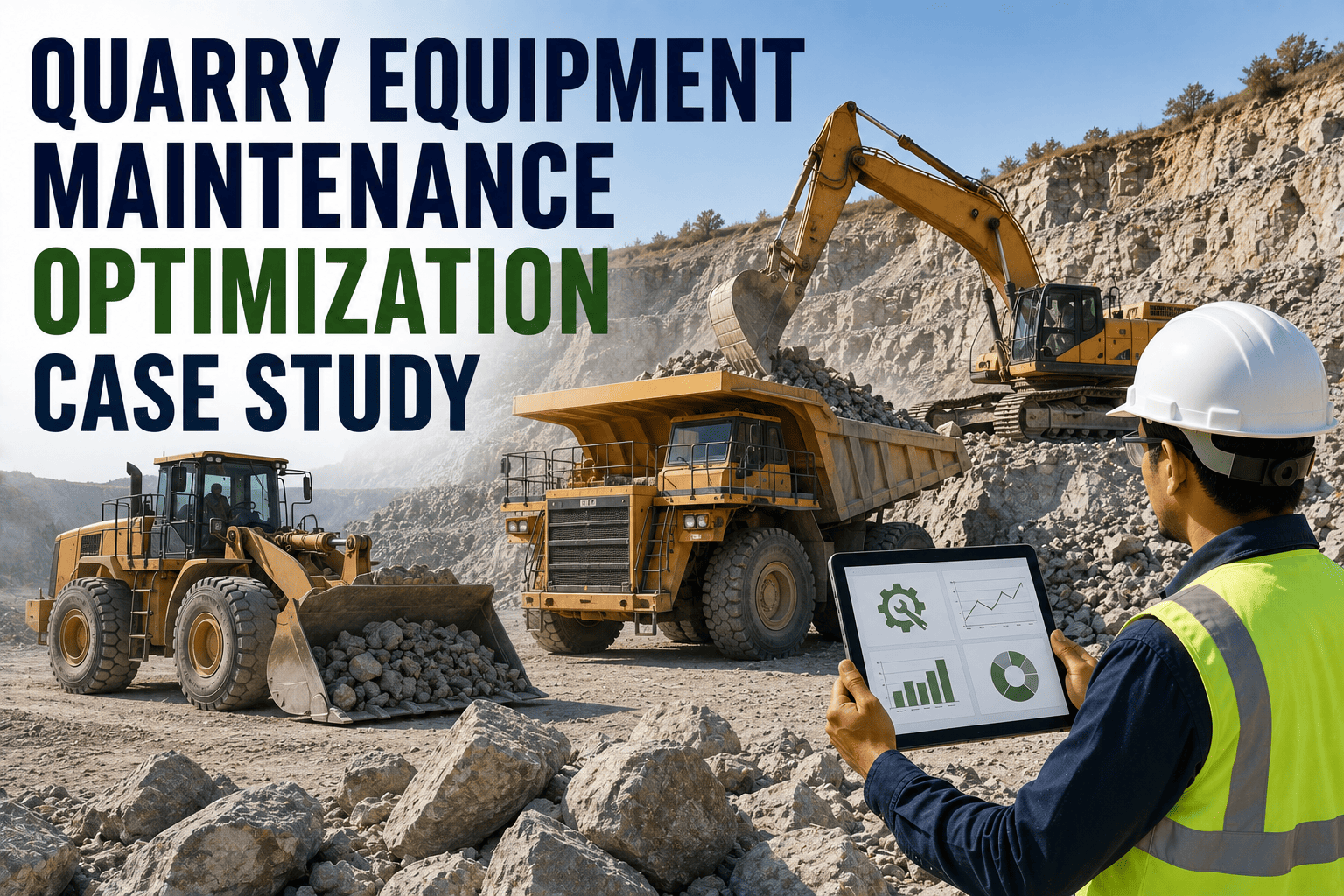
A cement plant's raw material supply starts at the quarry, and a quarry fleet that isn't available is a kiln that eventually runs short of feed. Excavators, haul trucks, drill rigs, and loaders work in dust, heat, and constant vibration, conditions that push maintenance schedules built on fixed intervals to fail in both directions, either servicing equipment too early or missing a failure that was building for weeks. This case study looks at how a quarry maintenance team used condition-based scheduling inside its CMMS to plan around real equipment data, and what happened to fleet availability, downtime, and maintenance cost. Sign up to see the same fleet maintenance workflow built for your own quarry.
The Challenge
Quarry equipment was serviced on fixed calendar intervals regardless of actual hours run or load conditions, so machines working double shifts got the same schedule as ones sitting idle. Breakdowns on haul trucks and excavators were common enough that dispatch kept a mental buffer of spare capacity just in case. Parts for older drill rigs were ordered reactively, which meant a failure could sideline a machine for days waiting on a component that should have been flagged weeks earlier.
Results After Moving To Condition-Based Fleet Maintenance
+21% Availability
Increase in fleet availability once servicing was tied to actual hours and condition instead of the calendar
-38% Downtime
Reduction in unplanned downtime across excavators, haul trucks, and drill rigs
-19% Maintenance Cost
Lower spend from fewer emergency repairs and parts ordered ahead of failure instead of after it
Availability Gains Across The Fleet
Excavators
+24%
Availability gain from tracking hydraulic and undercarriage wear trends
Haul Trucks
+19%
Availability gain from tyre, brake, and engine condition monitoring
Drill Rigs
+22%
Availability gain from parts pre-ordered against predicted failure windows
Loaders
+17%
Availability gain from servicing scheduled around actual operating hours
Fleet Availability: Fixed Schedule vs Condition-Based
Average fleet-wide availability across excavators, haul trucks, drill rigs, and loaders, measured before and after servicing moved from fixed calendar intervals to condition and hours-based scheduling.
Keep The Fleet Running, Not Waiting On Repairs
Oxmaint schedules quarry fleet maintenance around actual hours and condition data, so excavators, haul trucks, drill rigs, and loaders spend more time working and less time in the shop. Sign up for a free trial to build your own fleet maintenance workflow, or book a demo to walk through this case study in detail.
Quarry Fleet Maintenance Before And After
| Area |
Before |
After |
| Service scheduling |
Fixed calendar intervals applied regardless of actual hours run |
Based on real operating hours and condition trends per machine |
| Parts availability |
Ordered reactively after a breakdown, causing multi-day delays |
Pre-ordered against predicted failure windows before parts run out |
| Dispatch planning |
Built around a buffer of spare capacity to absorb breakdowns |
Built around confirmed machine availability from live condition data |
| Fleet-wide availability |
Roughly 68% across excavators, trucks, drills, and loaders |
89% and climbing, with fewer machines idle waiting on repair |
The Results
Dispatch stopped planning around the assumption that something would break. Every excavator, haul truck, drill rig, and loader had a live condition profile, so servicing happened when the data called for it rather than on a fixed date, and parts for predictable failures were already on site before a machine needed them. Quarry output stopped being the thing that slipped every time a machine went down unexpectedly.
Frequently Asked Questions
Q
Why do fixed maintenance intervals work poorly for quarry equipment?
Quarry machines rarely run the same hours or face the same load conditions, so a calendar interval either services a lightly used machine too often or misses wear building up on one running double shifts, both of which waste time or invite failure.
Q
Does quarry downtime really affect the cement plant itself?
Yes, the quarry supplies raw material to the kiln, so a fleet with low availability can eventually create a feed shortage at the plant, which makes quarry equipment reliability a production issue, not just a maintenance one.
Q
What condition data actually gets tracked for quarry equipment?
Typically operating hours, hydraulic and undercarriage wear on excavators, tyre and brake condition on haul trucks, and component wear on drill rigs, all logged against each machine so servicing and parts orders follow the actual trend rather than a guess.
Get More Uptime Out Of Every Machine In Your Fleet
Oxmaint tracks condition and hours for every excavator, haul truck, drill rig, and loader, so maintenance happens on the machine's schedule, not the calendar's. Sign up for a free trial to build your own fleet maintenance workflow, or book a demo to walk through the full case study.