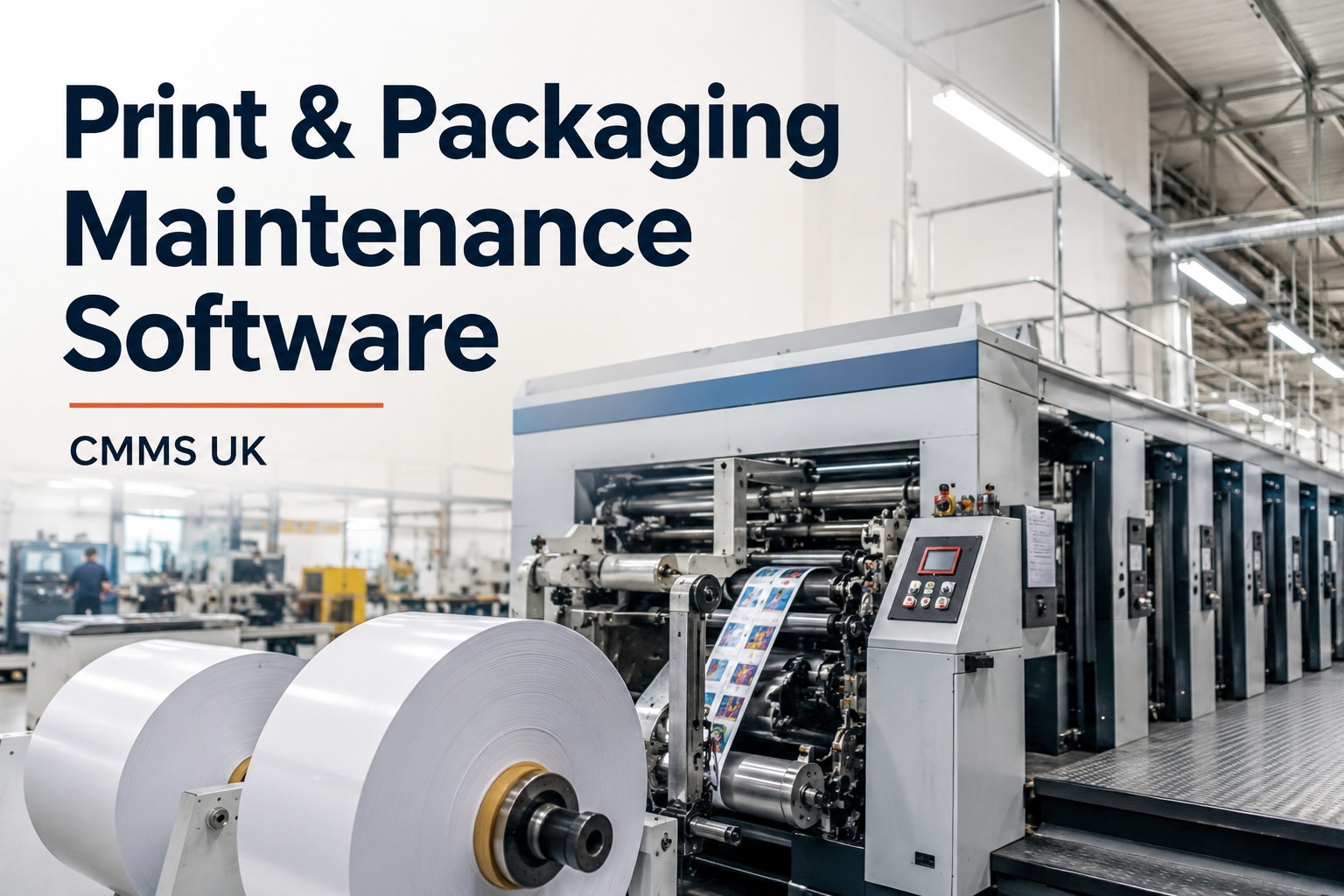
A modern printing or packaging plant runs at speeds that punish anything less than disciplined maintenance. A web offset press at 50,000 impressions per hour, a corrugator at 350 metres per minute, a flexo line changing over 12 times a shift — every cycle counts, every stoppage cascades. When a bearing fails on a printing tower or a knife wears past tolerance, it doesn't warn politely; it stops the line and puts customer deliveries at risk. Plants keeping OEE high run structured cycle-based PPM and defect capture on one platform. Book a demo to see press workflows live.
◆ PRINT · PACKAGING · CONVERTING · CYCLE-BASED PPM
Every press. Every cycle. Every impression counted. Maintenance timed to how the plant actually runs — not the calendar.
Every printing tower, every packaging line, every folder-gluer, every impression counter — under one throughput-driven maintenance system.
CYCLE-COUNT SIGNAL · WHY IMPRESSIONS BEAT DAYS
Web offset press
50,000
impressions / hour
Corrugator line
350
metres / minute
Flexo line changeovers
12+
per shift
A day in production = weeks of calendar-based wear
→
Cycle-based PPM wins
45min
Typical press stoppage cascade before recovery
18%
OEE uplift achievable with cycle-based PPM discipline
6-8
Distinct asset classes per typical converting plant
The Plant Architecture — Press to Palletiser as a Single Chain
A print or packaging plant isn't a collection of independent machines; it's a chain, and any weak link stops the flow. A working CMMS holds the whole chain — press, coating, laminating, converting, finishing, palletising — as one asset hierarchy, so cycle counts, PPM cycles and defects tie together rather than sitting in separate maintenance silos. Sign up free to hold the whole line as a single hierarchy.
PLANT ASSET HIERARCHY
One Chain · One Register · Every Class Tracked
01 · SUBSTRATE
Roll Handling
Unwinders · Reel stands · Splicers · Tension control
→
02 · PRINT
Press Towers
Offset · Flexo · Gravure · Digital · Ink management
→
03 · COAT / LAMINATE
Surface Finish
Varnish · UV · Lamination · Drying · Curing
→
04 · CONVERT
Cut & Form
Die-cutters · Slitters · Folder-gluers · Corrugators
→
05 · FINISH
Pack & Palletise
Case packers · Stackers · Palletisers · Wrap · Dispatch
Cycle-Based PPM — Why Impressions and Metres Beat Weeks
Calendar-based PPM ("service the press every 6 weeks") misses how presses actually wear. A press running 3 shifts hits its wear thresholds twice as fast as one running 1 shift. Cycle-based PPM triggers work when the counter reaches the manufacturer's specified impression, metre or hour threshold — matching maintenance to actual wear. Book a demo to see cycle-count trigger workflow live.
HOURS-BASED
Motor & Drive Servicing
Main drive motors, servo drives, pump systems · Manufacturer schedule against running hours · Oil, bearings, belts
Every 2,000 hours
IMPRESSIONS
Press Cylinder & Blanket Service
Blanket wash and replacement, plate cylinder clean, ink train service, doctor blade replacement
Every 5M impressions
METRES RUN
Web-Path & Tension Service
Idler rollers, tension sensors, splicer components, web guide sensors · Corrugator single-facer service
Every 500k metres
CYCLE COUNT
Cutter Die & Knife Change
Die-cutter forme change, guillotine knife regrind or replacement, slitter blade replacement · Wear-critical
Every 250k cycles
CHANGEOVER COUNT
Format-Change Component Service
Folder-gluer format parts, packer changeover kits, flexo cassettes · Wear driven by number of format changes not runtime
Every 500 changeovers
The Downtime Cascade — What a Single Stoppage Actually Costs
The cost of a press stoppage isn't the repair — it's the cascade. Setup lost, plate re-registration, ink balance recovery, waste sheets, customer delivery risk. Understanding the true cascade cost is what justifies investment in cycle-based PPM discipline and rapid-response defect workflow. The four cost tiles below are typical for a mid-size UK converting plant.
01 · REPAIR ITSELF
£300
Part + labour
Actual technical repair cost · Bearing, sensor, minor mechanical component
→
02 · SETUP LOST
£1,800
Plate re-register
Plate cylinder re-registration, ink balance recovery, colour match verification, waste sheets
→
03 · PRODUCTION LOST
£4,500
Missed impressions
45 minutes at 50k impressions per hour on a job priced at £120 per thousand impressions
→
04 · CUSTOMER RISK
£8-15k
Late delivery exposure
SLA penalty, next-run priority reshuffle, expedited freight, relationship damage
TYPICAL CASCADE · SINGLE PRESS STOPPAGE
£14,600 - £21,600
From a £300 repair · The cascade dwarfs the repair every time
◆ PRINT & PACKAGING DEMO
See the Full Plant Workflow in 30 Minutes
Press-to-palletiser asset hierarchies with cycle-count integration, hours/impressions/metres/changeover-based PPM triggers, defect capture on line, downtime cascade tracking and OEE reporting that engineering and production directors both act on.
Defect Capture on the Line — From Operator to Fix in One Workflow
Print and packaging plants live or die by how quickly a small defect surfaces before it becomes a stoppage. A rising bearing temperature, an ink train showing register drift, a folder-gluer skipping every hundredth carton — all warning signs the operator sees first. If capture is a paper log or a WhatsApp message to the engineer, it's already lost. A mobile-first defect workflow turns the operator into a sensor and the engineer into a first-responder. Sign up free to run mobile defect capture on your lines.
01
Operator Sees
Vibration change · Colour drift · Register slip · Sheet mark · Unusual noise · Anything off-normal on line
→
02
Mobile Capture
Scan press QR · Log defect with severity · Photograph · Attach to running job number · Timestamped
→
03
Triage & Route
Auto-classify against defect library · Route to duty engineer · Similar-defect history surfaced with root cause
→
04
Engineer Attends
Mobile work order · Part lookup · Historical fix notes · Sign-in on machine · Time to fix captures
→
05
Verify & Restart
Machine verified · Root cause logged · Job restart tracked · OEE data updated · Defect closed with pattern flag
Expert Perspective — Why Print & Packaging Plants Reward Data Discipline
"
Every print and packaging plant engineering director I've worked with has the same OEE story. They know their number — say 68 percent — and they know the theoretical target is 85. What they usually don't have is a data trail that connects specific stoppages to specific assets to specific root causes across enough shifts to see real patterns. Without that trail, every problem is a fresh incident and every fix is a workaround. With that trail, the same folder-gluer skipping every 100th carton is recognised as a repeat pattern with a documented root cause that's a five-minute alignment fix rather than a rolling operational headache. That's what a properly configured CMMS actually delivers in this sector — not just PPM scheduling, but a shift-by-shift defect record that turns operators into sensors and turns individual stoppages into a recognisable failure library. The plants that reach 80-plus percent OEE aren't running exotic technology; they've moved from tribal knowledge to structured data. The cycle-based PPM piece is important, but the defect-history discipline is what actually moves the OEE number.
— UK Print, Packaging & Converting Engineering Practice
01
Cycle-count PPM triggers
Hours, impressions, metres, cycles and changeovers each drive their own PPM triggers per asset — not one calendar.
02
Mobile defect capture
Operators log defects on mobile against running job · Timestamp, photo, severity · No lost paper logs.
03
Failure-pattern library
Defect history builds a searchable library per asset · Repeat patterns surface for engineering root-cause action.
04
OEE integration
Downtime, changeover and defect data flow into OEE analytics for engineering and production directors.
Who Uses Oxmaint in UK Print & Packaging
The platform is used by the UK roles that keep production lines running day-to-day: commercial and web offset print plant engineering directors, corrugated packaging plant maintenance managers running box and case production, flexible packaging producers with flexo and gravure lines, folding carton and label converters, industrial packaging manufacturers producing sacks and bags, food and beverage packaging suppliers with FMCG customer commitments, and print-and-mail operations combining printing with high-speed enclosure and dispatch. Engineering, operations and continuous-improvement directors all use it as their single source of asset, cycle-count and defect truth.
Getting Print & Packaging Maintenance Live in 30-60 Days
Deployment starts with the plant asset register — every press, converting machine, finishing line and support asset with manufacturer, model, install date, cycle-count baseline and criticality classification. Cycle-based PPM templates configure per asset with hours, impressions, metres, cycles and changeover triggers. Mobile defect capture deploys on the shop floor with QR-code asset identification. Failure-pattern library structural to defect closure. OEE integration configures with existing production system where available, or captures directly through the CMMS where not. Multi-plant templating rolls the configuration across estates. Most UK converters see press register, cycle-based PPM and mobile defect capture live within 30-60 days. Sign up free to scope your plant deployment.
◆ EVERY PRESS. EVERY CYCLE. EVERY DEFECT LOGGED.
One Plant. One Platform. Every Cascade Prevented.
Oxmaint gives UK print and packaging operators the full press-to-palletiser cycle in one platform — cycle-count PPM triggers, mobile defect capture, failure-pattern libraries, OEE integration and cascade-cost visibility for engineering and production directors.
Frequently Asked Questions
What is print and packaging maintenance software?
Print and packaging maintenance software is a CMMS configured specifically for high-speed press, converting and finishing plant. It holds each machine as a cycle-counted asset — impressions on presses, metres on corrugators and web lines, cycles on die-cutters and slitters, changeovers on folder-gluers and packers — and triggers PPM work based on manufacturer thresholds rather than the calendar. It integrates mobile defect capture on the line, builds a searchable failure-pattern library per asset, tracks cascade-cost impact per stoppage, and feeds OEE analytics that engineering and production directors both act on. Coverage spans commercial offset, flexo, gravure and digital printing, corrugated and folding carton conversion, flexible packaging, and finishing operations including case packing, stacking and palletising.
How does cycle-based PPM work in practice?
Every asset holds a set of cycle counters relevant to its wear profile — running hours, impression count, metres of substrate processed, cutting cycles, or format changeovers. Counter data ingests from the machine's own control system where API access is available, or captures via operator input on shift handover. PPM templates configure per counter and threshold ("service ink train every 5 million impressions", "regrind guillotine knife every 250k cycles", "swap folder-gluer format kit every 500 changeovers"). When the counter reaches the threshold, the work order raises automatically with materials pre-picked, technician allocation from the rota, and downtime scheduled in liaison with production planning. Missing thresholds surface as prominent alerts before wear becomes damage.
Can operators capture defects on mobile from the line?
Yes. Every asset carries a QR code that operators scan on their mobile device to raise a defect ticket in seconds — severity classification, defect type from a controlled library, photograph, attached to the running job number and timestamped. Auto-triage routes the ticket to the duty engineer with the machine's failure-pattern history surfaced (a defect logged as "register slip on tower 3" pulls up all previous register-slip incidents on that press with root causes and fix notes). Engineer arrival, work performed, time to fix and root cause capture on the same mobile work order. Restart verification closes the ticket and feeds OEE data. The complete defect chain replaces paper logs and lost WhatsApp messages with a searchable, structural record per asset.
Does it integrate with existing production and OEE systems?
Yes. Where a production execution system, MES or existing OEE platform is already in place, Oxmaint integrates via API to receive machine-state and cycle-count data and to push maintenance-driven downtime back into the OEE calculation with correct classification. Where no such system exists, the CMMS captures downtime, changeover and defect duration directly and calculates OEE natively per asset and per shift. Multi-plant templating rolls the OEE reporting structure across estates so engineering directors and continuous-improvement teams have consistent comparison data across all sites. The point isn't to replace an existing MES investment — it's to make sure maintenance-driven downtime and defect data flow into the OEE picture rather than sitting in a separate maintenance silo.
How long does deployment typically take for a UK converting plant?
A single mid-size UK converting plant (10-40 major assets across press, conversion and finishing) typically goes live within 30-60 days — plant asset register import with per-asset cycle counters and criticality, cycle-based PPM template configuration for hours/impressions/metres/cycles/changeovers, mobile defect capture deployment with QR-code asset identification, failure-pattern library setup, OEE integration configuration with existing production system where present, and mobile deployment to shop-floor operators and engineering teams. Multi-plant estates (national converters, packaging groups) typically complete within a quarter. Existing PPM schedule and asset data migration from legacy CMMS or spreadsheet systems is the largest single scoping variable, particularly where cycle-count baselines have not been previously maintained.