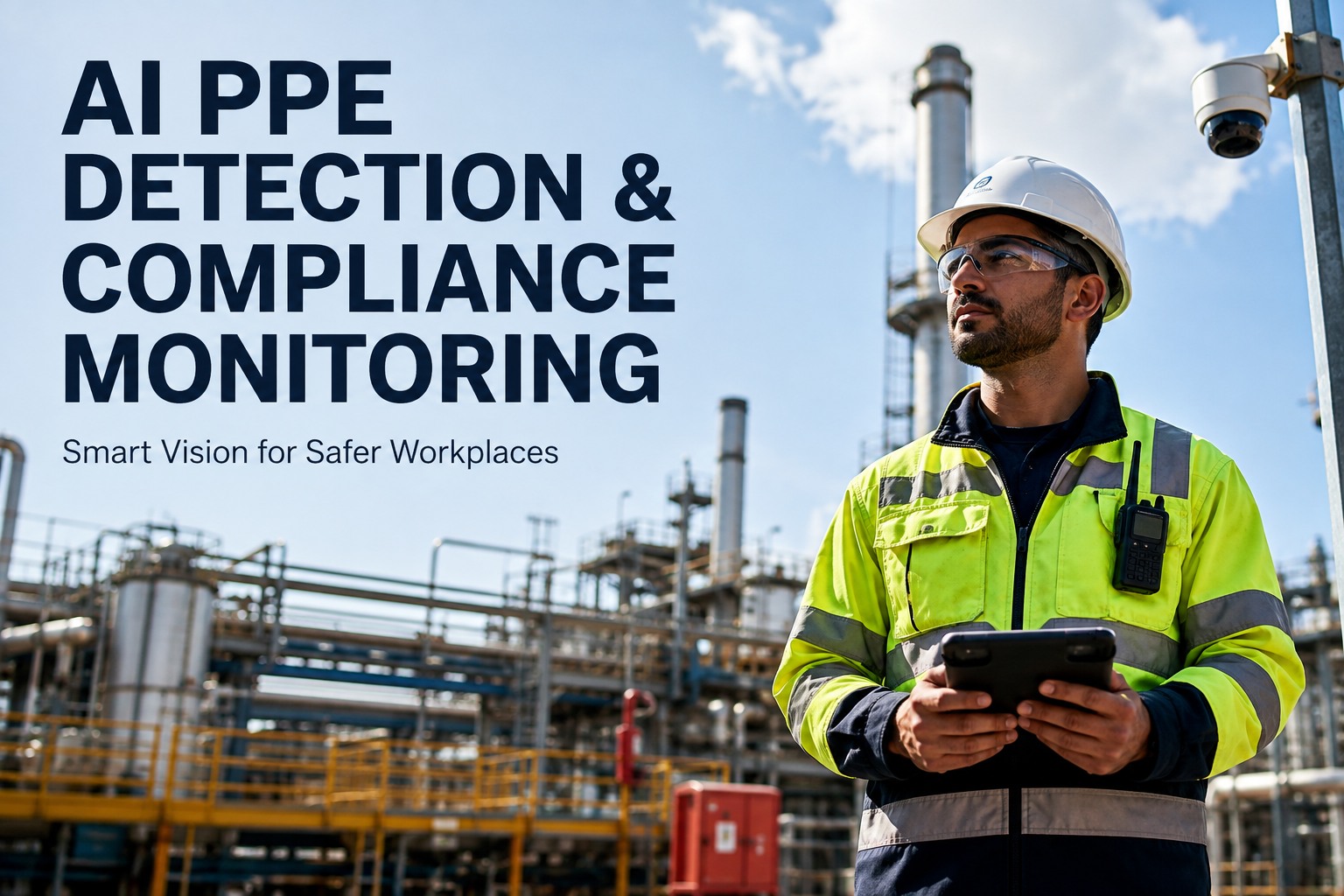
A PPE policy printed on a board doesn't protect anyone. What protects workers is the hard hat actually worn, the hi-vis on the shoulders, the safety glasses on the face. Manual spot checks catch a fraction of what happens across a full shift. Oxmaint AI Vision monitors your existing cameras continuously, detects missing PPE the moment a worker enters a defined zone, captures dated visual evidence, and identifies the recurring patterns — which area, which shift, which time — that drive genuine safety improvement. Book a demo to see AI PPE detection live.
96-97%
mean average precision for modern PPE detection models on hard hats, vests and eye protection at real production sites
<10ms
per-frame inference latency on edge hardware — fast enough for real-time zone entry alerts
15+
PPE item classes commercial systems now detect — from hard hats to fall-arrest harnesses
What the AI Actually Checks — Head to Toe
Modern PPE detection isn't just "hat or no hat". A well-trained model classifies each worker in-frame against the specific PPE requirements for the zone they're standing in, distinguishing between compliant, partially compliant (e.g. hard hat present but tilted or backwards), and non-compliant. The panel below shows the categories Oxmaint's model handles by default — the specific mix enforced per zone is configured from your existing safety policy.
PPE Detection Coverage — Head to Toe
Every category classified as compliant · partially compliant · non-compliant, against zone-specific requirements
Head protection
Hard hat presence, colour and orientation. Detects tilted, backwards or absent helmets. Colour classification for visitor / contractor / employee zone rules.
Eye protection
Safety glasses, goggles and face shields. Distinguishes protection worn correctly from pushed onto the helmet — a very common finding in grinding and welding zones.
Hi-vis clothing
EN ISO 20471 vests and jackets. Class 2 vs Class 3 classification, colour recognition (orange / yellow / green), reliable through partial occlusion by tools or posture.
Hand protection
Gloves across material types and colours. Zone-specific rules for cut-resistant, chemical, thermal or general-purpose glove requirements — enforced per handling zone.
Foot protection
Steel-toe and safety footwear detection where the camera angle gives floor-level visibility. Typically layered with hi-vis coverage in loading-bay and traffic zones.
Fall arrest & specialist
Full-body harness for work-at-height, respiratory protection in dust and fume zones, hearing protection in high-noise areas. Enforced against specific zone requirements.
Zone-Based Rules — Not Universal Alerts
Alerting on missing PPE anywhere on site produces noise. Alerting on missing PPE in the zones where it's actually required produces action. Oxmaint's zone-based rule engine maps each defined region of interest to its specific PPE requirements — so a worker in the office corridor doesn't trigger anything, a worker in the grinding zone without eye protection triggers an immediate alert, and a visitor without a blue visitor hard hat in the production area triggers an escalation to reception.
| Zone Type | Required PPE | Typical alert |
|---|
Production floor
General manufacturing |
Hard hat · hi-vis · safety footwear |
Missing hi-vis on operator → shift supervisor |
Grinding / welding cell
Hot work |
+ Eye protection · face shield · flame-retardant PPE |
Eye protection pushed up during active grinding |
Chemical handling
Reagent / decant areas |
+ Chemical gloves · goggles · apron |
Missing chemical gloves at decant point |
Work-at-height
MEWPs · roof · scaffolds |
+ Full-body harness · fall-arrest lanyard |
MEWP occupied without harness → immediate escalation |
Loading bay
Vehicle / forklift zone |
Hard hat · hi-vis (mandatory) |
Pedestrian in bay without hi-vis → forklift alert |
Visitor / contractor
Site entry |
Colour-coded PPE per role |
Contractor colour hard hat in restricted zone |
Zone rules are configured from your existing safety policy — not from a generic template. Sign up free to configure PPE zone rules for your site in the first setup session.
From Detection to Actionable Insight
Real-time alerts stop incidents in the moment. What actually drives sustained compliance improvement is the pattern data — which zone accumulates the most violations, which shift, which time of day, which specific PPE item. That's what makes the safety programme evidence-based rather than reactive. The dashboard-style view below shows the kind of compliance intelligence that emerges within the first few weeks of continuous monitoring.
Compliance Insights · Last 30 Days
Live
94.6%
Overall PPE compliance rate
+3.2% vs last period
28
Violations recorded
−41% vs last period
0
Serious injuries / SIF
In monitored zones
Pattern surfaced
Eye protection violations peak in the grinding cell 14:00-16:00. Root cause investigation surfaces unclear signage after the shift changeover — physical fix identified.
See AI PPE Detection Running on Your Own Cameras
Bring a sample RTSP feed — Oxmaint scopes zone rules, runs live detection, and shows you what the alerts, evidence packs and compliance dashboard look like on your actual site conditions. Thirty minutes.
Aligning With UK Regulation
PPE at work in the UK is governed by the Personal Protective Equipment at Work Regulations 1992 (as amended in 2022) — placing the duty on employers to assess risk, provide suitable PPE free of charge, and ensure it is properly used. AI vision doesn't replace the risk assessment or the training. It provides continuous documented evidence that the PPE selected under the risk assessment is actually being worn where required, which is exactly the evidence gap most sites carry between formal audits.
PPER 1992 (as amended 2022)
Extends the Regulations to limb (b) workers. Employer duty to assess, provide, maintain — and evidence that PPE is used as intended.
HSW Act 1974 · Section 2
General duty of care to employees. Continuous PPE compliance evidence supports the "so far as is reasonably practicable" standard.
EN ISO 20471
Hi-vis clothing classification. AI models distinguish Class 2 vs Class 3 garments so the correct type is enforced per zone.
CDM 2015 (construction)
Principal contractor duty to monitor site safety. Continuous vision monitoring provides documented compliance patterns for CDM records.
Expert Perspective — What Makes PPE Programmes Actually Work
Successful PPE programmes have never been about catching people out. They're about surfacing the root cause of every non-compliance — poor signage, sizing issues, PPE stored somewhere inconvenient, unclear zone boundaries — and fixing it. AI vision doesn't just alert on violations. Done well, it produces the pattern data that lets EHS teams stop treating symptoms and start fixing the underlying reasons compliance breaks down in specific places at specific times.
Root cause, not blame
Recurring violations in one zone point to a system problem — unclear signage, awkward PPE location, ambiguous zone boundary. Fix the system.
Zone rules over blanket alerts
Alerting on missing PPE everywhere produces noise. Alerting only where it's actually required produces credible signal that gets actioned.
Evidence supports the audit
Continuous compliance rate figures — hard numbers, not anecdote — carry weight with insurers, HSE inspectors and CDM reviewers.
Communication comes first
Deploying vision monitoring without workforce consultation destroys trust. Transparency about what's monitored and why makes it stick.
Who Uses AI PPE Detection in Practice
The workflow is used by the specific roles that carry safety-outcome obligations day-to-day: HSE managers running compliance evidence for insurers and HSE inspectors, site directors on construction projects tracking PPE compliance under CDM 2015, operations managers in warehousing and logistics reducing forklift-pedestrian incidents, and safety leaders in manufacturing shifting from periodic audits to continuous evidence-based programmes. Each role sees the same underlying camera-derived data filtered to their view — real-time alert dashboard, compliance trend report, or audit evidence pack. Sign up free to scope your PPE monitoring pilot, or book a walkthrough to see zone-based detection on your feeds.
Getting PPE Monitoring Live in 30 Days
Deployment moves through defined stages: DPIA and workforce consultation aligned to ICO guidance, site survey confirming which existing cameras are usable and where zone boundaries need drawing, model configuration for your specific PPE requirements per zone, and CMMS integration so alerts land as work orders rather than pop-ups nobody actions. Most single-site deployments cover 20-50 camera locations from initial survey to live monitoring inside 30 days. Sign up free to start the site survey conversation and get your deployment quoted inside the first week.
Move PPE Compliance From Anecdote to Evidence
Oxmaint AI Vision turns existing cameras into continuous PPE compliance monitors — zone-based rules, real-time alerts, dated evidence, and the pattern data that surfaces root causes for lasting improvement.
Frequently Asked Questions
Is AI PPE monitoring compatible with UK data-protection law?
Yes, when configured appropriately. Under UK GDPR and DPA 2018, workplace video monitoring is lawful where the employer has a legitimate interest (worker safety qualifies) and appropriate transparency, proportionality and data-minimisation measures are in place. Oxmaint supports blur/anonymisation of faces in evidence packs where the purpose is compliance monitoring rather than individual identification, retention policies aligned to your DPIA outcomes, and on-premises processing so footage doesn't leave the site. A workplace consultation with employees or their representatives is expected before deployment — not optional under ICO guidance.
Does the AI identify individual workers?
By default, no. The detection model classifies each person in-frame as a worker (compliant / partially compliant / non-compliant) without facial recognition or identity linking. That's typically what UK sites want — compliance evidence and pattern data without triggering the additional DPIA burden of biometric identification. Where role-based compliance is needed (visitor vs contractor vs employee), the workflow uses colour-coded PPE rather than facial recognition — visitor blue hard hats, contractor yellow, employee white, for example.
Can we use our existing CCTV?
In most cases, yes. Standard ONVIF-compliant IP cameras from Axis, Bosch, Hikvision, Hanwha and equivalent industrial brands work directly. What matters is camera placement (workers actually in frame at the zones you want to monitor), resolution (1080p or better for reliable PPE classification, typically usable up to 15 metres from the camera), and consistent lighting. Oxmaint's site survey confirms which of your existing feeds are usable and where new cameras or repositioning would materially improve detection accuracy.
How does the AI handle worker occlusion and clustering?
Occlusion is a known challenge — modern object-detection architectures (YOLOv8-class and above) handle partial worker occlusion substantially better than earlier generations, but a completely obscured worker can't be classified. In practice, deployment factors matter more than model choice: camera angles that avoid stacked worker positions, ROI definitions that focus on entry points to hazard zones (where workers pass through individually), and higher-density coverage in known problem areas. Oxmaint's scoping process addresses these placement considerations before deployment.
Does this replace safety walkarounds and audits?
No — and it isn't meant to. HSE-required inspections, formal audits under CDM 2015, insurer safety reviews and toolbox talks all continue. What AI vision replaces is the assumption that PPE compliance can be measured accurately from spot checks alone. Continuous monitoring provides the evidence baseline that formal audits are then benchmarked against, and produces the pattern data that lets safety walkarounds be targeted at the zones and times where issues actually cluster rather than randomised across the site.