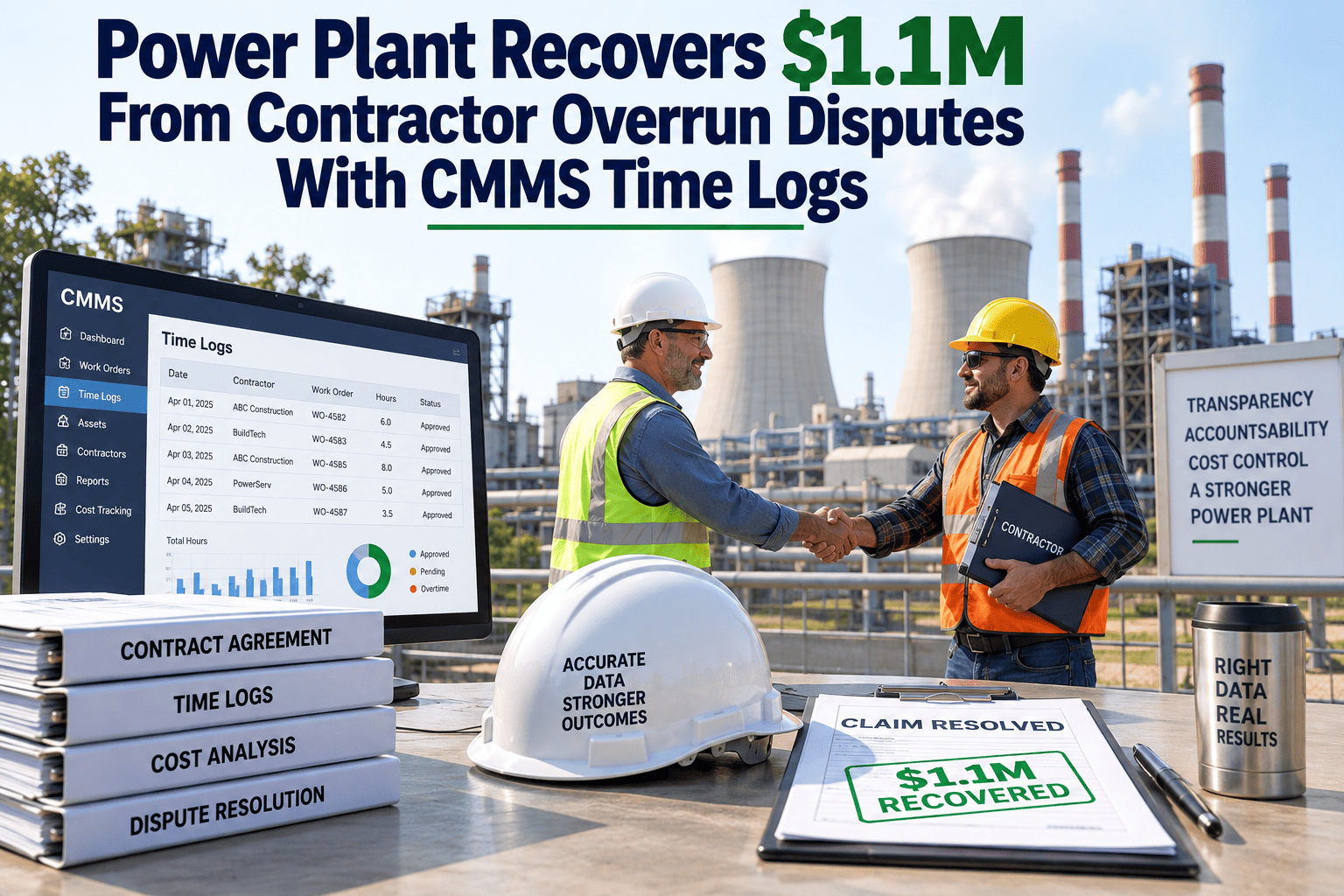
A contractor invoice for a planned outage rarely gets disputed line by line while the outage is still running. It gets disputed months later, when the final bill lands and the numbers do not match what anyone on site remembers. By then the only two sources of truth are the contractor's own time sheets and whatever the plant's maintenance team happened to write down, and one of those two sources was built specifically to justify the invoice. A UK power plant closed out a multi-contractor outage programme facing $1.1M in disputed time-and-materials charges across five separate contractor accounts, spanning padded labor hours, unapproved change orders, duplicate shift billing, and standby time billed as working time. Using timestamped work order records already sitting inside its maintenance platform, the plant rebuilt an evidence pack for every disputed line item and recovered the full $1.1M within three billing cycles, without a single claim going to arbitration or outside legal counsel. Here is how the evidence trail worked, category by category, contractor by contractor, and you can build the same trail on your next outage with OxMaint AI.
Case Study · Power Plant · Contractor Overrun Recovery
$1.1M Recovered From Contractor Overrun Disputes Using Time-Stamped Work Order Records
Five contractor accounts, one disputed invoice pile, and a maintenance platform that already had a timestamped answer for every hour, every change order, and every standby claim on the table, gathered from records the maintenance team was already creating during the outage itself.
$1.1M
total disputed contractor charges recovered across five separate accounts during outage closeout
5
contractor accounts with disputed time-and-materials charges resolved from the same evidence system
0
claims that required arbitration once timestamped work order evidence was presented
37%
Roughly a third of the disputed invoice value on this outage came from labor hours billed for periods where no corresponding work order existed in the plant's own maintenance records. Not fraudulent in every case. Sometimes a crew was rescheduled and the paperwork never caught up, sometimes a shift extension was verbal and never logged, and sometimes hours were simply rounded generously at invoice time. Whatever the cause, without a timestamped record on the plant's own side, every one of those hours defaulted to the contractor's number, because the plant had nothing to put against it. Arbitration over that kind of gap rarely favours the party with a weaker paper trail, and outage invoices are settled long after memory of a specific shift has faded, which is exactly why the record has to be built at the time, not reconstructed afterward.
Where the Disputed Charges Actually Came From
01
Time-and-Materials Hours With No Matching Work Order
Time-and-materials billing is common on outage work precisely because scope is fluid, but that flexibility only works in the plant's favour if every billed hour maps to a work order the plant itself created or approved. On this outage, several contractor time sheets showed labor hours on days and shifts where the plant's own work order log showed no active job for that crew, and with no internal record to compare against, those hours were effectively unchallengeable at invoice time. The gap was rarely one giant fabricated shift. It was usually a handful of hours here and there across dozens of shifts, small enough that no single line item looked worth fighting until the totals were added up at closeout.
02
Standby and Equipment-Down Time Billed as Working Time
Contractor crews and rented equipment sitting idle during a weather delay or a permit hold are usually billed at a reduced standby rate rather than a full working rate, but that distinction only holds if someone is recording when a crew actually went idle. Several invoices billed full working rates through periods the plant's own outage log showed as a documented hold, and without a timestamped record of exactly when the hold started and ended, the plant had no basis to challenge the higher rate. A four-hour weather hold billed at the working rate instead of the standby rate does not look dramatic on a single invoice, but across a multi-week outage with several contractors on site, those gaps compound quickly into a six-figure discrepancy.
03
Change Order Labor Billed Without Written Approval
Scope changes during an outage are normal, but a verbal go-ahead from a supervisor on the floor is not the same as an approved change order, and every contract on this outage required written sign-off before additional scope could be billed. Several change orders were billed as completed work with no corresponding written approval anywhere in the plant's records, leaving the plant to either accept the charge or dispute work it could not prove was unauthorised in the first place. In more than one case the extra work genuinely needed doing, which made it even harder to argue after the fact that it should never have been billed without a signature first.
OxMaint · Contractor Evidence Tracking
Build the Evidence Trail Before the Invoice Lands, Not After
Every work order, every approval, and every standby period timestamped and tied to the contractor account it belongs to, ready before closeout ever starts.
The $1.1M Recovery, Broken Down by Dispute Category
Once every contractor account had a full set of matching work orders, standby logs, and change order approvals behind it, the disputed total split cleanly into five categories. The largest single category, unmatched time-and-materials hours, accounted for more than a third of the entire recovery on its own, which is exactly why it is the first place worth checking on any contractor invoice review. Standby billing and unapproved change orders followed close behind, together making up almost half the disputed total, with duplicate shift billing and unverified material charges rounding out the smaller remainder.
Unmatched T&M labor hours
Standby time billed as working time
Unapproved change order labor
Duplicate billing across overlapping shifts
Materials billed without delivery record
How the Evidence Pack Closed Every Dispute
None of the four steps below required new software training or a separate reconciliation project. Every record already existed inside the maintenance platform from day one of the outage. The only new work at closeout was pulling the right records together by contractor account and presenting them in a format each contractor could not argue with.
Step 1
Pull Every Work Order Tied to the Contractor Account
Every work order the plant had created or approved for that contractor was filtered by account, date range, and crew, giving a complete internal record of what work the plant had actually authorised across the disputed period. This step alone took under an hour per contractor, since the records were already structured by account rather than scattered across shared drives and email threads.
Step 2
Compare Timestamps Against the Invoice Line by Line
Each billed hour on the contractor invoice was checked against the timestamped work order log for that same window, isolating exactly which hours had a matching internal record and which had none. Hours with a clear match were accepted immediately, which narrowed the actual dispute down to a much smaller set of genuinely contested line items instead of the entire invoice.
Step 3
Attach Standby and Approval Evidence to Each Flagged Line
For hours billed during a documented standby period, the outage log entry showing the hold start and end time was attached directly to the disputed line, along with any change order approval, or the lack of one, for scope-related charges. Where no approval existed, the flagged line was marked as disputed by default rather than accepted, shifting the burden of proof back onto the contractor instead of the plant.
Step 4
Present a Single Reconciled Evidence Pack per Contractor
Instead of a dispute letter arguing generally that an invoice seemed high, each contractor received a line-by-line reconciliation showing the exact work order, timestamp, or approval record behind every accepted charge and every disputed one, which is what kept every case out of arbitration. Every contractor settled within three billing cycles of receiving their reconciliation pack, well inside the payment terms most outage contracts allow.
What Changed Beyond the Dollar Figure
3
billing cycles was the longest any of the five contractors took to settle once the reconciled evidence pack was presented
100%
of the five disputed contractor accounts settled directly with the plant, with no claim escalated to arbitration, mediation, or outside legal counsel
5
dispute categories identified and fully evidenced from the same underlying work order, standby, and approval records already on file
Next Outage
the same account structure and approval workflow is now standard practice on every contractor engaged for planned outage work at this plant going forward
A dispute letter that says an invoice looks too high rarely moves a contractor. A line-by-line reconciliation with a timestamp behind every disputed hour almost always does.
Timestamped work orders, standby logs, and change order approvals, all tied to the contractor account they belong to, are what turn a billing argument into a closed dispute.
Contractor Billing Risk and How OxMaint Closes Each Gap
Every dispute category in this case study maps back to a contract clause that already existed, and to a piece of evidence the plant should have been capturing all along. The table below is the checklist this plant now runs against every contractor account before an invoice is approved, not after it is disputed, and it applies equally whether the contractor is on a time-and-materials rate, a fixed-price scope, or a hybrid arrangement covering both labor and materials.
Every outage before this one, we accepted the contractor's number because arguing against a time sheet with nothing of our own to show was a losing position, and legal costs alone made it cheaper to just pay the disputed amount than fight it. This time we had a work order and a timestamp for almost every hour on that outage, and the conversation with each contractor changed completely. We were not asking them to trust us. We were showing them the record, and none of them wanted to argue with their own approval trail.
Maintenance Manager, UK Power Generation Site
Frequently Asked Questions
How does OxMaint help catch billing that has no matching work order?
Every contractor account is filtered against the work order log by date, shift, and crew, so any billed hour with no corresponding authorised work order is immediately visible before an invoice is paid rather than months later at closeout.
Sign in to OxMaint to see how contractor work orders are tracked by account.
Can this evidence trail be built after an outage has already finished?
Yes, provided work orders, standby holds, and approvals were logged during the outage itself. The evidence pack in this case study was assembled at closeout from records already captured on site, not from a system set up after the fact, which is why the timing of adoption matters more than the timing of the dispute.
Does OxMaint replace the need for a written contract with standby and change order clauses?
No. The contract still defines what standby rates and change order approvals require, and legal counsel still interprets those clauses when a dispute is genuinely contested. OxMaint provides the timestamped evidence that proves whether those contract conditions were actually met for each billed hour.
How long does it take to set up contractor tracking before the next outage?
Most plants have contractor accounts, work order templates, standby-hold tracking, and change order approval workflows configured within a couple of weeks, well ahead of a typical outage planning cycle.
Book a demo to map a setup timeline against your next outage schedule.
Does this work across multiple contractors on the same outage at once?
Yes. Each contractor account, crew, and work order is tracked separately, so overlapping shifts, standby periods, and change orders across five or more contractors on the same outage stay attributable to the right account without manual cross-checking, which is exactly what made reconciling five accounts at once manageable in this case.
The Best Time to Build a Contractor Evidence Trail Is Before the Dispute, Not During It
Timestamped work orders, standby logs, and change order approvals, tied to every contractor account on the outage, ready the moment a billing question comes in rather than assembled under pressure once the dispute has already started.