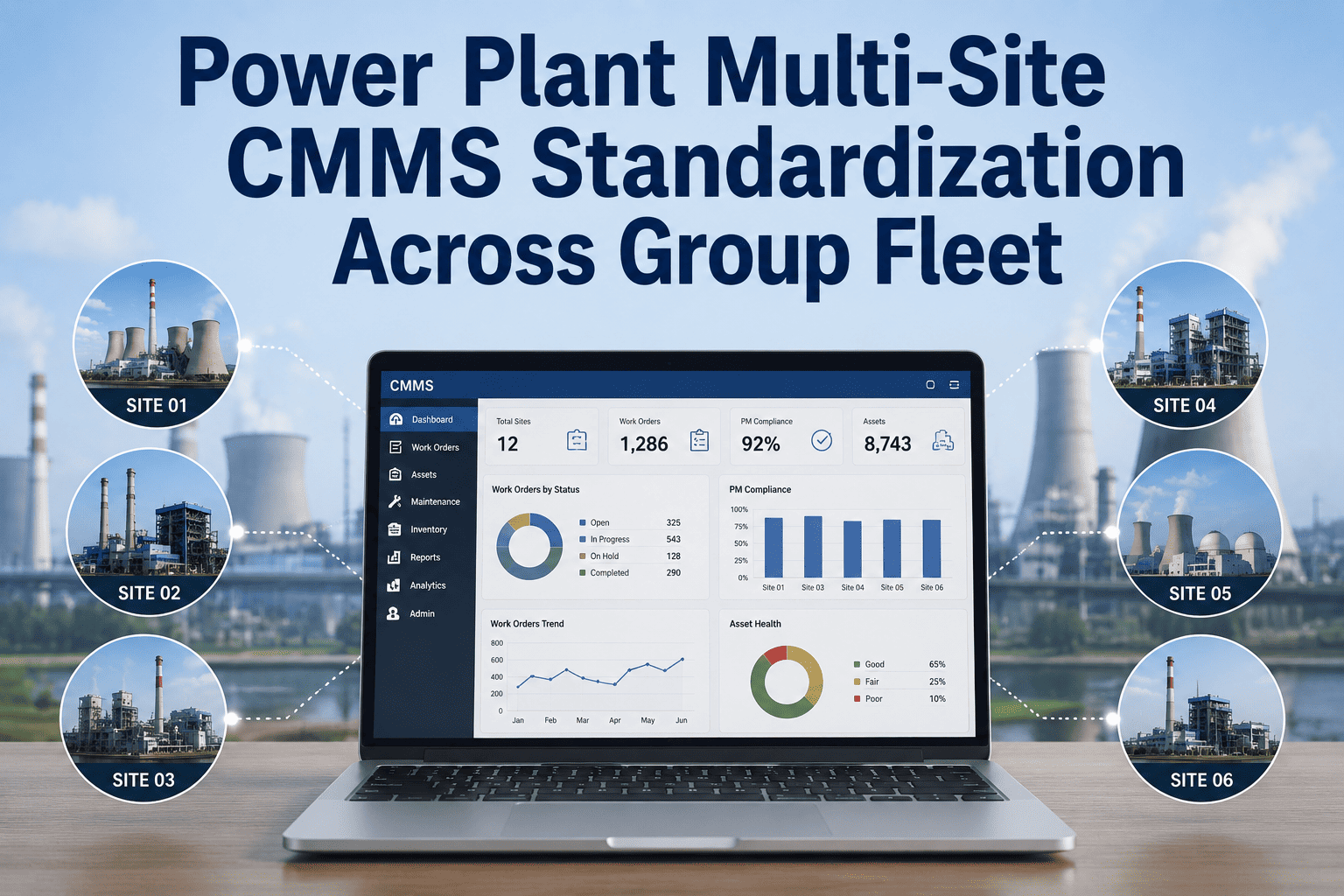
One station in the fleet reports 94% availability. Another, running the same turbine class, limps along at 71% — and nobody at group level can say why, because the two plants track maintenance in different systems, with different failure codes, and different definitions of what counts as downtime. Multi-site standardization is not about forcing every station to work identically. It is about giving corporate one comparable view while every plant keeps running its own floor. Sign up to see how a fleet-wide CMMS rollout looks across your own group of stations.
Why It Matters
Standardization fails the moment it feels like corporate surveillance. Force every plant onto identical procedures and local teams route around the system with spreadsheets by month three. The fix is a two-tier model: corporate defines the KPI definitions, failure codes, and mandatory inspection points that make plants comparable, while each station keeps the autonomy to run its own PM schedules, add site-specific steps, and manage its own crews.
Where The Line Sits Between Corporate And Plant
Getting this split right up front is what determines whether a rollout gets adopted or quietly ignored six months later.
Corporate Owns
KPI definitions (MTTR, MTBF, backlog, availability), unified failure and asset taxonomies, group-wide dashboards, and audit-ready compliance reporting across every station.
Plant Retains
Day-to-day PM scheduling, local crew assignment, site-specific inspection steps for unique equipment configurations, and the freedom to run shifts the way that plant actually operates.
A Rollout In Waves, Not A Big Bang
1
Standardize The Taxonomy First
Unified failure codes, asset classes, and KPI definitions get agreed across the group before any software goes live — without this, even the best CMMS produces a different flavor of data at every station.
2
Pilot At One Or Two Stations
Choose plants with receptive management and solid IT infrastructure. Validate the taxonomy, KPI dashboards, and PM templates before anyone else in the group has to live with them.
3
Scale With A Champion
A respected maintenance director advocating for the platform, backed by training materials and best practices from the pilot, moves the remaining stations far faster than a corporate mandate alone.
4
Steer It, Don't Set It And Forget It
A bi-weekly steering committee reviews deployment progress, surfaces best practices from early-adopter plants, and keeps refining PM templates as the rollout scales across the fleet.
Most groups complete initial deployment across all sites within four to six weeks, with full KPI dashboards live within 90 days — the pace depends mainly on how much existing PM documentation needs standardizing, not on the software itself.
One System, Role-Based Views
Corporate reliability teams see fleet-wide dashboards. Plant managers see their station's performance. Technicians see only their assigned work orders. Nobody gets buried in data that isn't theirs to act on. Sign up for a free trial to configure your first station, or book a demo to see the group view mapped to your fleet.
Where Fleet Rollouts Stall
Software Rolled Out Before Taxonomy
Every station starts logging failures its own way, and group-level comparison becomes impossible from day one
Big-Bang Launch Across All Sites
No pilot to catch config issues means every mistake gets repeated at every station simultaneously
No Local Autonomy Preserved
Corporate mandates every field and every step, and plant teams quietly revert to spreadsheets within months
No Steering Committee
Nobody owns the rollout past go-live, so best practices from the pilot never reach later sites
Permissions Left Flat
Every user sees every plant's data, so nobody trusts the system to keep local operations private
Cross-Plant Wins Never Captured
Shared inventory, shared learnings, and shared procurement savings go unrealized because no one is looking across stations
Frequently Asked Questions
Q
Can individual stations keep their own procedures while feeding group reporting?
Yes, and this is by design. Corporate defines mandatory inspection points and how KPIs are calculated, while each station retains the ability to add site-specific steps for local conditions, equipment configurations, or regulatory requirements.
Q
How long does a fleet-wide rollout actually take?
Most groups complete initial deployment across all sites within four to six weeks on a rolling schedule, with full KPI dashboard functionality live within 90 days. The timeline depends mostly on asset data migration and how much existing PM documentation needs standardizing.
Q
Does SSO handle permissions across plants, or is role-based access still needed?
No, SSO only confirms who a user is through your corporate identity provider. Role-based permissions then control what they can see and do inside the CMMS — which stations, shifts, and modules they can access — and both layers are needed together.
One Comparable View Across Every Station In The Fleet
Oxmaint standardizes failure codes, asset taxonomies, and KPI definitions across your group while every plant keeps the autonomy to run its own PM schedules and crews — so corporate finally sees one number, not eighteen versions of it. Sign up for a free trial to configure your pilot station, or book a demo to see fleet-wide reporting mapped to your group.