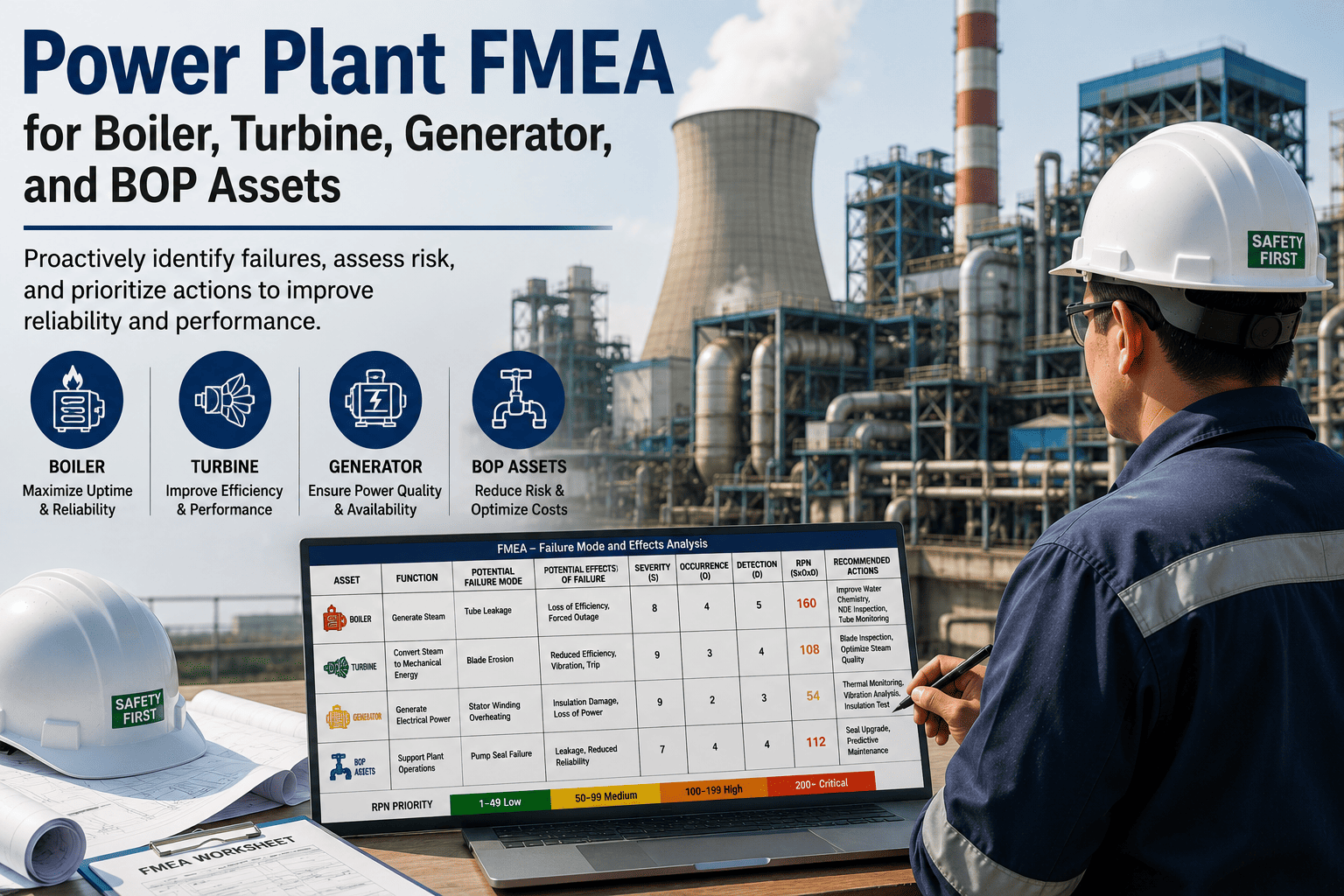
A boiler tube leak, a turbine blade crack, a generator winding fault, and a failed BOP pump don't carry the same risk, even if each one stops the unit. FMEA is how a plant tells those four apart before any of them happen, ranking failure modes by how severe they are, how often they occur, and how likely they are to be caught in time. Sign up to run FMEA across boiler, turbine, generator, and balance-of-plant assets and route every high-RPN failure mode straight into a CMMS work order.
Why It Matters
A power station has thousands of components that could fail, and no maintenance budget covers all of them equally. FMEA exists to sort failure modes by actual risk instead of by which system happens to be loudest about a problem that quarter. Done properly, it turns a long list of "things that could go wrong" into a short list of what to inspect, monitor, or redesign first — and a documented reason for every item on that list.
The Four Numbers Every FMEA Produces
Every failure mode entered into an FMEA gets scored the same way, whether it's a boiler drum crack or a lube oil sensor fault. The scoring is what makes wildly different assets comparable on one priority list.
Severity
How serious the consequence is if the failure happens — safety impact, environmental release, or generation loss, rated on a fixed scale.
Occurrence
How often that failure mode has actually happened or is expected to happen, based on history and known degradation rates.
Detection
How likely current inspection, monitoring, or alarms are to catch the failure before it progresses to a forced outage.
RPN
Severity multiplied by occurrence multiplied by detection — the single ranking number that decides what gets attention first.
How Failure Modes Differ By System
Boiler, turbine, generator, and BOP assets fail in different ways and get caught by different means, which is exactly why a single plant-wide FMEA has to treat each system on its own terms rather than applying one generic checklist.
| System |
Typical Failure Mode |
Primary Detection Method |
| Boiler |
Tube wall thinning, creep cracking |
Ultrasonic thickness testing, visual inspection |
| Turbine |
Blade fatigue cracking, bearing wear |
Vibration monitoring, borescope inspection |
| Generator |
Winding insulation breakdown |
Partial discharge testing, insulation resistance checks |
| Balance Of Plant |
Pump seal leakage, valve seat wear |
Routine operator rounds, condition alarms |
Turn Every High-RPN Failure Mode Into A Work Order
Oxmaint links each FMEA entry to the asset it describes and routes high-priority failure modes directly into scheduled inspections and work orders, so the analysis doesn't sit in a spreadsheet after the workshop ends. Sign up for a free trial to run it on your own assets, or book a demo to see it set up for your plant.
Where FMEA Programs Break Down
Scores Set Once, Never Revisited
Occurrence and detection ratings from years ago left unchanged as actual failure history accumulates
High-RPN Items Never Actioned
The workshop identifies top risks but no work order or inspection plan is ever created from them
Analysis Lives In A Spreadsheet
The FMEA sits disconnected from the CMMS, so maintenance planning never actually references it
Inconsistent Scoring Across Teams
Boiler, turbine, and BOP teams each rate severity differently, making RPN scores impossible to compare
Detection Rated On Assumption
Detection scores based on what inspection is supposed to happen, not what actually happens in practice
No Link Back To Root Cause
A failure mode is logged without the underlying cause it traces back to, so mitigation targets the symptom
Frequently Asked Questions
Q
What does RPN actually mean in a power plant FMEA?
RPN, or Risk Priority Number, is severity multiplied by occurrence multiplied by detection. It's the single score used to rank failure modes against each other across completely different systems, from a boiler tube to a BOP pump seal.
Q
Why do boiler, turbine, and generator FMEAs need different detection scoring?
Each system is monitored by different methods with different reliability — ultrasonic thickness testing catches boiler wall thinning very differently than vibration monitoring catches a turbine bearing fault, so detection ratings have to reflect the actual method used, not a generic assumption.
Q
Is an FMEA workshop finished once the RPN scores are calculated?
No — the scores only create value once high-RPN failure modes are turned into actual inspection tasks or work orders. An FMEA left as a static spreadsheet after the workshop protects nothing.
Move From A Static FMEA To A Living Reliability Plan
Oxmaint keeps severity, occurrence, and detection scores tied to real inspection and failure history across boiler, turbine, generator, and BOP assets, so RPN reflects what's actually happening on the plant. Sign up for a free trial to run it on your own fleet, or book a demo to see it configured for your systems.