Every maintenance decision in a power plant sits on top of an asset hierarchy — whether or not that hierarchy is written down anywhere. When it only exists in the heads of senior engineers, reliability programmes stall quietly: work orders can't be tracked to the right equipment level, failure data can't be aggregated across similar assets, and a RAM model has no structural foundation to stand on. ISO 14224 gives power plants a globally recognised way to fix that. Sign up to build your asset register against the ISO 14224 taxonomy in one CMMS.
Why It Matters
A pump failure logged against "the pump" is nearly useless for reliability analysis. A pump failure logged against a defined equipment unit, with a standardised failure mode, tied to a system boundary, is data that can feed a reliability block diagram. ISO 14224's taxonomy is what makes the difference — it connects a raw work order to asset function and maintenance strategy through a consistent, top-down classification that every part of the organisation reads the same way. Without it, every plant's maintenance history is its own island, incomparable to any other site or any industry benchmark.
Location Levels vs Equipment Levels
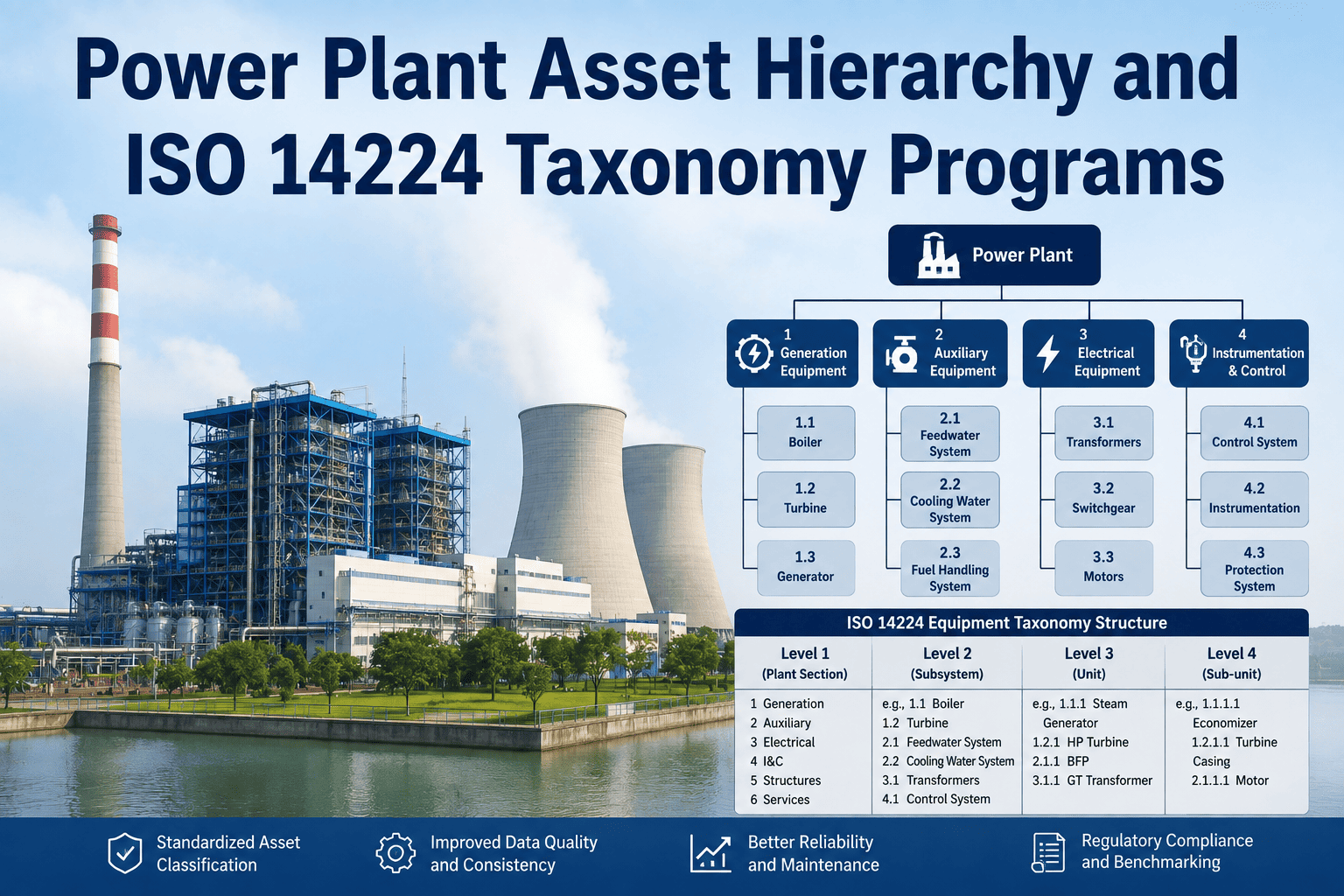
ISO 14224's full taxonomy runs nine levels, but they split cleanly into two groups — where an asset sits, and what an asset actually is.
Location Levels (1-5)
Industry down to section or system — this is the five-tier structure most power plants build their CMMS site hierarchy around first.
Equipment Levels (6-9)
Equipment unit down to individual part — this is where failure codes and maintainable items actually get recorded.
Parent-Child Rule
Every child asset belongs to exactly one parent, which is what turns a flat equipment list into a true hierarchy.
The location levels answer where an asset physically sits and which system it belongs to, the equipment levels answer what the asset is down to the maintainable item, and the parent-child rule is what keeps every level connected instead of becoming a disconnected spreadsheet.
The Five-Tier Registry In A Power Plant CMMS
| Tier |
Represents |
Example |
| Site |
The physical location or installation |
A specific power station |
| Plant / Unit |
A generating unit within the site |
Unit 2 combined cycle train |
| Section / System |
A functional system within the unit |
Cooling water system |
| Equipment Unit |
The individually tagged asset |
Centrifugal pump P-101 |
| Maintainable Item |
The component that gets replaced |
Mechanical seal, bearing |
Turn Scattered Records Into Structured Reliability Data
Oxmaint enforces the ISO 14224 hierarchy at the point of data entry, so every work order, spare part, and failure code links back to the correct asset tag automatically. Sign up for a free trial to run it on your own register, or book a demo to see it configured for your plant.
Where Asset Hierarchy Programs Break Down
No Assigned Data Owner
No one accountable for keeping a system boundary's classification correct over time
Custom Taxonomy Invented
Site-specific naming built from scratch instead of mapping to the recognised standard
Orphaned Work Orders
Maintenance history logged against equipment that was never properly registered
Failure Codes Missing
Work orders closed with free-text notes instead of standardised failure mode codes
New Assets Misclassified
Equipment added to the register without checking it against the parent hierarchy
RAM Models Have No Base
Reliability analysis attempted on top of failure data that was never structured
Frequently Asked Questions
Q
Is ISO 14224 only meant for oil and gas facilities?
It was formally developed for the petroleum, petrochemical, and natural gas industries, but its taxonomy and hierarchy logic are generic enough that power, utilities, and other asset-intensive sectors widely adopt it as a best-practice framework for the same reason — comparable, structured reliability data.
Q
Do we need all nine ISO 14224 levels to get value from the standard?
No. Most plants start with a practical subset — commonly five working levels from site down to equipment unit — and add finer maintainable-item detail only where the reliability program actually needs it. The right number of levels is whatever lets the team plan work and analyse failures effectively.
Q
Why does an asset hierarchy degrade without ongoing governance?
New equipment gets added, technicians take shortcuts under time pressure, and without a named data owner running regular audits, classification drift creeps in quietly. A hierarchy that was correct at commissioning can be unreliable within a year if no one is checking it.
Give Your Failure Data A Foundation It Can Stand On
Oxmaint keeps the asset register, failure codes, and system boundaries tied to their evidence in one auditable log, so proving your maintenance data is structured doesn't mean untangling a spreadsheet someone built years ago. Sign up for a free trial to run it on your own register, or book a demo to see it configured for your team.