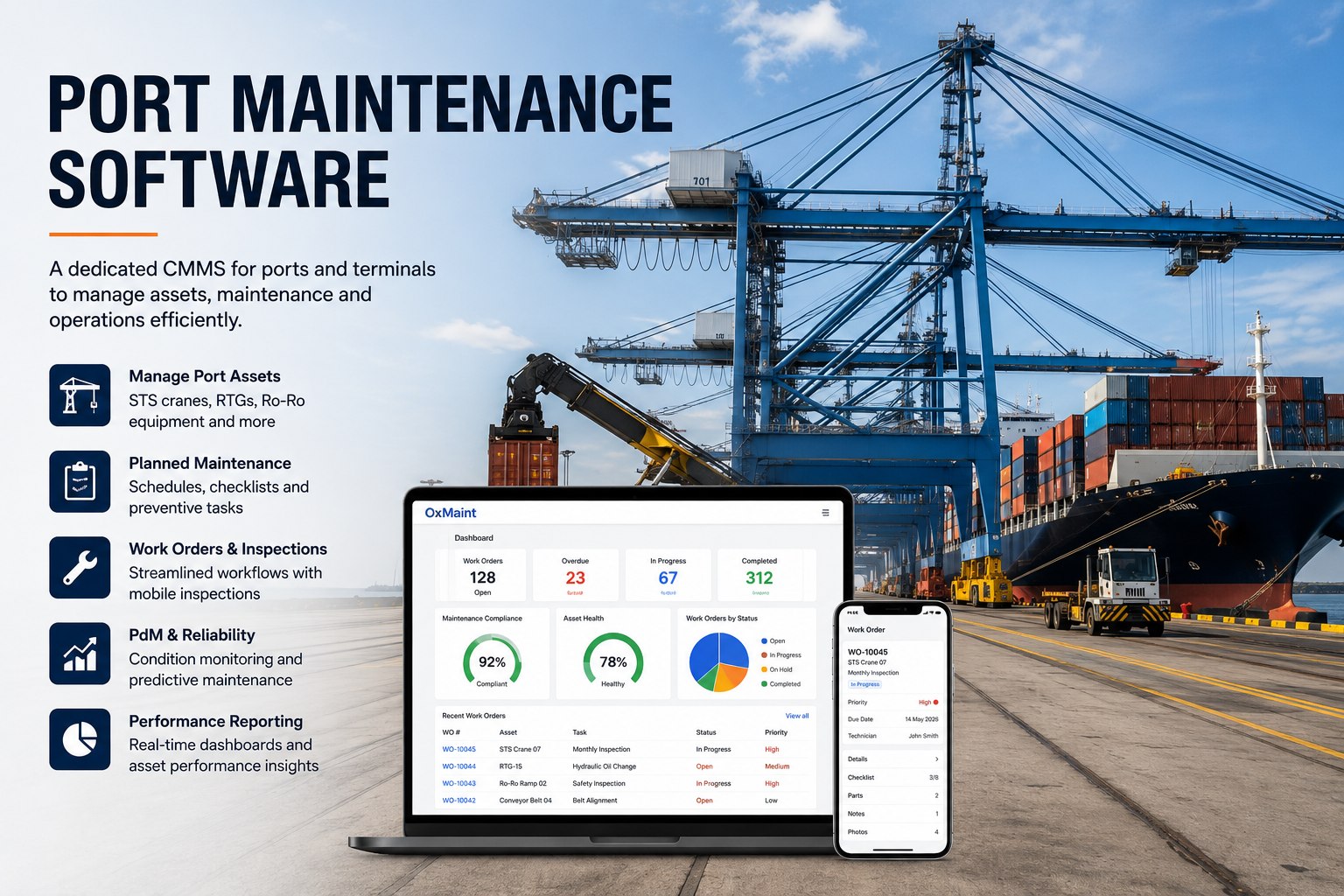
UK ports move £500 billion of trade a year. Every hour of downtime at a container berth costs the operator and the shipping line — port productivity is measured in moves per hour, and every unplanned STS crane stoppage ripples through the schedule. Marine environments corrode faster, gantries run 24/7, RTG stacks never sleep, and equipment operates at scale most industrial sites never see. Port maintenance isn't a support function — it's the throughput ceiling of the entire terminal. Book a demo to see port maintenance workflows in action.
◆ PORT ENGINEERING · TERMINAL OPERATIONS · 24/7 UPTIME
One stopped STS crane can hold a container ship in the berth for hours. Port maintenance is measured in vessels waiting.
Every crane. Every RTG. Every reach-stacker and Ro-Ro tractor. Under a single asset system that runs at berth speed.
£500bn
Annual UK port trade throughput
30mph
STS crane target moves-per-hour benchmark
24/7
Duty cycle across major container terminals
The Terminal Fleet — What Actually Sits on the Asset Register
The scale problem in port maintenance is that "terminal equipment" is not one asset class — it's five or six overlapping fleets, each with different examination regimes, different spares chains, different failure modes, and different downtime consequences. The register that a port CMMS has to hold looks like this on any medium container terminal.
QUAYSIDE
STS Container Cranes
Ship-to-shore gantries — the throughput bottleneck of every container berth. Boom, trolley, spreader, hoist, gantry rails.
STACK YARD
RTG / RMG Cranes
Rubber-tyred and rail-mounted gantries stacking containers 5-6 high in the yard. Diesel or e-RTG with cable reels.
HORIZONTAL
Reach Stackers & Empty Handlers
Kalmar / Konecranes / SANY vehicles for container repositioning, empty stacks, hinterland transfer.
RO-RO
Terminal Tractors & Trailers
Trailer tugs, MAFI trailers, dock rams. High-duty vehicles running vessel-to-yard cycles at Ro-Ro berths.
FIXED PLANT
Conveyors, Silos & Bulk Handlers
Bulk terminal belts, shiploaders, unloader grabs, silos, dust extraction. Continuous-flow assets serving bulk berths.
INFRASTRUCTURE
Berth & Landside Assets
Fenders, bollards, quay walls, mooring equipment, weighbridges, reefer racks, high-mast lighting, drainage.
Inside the STS Crane — Where Maintenance Actually Happens
The STS ship-to-shore is where port maintenance either lives or dies. It's the single most complex asset on the quay, the single most expensive to have offline, and the single most heavily regulated (LOLER, PUWER, thorough examination cycles, wire rope inspection, structural surveys). A working port CMMS has to hold the STS not as one asset but as a nested register of subassemblies with their own examination and PPM lives.
STS ASSET ANATOMY
Subassembly · PPM Frequency · Failure Consequence
Weekly wire rope · 6-mo LOLER
Load drop · CATASTROPHIC
Monthly · Bearings / wheels
Trolley stall · HIGH downtime
Per-shift check · Weekly PPM
Container drop · CATASTROPHIC
Boom & Hoisting Structure
Structural annual · NDT cyclical
Fatigue crack · CATASTROPHIC
Thermographic quarterly
Drive trip · Operation halt
Rail survey annual · Bogies quarterly
Derail · HIGH downtime · Injury risk
The Marine Environment — Why Port Corrosion Changes the PPM Plan
Every port CMMS has to solve one problem that inland industrial sites don't face: chloride-driven atmospheric corrosion at scale. Salt-laden air, wind-driven rain, splash zones on quay-wall infrastructure and cyclical wetting on stacked containers create a corrosion category (ISO 12944 C5-Marine) that eats through paint systems, wears out fasteners, degrades cable insulation and shortens the safe examination life of load-bearing steelwork. Preventive maintenance intervals set for inland duty are wrong at a port. Sign up free to run marine-adjusted PPM across your terminal fleet.
ISO 12944 · CORROSIVITY
Marine Environment PPM Adjustment
C5-M
Very High Marine
Splash zones, tidal fenders, sea-facing steelwork on the outer berth face. Continuous salt-water contact or spray.
PPM adjustment · Coating inspection quarterly · Cathodic protection continuous
CX
Extreme Offshore
Berthing structures with prolonged immersion or heavy chloride loading. Applies to certain jetty and pontoon assets.
PPM adjustment · Specialist marine coating regime · UT thickness monitoring
C4
High — Industrial/Coastal
Landside terminal assets exposed to salt-laden air but not direct spray. STS gantry structures, RTG upperworks, high-mast lighting.
PPM adjustment · Coating survey 6-monthly · Fastener replacement schedule
C3
Medium — Sheltered Landside
Terminal-back assets shielded from prevailing wind. Yard reach-stackers when garaged, workshop plant, hinterland equipment.
PPM adjustment · Standard inland interval with salt-wash cycles
◆ PORT MAINTENANCE DEMO
See the Full Terminal Workflow in 30 Minutes
STS and RTG hierarchies with subassembly-level PPM, LOLER thorough examination scheduling, marine-adjusted coating cycles, work-order dispatch to berth teams, PdM sensor integration, spares chain and audit-ready evidence packs.
Predictive Maintenance on the Quay — What Actually Moves the Needle
Predictive maintenance in port operations isn't about adding sensors to everything. It's about focused deployment on the failure modes that halt berth productivity most expensively. Wire rope condition monitoring on STS hoists. Vibration analytics on RTG travel motors and gearboxes. Thermographic scanning of VFDs and switchgear. Structural monitoring on aging gantry cranes. Oil analysis on reach-stacker and terminal-tractor fleets. The pattern that works is a hybrid maintenance plan: standard PPM cycles for the fleet, condition-based intervals for the critical subassemblies whose failure would stop a berth, and PdM sensor telemetry for the two or three highest-consequence rotating assets on the terminal. Sign up free to deploy hybrid PPM and PdM across your terminal.
Wire Rope Monitoring
STS main hoist & boom ropes
Magnetic flux leakage sensors detect broken wires and cross-section loss before visual inspection catches them. Prevents load-drop scenarios and extends discard-decision windows.
Vibration Analytics
RTG travel & hoist motors
Bearing defect frequencies picked up weeks before audible failure. Highest-ROI PdM deployment across a port because RTG travel motor failures halt entire yard blocks.
Thermographic Scanning
VFD cabinets, switchgear, connections
Hotspot detection on high-current electrical systems prevents cable and connection failures that would take crane control systems offline for extended repair windows.
Oil Analysis Programme
Terminal tractors, reach stackers
Wear-metal spectroscopy on engine, transmission and hydraulic oils detects internal wear signatures — extends drain intervals safely and forecasts component replacement.
Expert Perspective — Why Terminal Maintenance Is Different
"
Ports are one of the very few operating environments where every hour of maintenance downtime has a hard, quantifiable cost measured in vessel time and lost moves. Land-based industrial maintenance can defer a work order overnight and pick it up tomorrow — a berth engineer can't, because a stopped STS on a Panamax discharge is money burning in real time. What this changes about the CMMS choice is that the system has to run at the pace the terminal runs at. Work orders raised on the quay have to land in the right technician's hand in seconds. Spares availability has to be a query, not a phone call. LOLER dates have to be visible before the vessel schedule commits to a berth. And condition data from the sensors that matter — hoist ropes, RTG motors, VFD cabinets — has to translate into planned intervention windows before it becomes an unplanned stoppage. Ports that solve that pattern hold their berth productivity through the vessel schedule; ports that don't lose it one incident at a time.
— Port Engineering & Terminal Operations Practice
01
Subassembly hierarchy
Every STS, RTG and reach stacker held as a nested asset with PPM and examination cycles at the subassembly level.
02
LOLER-integrated scheduling
6-monthly thorough examinations tied to asset records with automated reminders and CP report ingestion.
03
Marine-adjusted PPM
Every fixed asset tagged with ISO 12944 corrosivity so intervals scale to environment, not to inland defaults.
04
Mobile at berth-speed
Fault raise and work-order dispatch on the quay in seconds. Berth teams work in the app, not on paper.
Who Uses Oxmaint at UK Ports and Terminals
The platform is used by the UK operational roles that own terminal engineering on the ground: port engineering managers running STS and RTG fleets across container berths, maintenance managers coordinating LOLER thorough examinations with third-party CPs, workshop supervisors managing reach-stacker and Ro-Ro tractor service cycles, terminal reliability engineers deploying condition monitoring on critical rotating assets, planning engineers slotting PPM around vessel schedules, bulk terminal engineers running shiploader and conveyor infrastructure, and asset directors reporting equipment availability and berth productivity to terminal boards. Sign up free to configure port maintenance for your terminal.
Getting Terminal Maintenance Live in 45-90 Days
Deployment starts by importing the terminal asset register — STS, RTG, reach stackers, terminal tractors, conveyors, fixed infrastructure — with subassembly hierarchies built out for critical cranes. LOLER examination schedules tie to lifting equipment with CP appointment records. PPM cycles configure per asset class with marine corrosivity adjustment on fixed steelwork. Work-order dispatch reaches berth and workshop teams via mobile. Sensor integration ties in for prioritised PdM assets. Spares inventory links to preventive routines and reactive dispatch. Most container and Ro-Ro terminals see the STS/RTG asset register, LOLER scheduling and work-order workflow live within 45-60 days; full multi-terminal deployments across a port group inside a quarter. Book a walkthrough to see live UK port deployments.
◆ TERMINAL UPTIME ON ONE PLATFORM
Every Crane. Every RTG. Every Berth Cycle.
Oxmaint gives UK port operators the full terminal maintenance cycle in one system — STS and RTG asset hierarchies, LOLER-integrated scheduling, marine-adjusted PPM, mobile berth-side work orders, PdM sensor telemetry and availability reporting ready for terminal boards.
Frequently Asked Questions
What is port terminal maintenance software?
Port terminal maintenance software is a CMMS (computerised maintenance management system) configured for the specific asset mix of a working port — STS ship-to-shore cranes, RTG/RMG stack cranes, reach stackers, terminal tractors, Ro-Ro trailers, conveyors, shiploaders and fixed berth infrastructure. It holds these assets as subassembly hierarchies so PPM cycles and LOLER thorough examinations run at the right level, schedules preventive work around vessel arrivals, dispatches reactive work orders to berth-side and workshop teams, and captures examination reports and condition data for regulatory and insurance evidence. The distinguishing requirement versus generic industrial CMMS is that it has to run at berth-speed — fault raise to technician dispatch in seconds, LOLER visibility before the vessel commits.
Does it handle LOLER thorough examinations for STS and RTG cranes?
Yes. Under LOLER 1998 lifting equipment used at work — including STS cranes, RTGs, reach stackers and any spreader or lifting accessory — must be thoroughly examined at least every 6 months (for lifting equipment used to lift people or lifting accessories) or at least every 12 months (for other lifting equipment), and per the written scheme drawn up by a competent person. Oxmaint holds LOLER schedules per asset, generates advance reminders before statutory deadlines, ingests CP examination reports directly against the asset record, converts CP-identified defects into tracked work orders and retains the complete examination history exportable to HSE and insurers on demand.
How does the platform handle marine corrosion effects on PPM intervals?
Every fixed asset in the terminal register can be tagged with its ISO 12944 corrosivity category — C3 sheltered, C4 industrial/coastal, C5-M very high marine, or CX extreme offshore. PPM cycles, coating inspections, structural surveys and fastener replacement schedules then reference the corrosivity tag rather than defaulting to inland intervals. Splash-zone fenders on the outer berth face at C5-M get quarterly coating inspections and continuous cathodic protection monitoring; back-yard workshop plant at C3 runs standard inland intervals. This prevents both under-inspection (which causes premature failure of marine-exposed assets) and over-inspection (which wastes maintenance hours on sheltered plant).
Which condition monitoring technologies work best in a port environment?
The highest-ROI condition monitoring deployments at UK ports are: wire rope monitoring using magnetic flux leakage sensors on STS main hoist and boom ropes (prevents load-drop failure modes); vibration analytics on RTG travel and hoist motors (detects bearing defects weeks before failure and is the single most productive PdM investment at container terminals); thermographic scanning of VFD cabinets, switchgear and high-current connections (prevents electrical failures that halt crane control); and oil analysis programmes on reach-stacker and terminal-tractor fleets (extends drain intervals safely and forecasts internal wear). Oxmaint integrates sensor telemetry directly into the asset record so alerts translate to planned work orders before unplanned downtime.
How long does deployment typically take at a UK port?
A single container or Ro-Ro terminal typically goes live within 45-60 days — asset register import (with STS/RTG subassembly hierarchies), LOLER schedule configuration, PPM cycle setup with marine corrosivity adjustment, mobile deployment to berth and workshop teams, spares inventory link. Multi-terminal port-group deployments typically complete within a quarter. Sensor-based PdM integration for wire rope, vibration and thermographic monitoring adds to timeline where those systems are being deployed simultaneously, though most ports phase PdM after core CMMS goes live so the maintenance workflow is bedded in before condition alerts start flowing in.