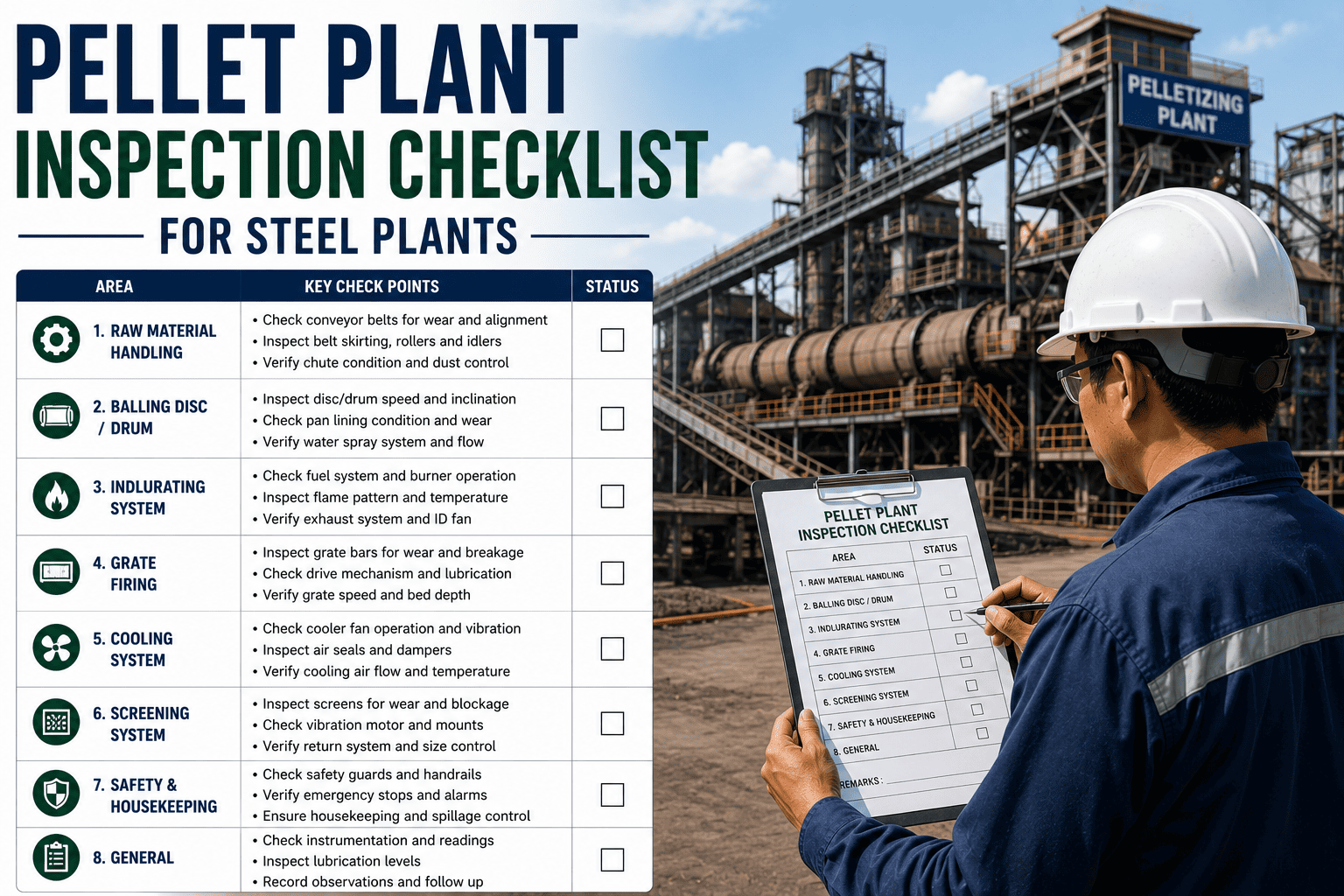
A pelletizing line runs continuously through drying, firing, and cooling zones that can each sit above 1,300°C, and it rarely fails without leaving a clue first. The clue usually shows up as a slightly uneven flame pattern, a grate bar that's starting to crack, or a fan bearing running a few degrees warmer than yesterday. This checklist covers the eight points a pellet plant inspection route should never skip. Sign up to turn this checklist into a recurring digital inspection your team can't miss a step on.
8 Points
Core checks that belong on every pellet plant inspection route
1350°C
Approximate firing zone temperature the induration furnace runs at
4 Zones
Thermal zones on the travelling grate worth checking separately
Zero Skips
Tolerance for missed checks, since early drift rarely repeats itself
Why Pellet Quality Depends On What The Inspection Route Catches
Compressive strength, size distribution, and reducibility of the finished pellet all trace back to the same things a walk-around should be checking: temperature uniformity across the burners, grate bar integrity, and balling disc condition. A single cracked grate bar can cascade into damage on the bars next to it, so catching it early is far cheaper than replacing a section mid-campaign.
The Pellet Plant Inspection Checklist
Balling Disc & Drum Condition
Check disc angle, speed, and liner wear, since these determine green pellet size distribution before firing even begins
Travelling Grate & Grate Bars
Inspect grate bars for thermal cracking, since one failed bar can damage the pallets running next to it
Indurating Furnace Refractory
Look for spalling or thinning in the hood and windbox refractory, which sees the most extreme temperature cycling
Burner System & Flame Pattern
Watch for eroding burner tips and a shifting flame pattern, since either one throws off temperature uniformity
Process Fan Bearings & Impeller
Track bearing temperature closely, since bearing failure is the number one failure mode on fans handling hot, dust-loaded gas
Annular Cooler & Grate Plates
Check cooler grate plates and discharge conveyors for wear that would slow the cooling cycle or unbalance airflow
Roller Screens & Material Handling
Confirm roller screen integrity, since screen wear directly affects final pellet size distribution
Kiln Shell Alignment & Tyre Wear
On grate-kiln lines, check for shell creep and tyre migration, which raises refractory stress and drive load
Never Miss A Pellet Plant Inspection Point
Oxmaint turns this eight-point checklist into a recurring digital route, capturing readings against every zone of the furnace so drift is caught before it reaches pellet quality. Sign up for a free trial to build your pellet plant inspection route, or book a demo to see it in action.
What An Abnormal Reading Might Be Telling You
| What You Notice |
Possible Cause |
| Cracked or shifted grate bar |
Thermal fatigue, with a real risk of cascading into neighboring bars |
| Uneven flame pattern at a burner |
Eroding burner tips affecting temperature uniformity across the bed |
| Rising fan bearing temperature |
Early bearing wear, the leading failure mode on dust-loaded process fans |
| Kiln shell drifting out of alignment |
Shell creep or tyre migration, raising refractory stress and drive load |
Paper Checklist vs A Digital Inspection Route
Paper Checklist
Burner and grate bar readings filed away, hard to compare zone by zone
Easy for a busy shift to skip a check without anyone noticing
No trend line until someone manually pulls old sheets together
Digital Inspection Route
Every reading logged against the exact zone or asset automatically
A skipped point flags itself instead of quietly disappearing
Trend lines build on their own, making slow drift easy to catch early
Where A CMMS Fits Into Pellet Plant Inspections
Oxmaint turns this eight-point checklist into a recurring digital route, capturing each reading against the furnace zone or asset so trends are visible instantly and a missed check never slips through unnoticed.
Frequently Asked Questions
Q
How often should a pellet plant inspection be done?
Burners, grate bars, and fan bearings are best checked daily, while refractory and kiln shell alignment are typically reviewed on a weekly to monthly basis depending on campaign age.
Q
Which check on this list matters most?
Grate bar condition tends to matter most, since a single cracked bar can damage the bars around it and turn a small repair into a much larger one.
Q
Can a CMMS turn this checklist into a recurring digital inspection?
Yes, a CMMS can schedule the checklist as a recurring route, prompt the technician for each reading by zone or asset, and build a trend history automatically across the pelletizing line.
Turn This Checklist Into A Route Your Team Follows Every Day
Oxmaint schedules this eight-point pellet plant inspection as a recurring digital route, capturing readings and trends automatically across every zone. Sign up for a free trial to build your pellet plant inspection route, or book a demo to see it in action.