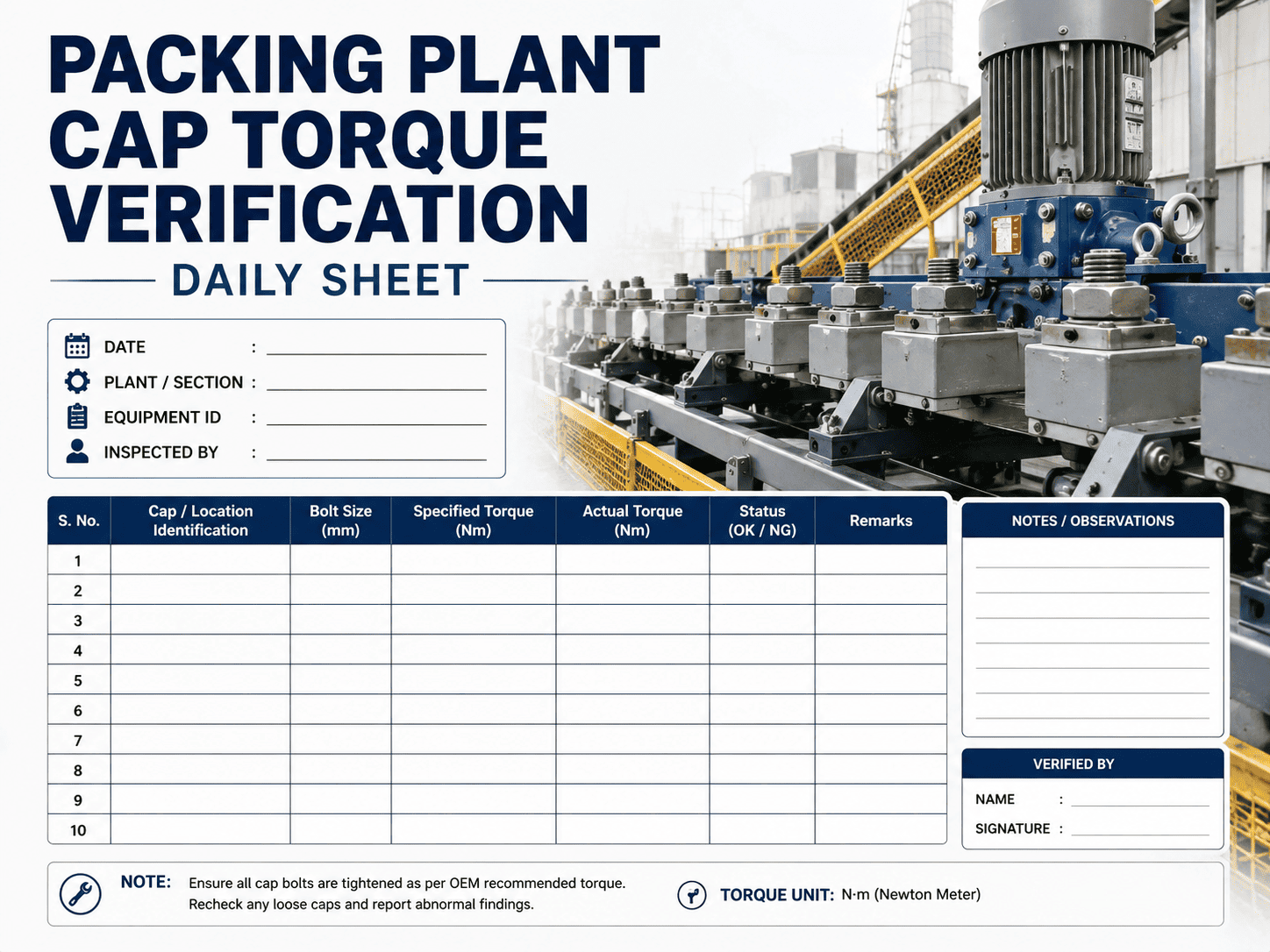
A packing line can run all shift without a single jam and still fail the customer the moment a bag splits open on the truck bed. Weak valve closure, an under-torqued applicator, a load cell that's quietly drifted, none of it shows up as downtime, it shows up as a claim three days later. Sign up to log every torque check, bag weight reading, and valve inspection against one daily sheet, tied to the station that produced it.
Why It Matters
Legal Metrology rules leave almost no room for short weight, and a burst bag in transit is a customer claim that traces straight back to the packing line. Cap torque and applicator pressure are the two checks most plants skip on a busy shift, and the two that cause the most bags to fail after they've already left the plant.
Four Stations, Four Checks
Filling Spout
Net weight against the load cell, checked per shift with test weights and logged before drift exceeds the tolerance band
Valve Closure
Sonotrode seal strength and valve flap seating, since a weak seal is the leading cause of bags bursting after dispatch
Cap Applicator
Applicator torque verified against the design specification, since under-torque loosens in transit and over-torque cracks the closure
Rejector Station
Reject rate tracked shift by shift, since a rising rate is usually the first visible sign of an upstream torque or weight drift
The Daily Verification Sheet
Weigh three test bags at shift start: compare each against the load cell reading and log the variance before packing begins
Verify applicator torque against spec: check the setting on the driver, not just the visual seat of the cap on the bag
Inspect valve seal on a sample bag: pull one bag off the line and check the seam for gaps or uneven pressure marks
Log the shift reject rate: compare against the 99.7 percent design target and flag anything below 98 percent for review
Sign off and route deviations to maintenance: any reading outside tolerance needs a corrective action noted before the next shift starts
Every Station, One Daily Sheet
Oxmaint logs bag weight, applicator torque, and valve seal checks against each filling head, flags drift before it turns into a reject spike, and keeps every shift's sheet ready for review. Sign up for a free trial to run it on your own packing line, or book a demo to see it configured for your plant.
Where Cap Torque Drifts From
Torque rarely fails as a single bad bag, it fails as a slow slide across a shift. A worn gripper pad loses grip pressure and the applicator compensates by running longer, which masks the drop until several hundred bags have gone out under-torqued. A servo drive running past its service interval loses positioning accuracy on the applicator head, so torque becomes inconsistent bag to bag instead of uniformly low. A batch of caps from a new supplier fits a fraction looser, and the same torque setting that worked last month now leaves a visible gap. Reading applicator torque against reject rate and load cell drift together catches the pattern before a customer opens a truck full of split bags.
Tolerance Reference By Check
| Check |
Frequency |
Tolerance |
| Bag net weight |
Every shift start, three test bags |
Load cell drift under 50g before recalibration |
| Applicator torque |
Daily, verified on driver setting |
Within design specification for cap and bag type |
| Reject rate |
Tracked shift by shift |
Design target 99.7 percent, review below 98 percent |
Frequently Asked Questions
Q
How often should applicator torque actually be checked?
Torque should be verified at least once per shift, and re-checked whenever the cap supplier, bag material, or gripper pad changes, since any of those shifts the grip needed to reach the same torque setting.
Q
What's the earliest sign that torque is drifting?
A creeping reject rate is usually the first visible signal, showing up before any single bag looks obviously wrong. Tracking reject rate shift by shift instead of as a monthly average catches the drift while it's still a maintenance fix, not a recall.
Q
Does under-torque or over-torque cause more failures?
Both cause failures but at different points. Under-torque loosens during transit and handling, while over-torque can crack the closure at the moment of capping. Verifying against the manufacturer's design spec, not a fixed number across all bag types, keeps both risks in check.
Stop Chasing Torque Drift After It Ships
Oxmaint keeps bag weight, torque, and valve checks tied to each filling head and applicator, so a drifting reading surfaces mid-shift instead of in a customer claim. Sign up for a free trial to run it on your own packing line, or book a demo to see it configured for your plant.