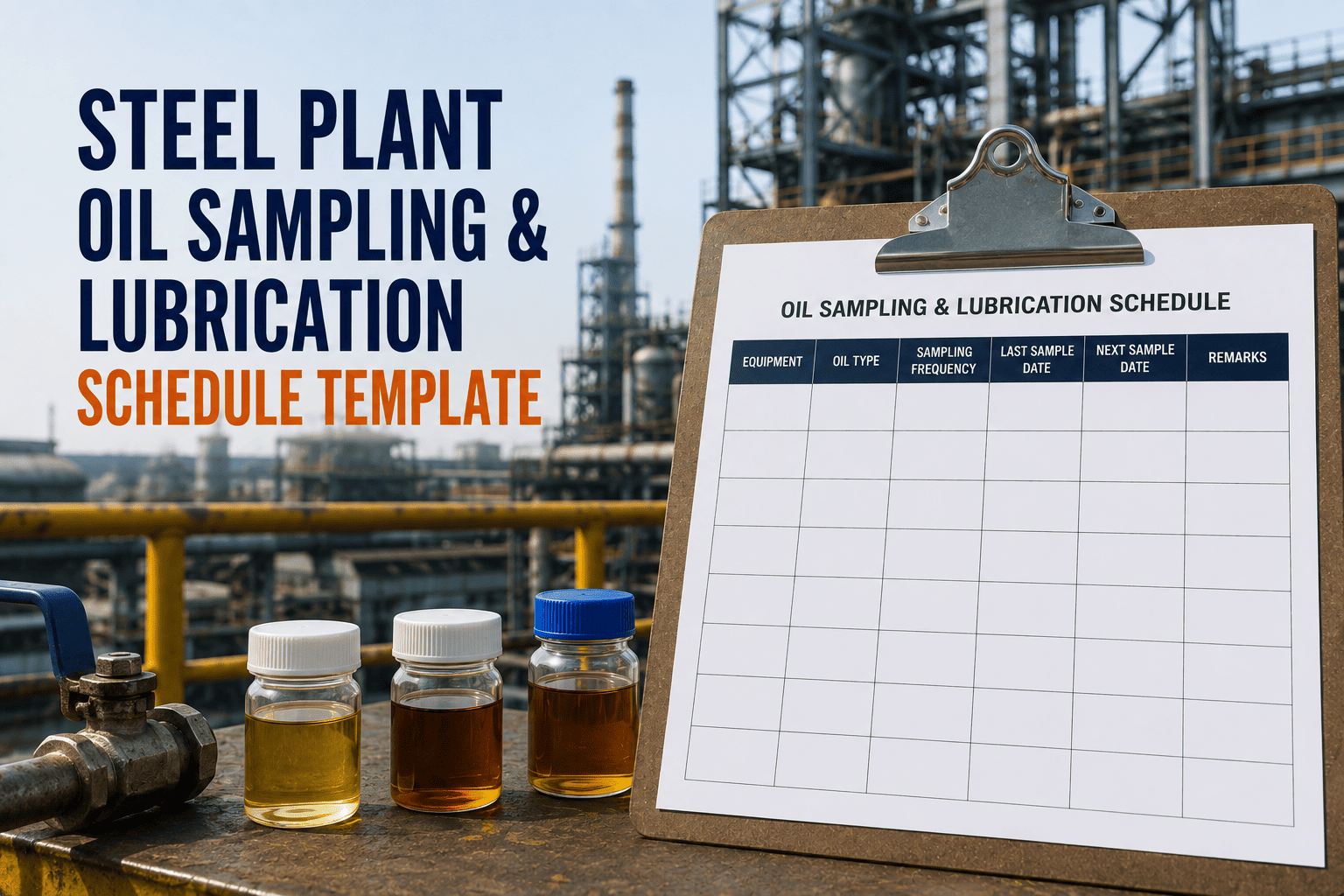
A gearbox on a caster drive can run for months on oil that looks clean to the naked eye while its particle count silently climbs past ISO 18/16/13 — invisible to a visual check, but caught weeks early through the right sample point and the right analysis package. Roughly 70% of lubrication-related failures in a steel plant trace back to contamination that a properly scheduled oil sampling route would have flagged before it turned into wear debris. This template lays out exactly which points to sample, what to test for, and how often, across rolling mill gearboxes, hydraulic systems, and caster bearings. Sign up for a free trial or book a demo to see how Oxmaint turns oil analysis results straight into prioritized work orders.
70%
of lubrication-related failures in a steel plant trace back to contamination a sampling route can catch early
4-6 wk
typical detection window between abnormal particle count and gearbox or bearing failure
40-60%
reduction in unplanned lubrication failures reported by plants running scheduled oil analysis tied to a CMMS
$30-80
typical cost per oil sample, versus thousands lost per hour of unplanned gearbox downtime
Why a Generic Lubrication Schedule Misses Steel Plant Failures
A lubrication schedule built for general equipment doesn't account for the contamination sources, oil volumes, and duty cycles that define rolling mill gearboxes, hydraulic units, and caster bearings.
01
Same Grease for Every Bearing
High-load caster bearings and light-duty auxiliary motors are relubricated with the same product and interval, regardless of actual duty.
02
Oil Sampled Only After Trouble Starts
Samples get pulled once a gearbox already sounds off or runs hot, well past the point where contamination could have been caught early.
03
No ISO Cleanliness Baseline
Without a documented baseline cleanliness code, an analyst can't tell a rising particle count from normal variation.
04
Lab Results Never Reach a Work Order
Analysis reports sit in email or a shared folder, disconnected from the CMMS that should turn a flagged result into a scheduled top-up or oil change.
Turn a flagged oil sample into a work order automatically
See how Oxmaint converts lab results into prioritized, scheduled lubrication tasks before failure.
Sampling Frequency by Asset Criticality
Not every gearbox or bearing needs the same sampling intensity. The schedule should be built around what a lubrication failure actually costs, not one blanket interval.
C
Critical — Weekly Sampling
Rolling mill main gearboxes, caster hydraulic power units, and main drive bearings where failure stops production immediately.
H
High — Monthly Sampling
Secondary gearboxes, roll stand bearing housings, and auxiliary hydraulic circuits with meaningful but not immediate impact.
M
Medium — Quarterly Sampling
Redundant pumps and non-critical gear drives where a failure has a backup path and doesn't halt the line on its own.
L
Low — Condition-Based Only
Non-critical auxiliary equipment sampled opportunistically or when an operator reports a visible oil change.
Building the Schedule: A Four-Step Workflow
1
Rank Assets and Set Sample Points
Start with the gearboxes, hydraulic reservoirs, and bearing housings whose failure causes the highest production impact.
Failure cost ranking
Sample point mapping
Reservoir access check
▼
2
Choose the Analysis Package
Match each sample point to viscosity, particle count, moisture, and ferrography testing based on its known failure modes.
Viscosity
Particle count
Ferrography
▼
3
Record a Baseline Cleanliness Code
Capture an initial ISO cleanliness reading on known-good oil so future samples have something real to compare against.
ISO 4406 code
Reference sample
Documented condition
▼
✓
Set Alarm Limits and Trend
Define alert and alarm limits per sample point, and route every out-of-limit result into a CMMS work order automatically.
Alert/alarm limits
Trend tracking
Auto work order
What Belongs in Every Sample Point Record
Asset ID and Sample Point
Gearbox, hydraulic reservoir, or bearing housing clearly tagged, matching the CMMS asset record exactly.
Lubricant Type and Grade
Correct oil or grease grade documented so relubrication never mixes incompatible products.
Analysis Package
Viscosity, particle count, moisture content, and ferrography specified per point where wear debris is the primary concern.
Baseline and Alarm Thresholds
Reference ISO cleanliness code documented alongside alert and alarm limits specific to that point.
Sampling Interval
Frequency set by criticality tier — weekly, monthly, or quarterly — not a single plant-wide default.
CMMS Work Order Trigger
A defined threshold that automatically opens a work order when crossed, closing the loop between result and repair.
Stop losing lab results in email threads
Oxmaint imports oil analysis results via CSV, REST API, or direct lab integration and trends them automatically.
Book a Demo
Calendar-Based Lubrication vs. Route-Driven Oil Analysis
Calendar-Based Lubrication
Grease and oil topped up on a fixed schedule regardless of actual condition
Oil checked visually, missing early-stage particle and moisture contamination
Same interval applied to critical gearboxes and low-impact auxiliary pumps
Lab results emailed and filed, disconnected from work orders
Gearbox failures still arrive as unplanned stoppages despite the schedule
Route-Driven Oil Analysis
Sampling interval set by asset criticality and known contamination speed
Particle count and ferrography tracked, catching wear debris weeks out
Critical gearboxes on weekly sampling, auxiliaries on quarterly
Results feed directly into CMMS trending and automatic work orders
Oil changes and top-ups planned before contamination reaches the gear teeth
Where Lubrication Schedules Break Down
| Schedule Problem |
Root Cause |
Fix |
| Gearbox fails despite a recent oil top-up |
Oil checked visually instead of tested for particle count and moisture |
Particle count, moisture, and ferrography added to every critical sample point |
| Sampling route takes too long to complete |
Every asset sampled on the same interval regardless of criticality |
Sampling frequency set per asset tier — weekly for critical, quarterly for low-impact |
| Analyst can't tell if a result is abnormal |
No documented baseline ISO cleanliness code exists for comparison |
Baseline sample recorded for every point when the oil is known to be clean |
| Flagged result never turns into an oil change |
Lab report emailed and filed, separate from the CMMS |
Threshold crossings routed automatically into a CMMS work order |
| Wrong grease used during relubrication |
No documented lubricant grade at the point of service |
Lubricant type and grade attached to every asset record and route point |
How Oxmaint Connects Your Lubrication Route to Work Orders
An oil sampling schedule is only useful if a flagged result turns into a scheduled repair. Oxmaint converts oil analysis, vibration, and thermal readings into prioritized work orders automatically, whether the result comes from a plant lab or a third-party testing partner. Sign up to connect your lubrication data to a live maintenance workflow.
Criticality-Based Sampling Scheduling
Sampling intervals maintained automatically by asset criticality, from weekly on main gearboxes to quarterly on auxiliaries.
Automatic Work Order Generation
Threshold crossings and trending alarms convert directly into prioritized work orders, closing the loop between result and repair.
Flexible Lab Data Integration
Sample results imported via CSV, REST API, or direct lab integration, no manual re-entry required.
Baseline and Trend History by Asset
Every sample stored against the asset record, building the trend history that separates early contamination from normal variation.
Turn Your Lubrication Route Into Planned Repairs
Oxmaint connects rolling mill, hydraulic, and caster lubrication data to a criticality-based schedule and automatic work order workflow.
Frequently Asked Questions
Which steel plant assets should be sampled first?
Start with the highest-criticality lubricated assets — rolling mill main gearboxes, caster hydraulic power units, and main drive bearing housings — since these generate the most unplanned downtime cost and are the most sensitive to contamination.
How far in advance can oil analysis detect a developing failure?
Rising particle count and early wear debris are typically detectable 4 to 6 weeks before a gearbox or bearing reaches functional failure, well before the contamination shows up as noise, heat, or a visible oil change.
What tests should be included in a standard sample?
A standard package typically includes viscosity, particle count against an ISO 4406 cleanliness code, moisture content, and ferrography for critical gearboxes where wear metal analysis matters most.
Can Oxmaint work with results from a third-party oil lab?
Yes. Oxmaint integrates with lab results through REST API and CSV import, so sample data from an in-house lab or a third-party testing partner both feed into the same CMMS work order workflow.