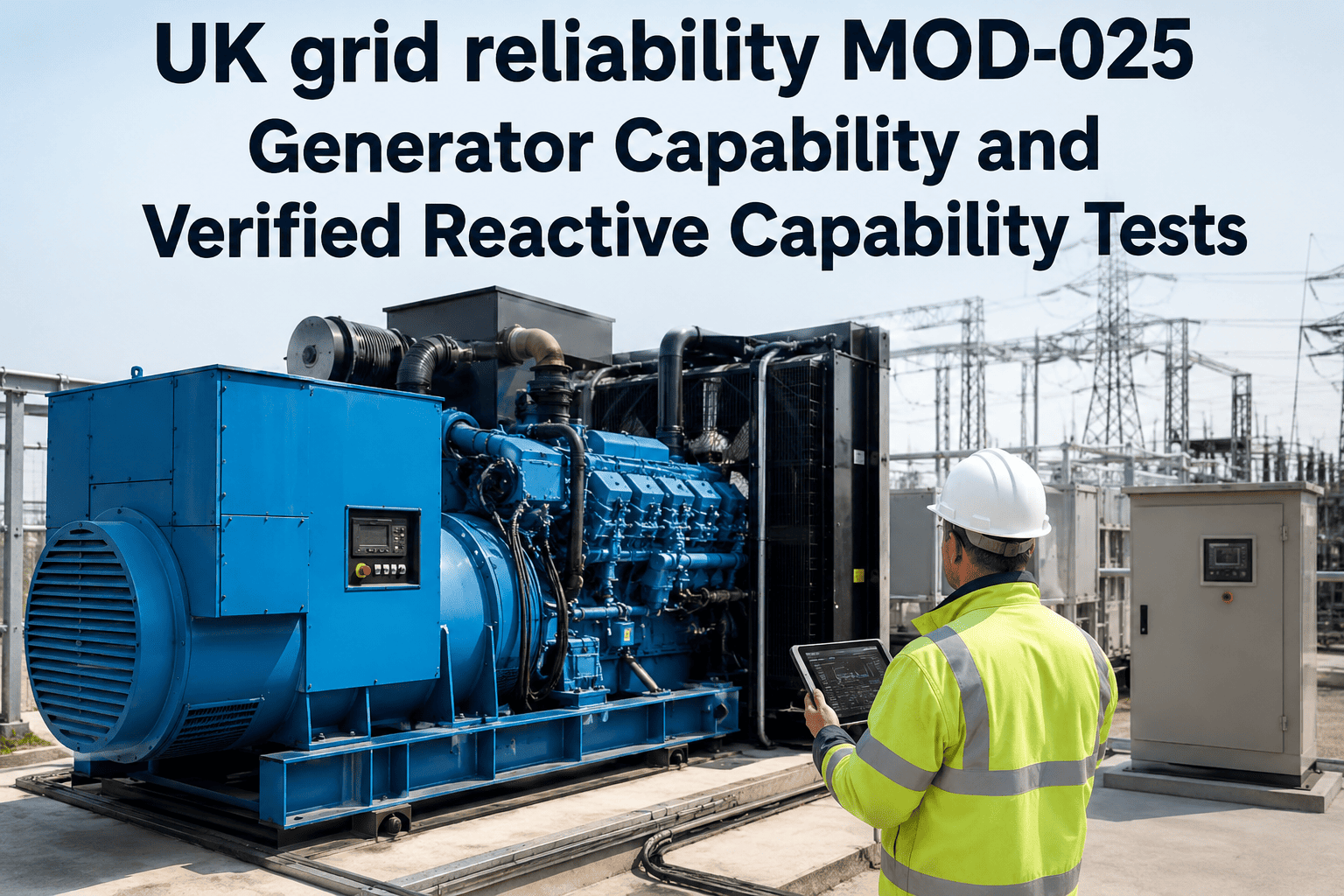
A generator that can supposedly deliver 0.85 leading power factor on paper but has never actually been tested at that point isn't a fact on the grid — it's a number sitting in a planning model. NERC's MOD-025 standard exists to close that exact gap: it requires every applicable Generator Owner to verify, through real testing, manufacturer data, or engineering analysis, what a unit can actually produce, and to report that verified number to the Transmission Planner. Sign up to track your MOD-025 verification cycle, test evidence, and reverification triggers inside one CMMS built for compliance records, from real power to leading reactive capability.
Why It Matters
Transmission planners build voltage support studies, contingency margins, and stability limits on the reactive power number a Generator Owner reported. If that number was never verified, or was verified years before an excitation upgrade quietly changed it, the planning model carries an error nobody sees — until the grid actually needs that reactive power and it isn't there.
What MOD-025 Actually Asks Owners To Verify
Real Power Capability
Verified gross and net MW output, consistent with what's reported under MOD-024, not the figure the nameplate promised at commissioning.
Lagging Reactive Power
Maximum overexcited capability verified under real operating conditions — the number transmission planners lean on for voltage support studies.
Leading Reactive Power
Minimum underexcited capability — usually the most constrained limit on the machine, and the one most owners never actually test.
Synchronous Condensers
Verified at just two points, one overexcited and one underexcited, since there's no real power output to test around.
Applicability runs on nameplate rating and generator type, so not every unit on a site falls under MOD-025 the same way — but every applicable unit needs its own verification record, its own method on file, and its own reverification clock running.
Where MOD-025 Verification Trips Up Owners
Out Of Cycle Since Commissioning
Tested once at commercial operation and never verified again, even after years of excitation changes
Undocumented Method
Reporting a capability number without stating whether it came from testing, manufacturer data, or analysis
Missing Ambient Conditions
Capability shifts with temperature, cooling water, and altitude — a number without those assumptions can't be checked against the planning case
Excitation Change, No Reverification
AVR upgrades and field modifications quietly change reactive capability, and the reverification trigger gets missed
Leading Power Factor Skipped
The most constrained capability on the machine is also the one most owners never actually test
12-Month Window Missed
New units and long-shutdown units returning to service carry a 12-month verification clock that starts on day one
Stop Reverifying From Memory
Oxmaint tracks every generating unit against its own MOD-025 verification method, ambient assumptions, and reverification trigger, with test evidence attached and ready for the Transmission Planner. Sign up for a free trial to run it on your own fleet, or book a demo to see it set up around your generators.
Verification Methods MOD-025 Accepts
| Method |
What It Involves |
Documentation Required |
| Staged testing |
Unit run to defined lagging and leading points under controlled conditions |
Date, time, ambient conditions, GSU ratios and losses if measured off the transformer |
| Operational data |
Actual historical operating points used in place of a dedicated staged test |
Verification period covered and the conditions during that period |
| Manufacturer data or analysis |
Engineering calculation or OEM curve used where testing isn't practical |
Clear identification of the method used and the assumptions behind it |
Frequently Asked Questions
Q
What triggers a MOD-025 reverification?
Excitation system changes, AVR upgrades, and field modifications affecting real or reactive capability all trigger it, alongside the standard's defined periodic intervals — the reverification clock resets whenever the machine's actual capability could have changed.
Q
Does MOD-025 apply to wind and solar facilities?
Reactive power verification applies, though real power capability is handled differently for wind and photovoltaic Facilities under the standard's attachment provisions, and wind site verification is counted by site rather than by individual turbine.
Q
What if a unit hasn't been tested since commissioning?
That unit is out of cycle, and it happens more often than owners expect — reported capability no longer reflects reality, and priority should go toward getting it verified before an audit or a planning study treats the gap as unexplained.
Give Your Transmission Planner Numbers They Can Trust
Oxmaint ties every generator's real and reactive power verification to its method, its ambient assumptions, and its reverification trigger, all in one auditable record. Sign up for a free trial to run it on your own fleet, or book a demo to see it configured for your generating units.