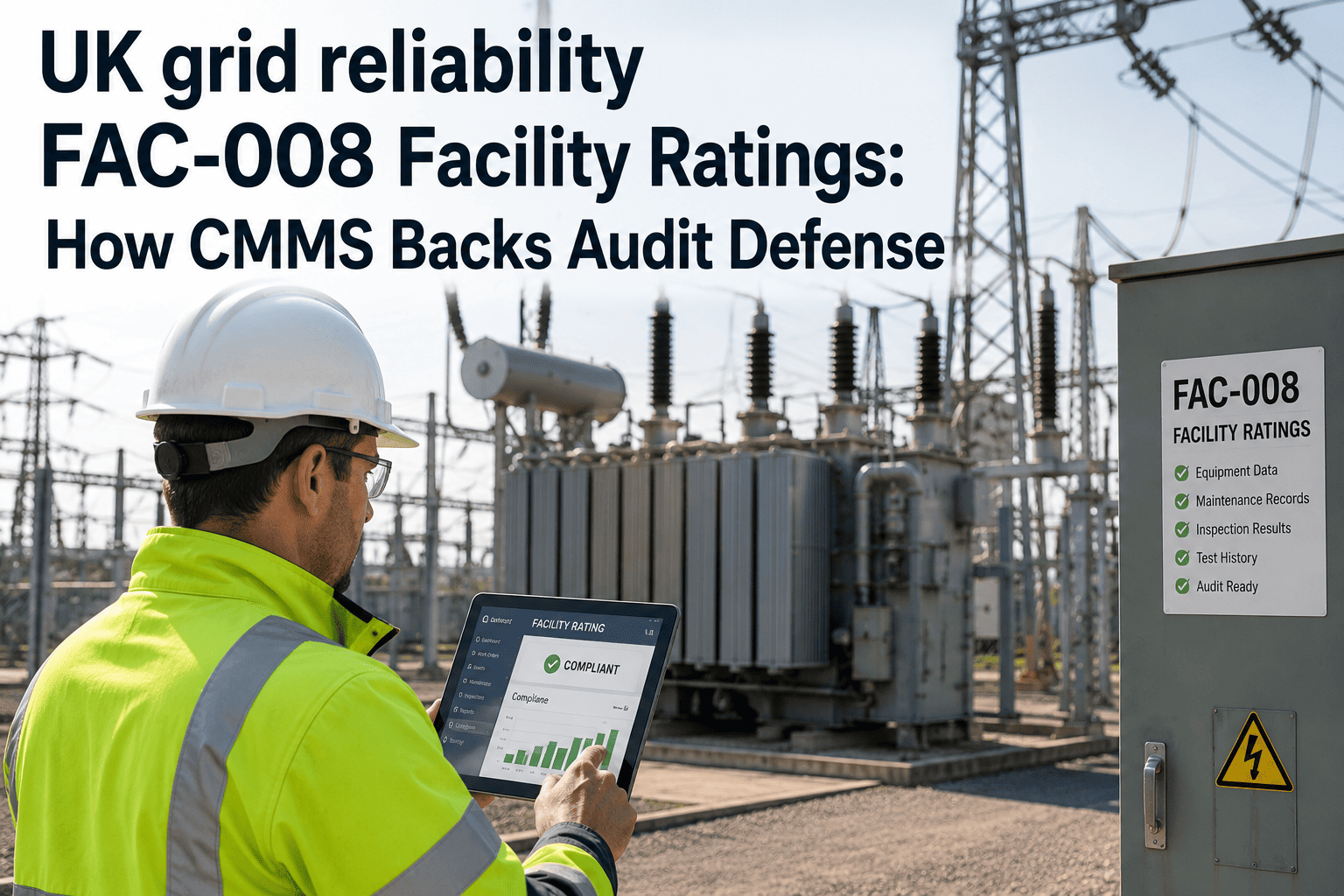
A transmission line's rating isn't one number — it's the rating of its single weakest component, whichever piece of equipment along that line gives out first under heat. NERC's FAC-008 standard exists because getting that "most limiting element" wrong doesn't just mean a paperwork error — it was one of the contributing factors behind the August 2003 blackout, and it remains an area FERC actively enforces against. Sign up to track every Facility Rating, its methodology, and every equipment change that could shift it, inside one CMMS built to hold up under an audit.
Why It Matters
FERC has publicly pursued facility ratings violations against utilities whose documented ratings didn't match their own Facilities Rating Methodology. When a rating drifts from what the methodology says it should be, the result isn't just a compliance finding — it's equipment running beyond its design, line sag beyond clearance, or an unplanned outage nobody saw coming because the number on file was wrong.
What Every Facility Ratings Methodology Has To Define
Continuous Rating
The maximum load equipment can carry indefinitely without damage or unacceptable aging — the baseline every other rating gets compared against.
Emergency & Short-Term Ratings
Higher limits allowed for a defined duration during contingencies, always tied back to the documented methodology that justifies them.
Most Limiting Element
The single weakest component in the Facility — conductor, transformer, breaker, or terminal equipment — that sets the rating for the whole chain.
Ratings can come from equipment manufacturer specifications, from an industry standard developed through an open process such as IEEE, or from documented engineering calculations — but whichever source is used, the methodology has to say so, and the rating actually applied has to match it.
Where FAC-008 Ratings Fail Under Scrutiny
Rating Doesn't Match Methodology
The documented rating and the methodology that's supposed to produce it quietly drift apart over time
Undocumented Equipment Changes
A swapped transformer or conductor changes the most limiting element, but the rating on file never gets updated
Clearance Measurements Skipped
Methodology fails to account for clearance consistent with the National Electric Safety Code, a specific point FERC has flagged
Nameplate vs Field Reality
Documented ratings don't match actual field conditions once equipment ages or gets modified
Methodology Not Kept Current
A Facilities Rating Methodology written once and never revisited as standards or equipment evolve
Records Can't Be Produced On Request
Ratings and methodology changes have to be available within 21 calendar days of a request — scattered files make that deadline hard to hit
Keep Every Rating Tied To Its Evidence
Oxmaint links each Facility Rating to its methodology, its most limiting element, and every equipment change that could have shifted it, so nothing drifts silently between audits. Sign up for a free trial to run it on your own Facilities, or book a demo to see it configured for your rating records.
Acceptable Bases For A Facility Rating
| Basis |
Source |
Where It Fits |
| Manufacturer specification |
Nameplate rating or OEM documentation |
Individual equipment items like transformers and breakers |
| Industry standard |
Open-process standards such as IEEE |
Conductor ampacity and thermal calculations |
| Engineering calculation |
Documented, technically sound methodology |
Facilities without a direct manufacturer or standard basis |
Frequently Asked Questions
Q
What is a Facility Rating under FAC-008?
It's the maximum electrical capability of a Facility under defined operating conditions, used to determine System Operating Limits — and it's set by the single most limiting piece of equipment in that Facility, not an average or a best case.
Q
How long do Facility Rating records need to be kept?
Current ratings and any changes to them are kept for three calendar years, and if an entity is found non-compliant, related records are kept until it's brought back into compliance.
Q
Why is FAC-008 considered one of the harder standards to stay compliant with?
It's data-intensive by nature — every Facility needs a rating that's traceable back to a documented methodology, and that methodology has to stay current as equipment is replaced, which is exactly the kind of ongoing link that's easy to lose track of across spreadsheets and file folders.
Be Ready The Day FERC Asks For Your Ratings
Oxmaint keeps Facility Ratings, methodology documentation, and equipment change history in one place, produced in minutes instead of days. Sign up for a free trial to run it on your own Facilities, or book a demo to see it set up for your team.