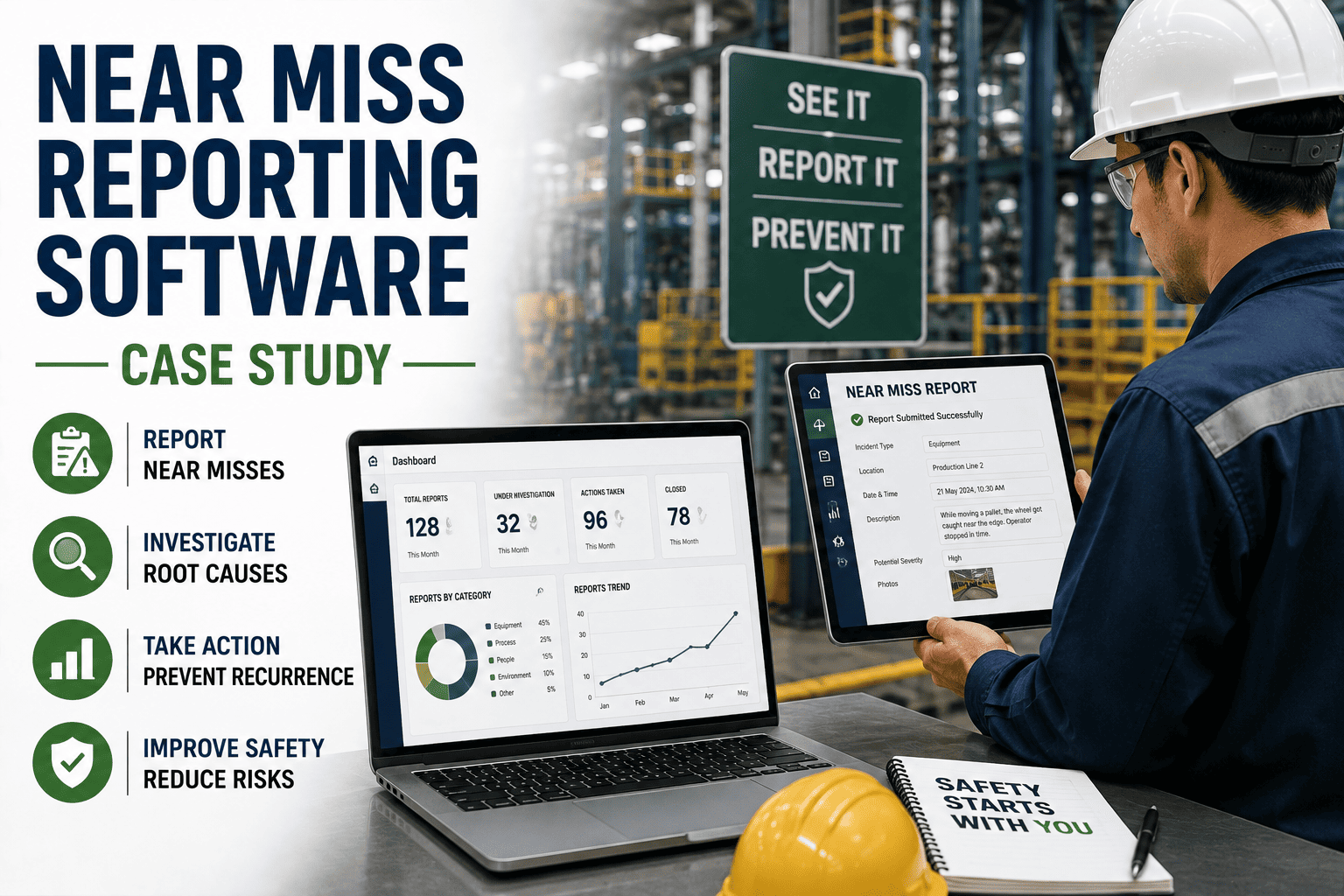
Discover how digital near-miss reporting software improved safety reporting, incident management and workplace risk reduction across steel plants.

By Mark strong on August 1, 2026

near-miss-reporting-software-case-study

Most near-miss reports in a steel plant never make it past the shift supervisor's notebook. By the time anyone logs it, the moment is gone, the details are fuzzy, and the corrective action never gets assigned. Plants that move near-miss reporting onto a CMMS see a different pattern: reports rise instead of fall, because the barrier to filing one drops from a form and a walk to the office down to a few taps on the floor. Sign up to see how near-miss data could look on your own plant floor.

3.2x More Reports
Near-miss reports filed within six months of moving from paper logs to digital reporting
Same-Shift Filing
Average time to log a near miss, down from 2-3 days on paper-based systems
-31% TRIR
Reduction in total recordable incident rate across a full reporting year
The Problem

In a steel plant, a near miss near a ladle crane or a rolling line is exactly the kind of signal that predicts the next serious incident. But when reporting means finding a paper form, walking to a supervisor's office, and waiting for someone to type it into a spreadsheet, most workers just don't bother. The near misses that do get logged usually arrive days later, stripped of the details that would have made them useful.

How A Near Miss Moves Through The System

Capture
Triage
Investigation
Corrective Action
Closure
On paper, this chain routinely stalls at triage, since nobody owns the follow-up until an EHS officer manually sorts the week's forms. On a CMMS, each stage is a tracked status, so a report can't quietly sit unassigned.
Turn Every Near Miss Into A Tracked, Closed-Out Record

Oxmaint routes every near-miss report straight to the right owner and tracks it through to closure automatically. Sign up for a free trial to see it running on your own plant data, or book a demo to walk through a real steel plant rollout.

Near-Miss Reporting Before And After

Metric Before After
Reporting method Paper forms logged days later at a desk Reported from the floor within the same shift
Ownership of follow-up Unassigned until an EHS officer sorts the backlog Auto-routed to the responsible supervisor instantly
Report volume Low, since filing felt like extra paperwork Up 3.2x once reporting took under two minutes
Corrective action closure Often missed or closed without verification Tracked to sign-off with photo evidence attached
The Results

The steel plants that see the biggest safety gains aren't the ones that punish near misses, they're the ones that make reporting effortless and visible. Once workers see a report turn into a fixed guardrail or a repaired sensor within days, they keep reporting. That feedback loop, more than any single policy change, is what drove the TRIR reduction and the drop in repeat incidents at similar work stations.

Frequently Asked Questions

Q Why do steel plants get so few near-miss reports on paper systems?
Filing a paper report usually means stopping work, finding a form, and walking to an office, so most near misses just get mentioned verbally and forgotten instead of logged.
Q Does digital near-miss reporting actually reduce incidents, or just reporting numbers?
Report counts rise first because filing gets easier, but incident rates fall afterward, since each report now routes to a tracked corrective action instead of disappearing into a drawer.
Q How long does it take a steel plant to see safety results after switching?
Reporting volume typically rises within weeks, but the measurable drop in recordable incidents usually shows up over a two-to-three quarter window as corrective actions close out.

Give Every Near Miss A Tracked Path To A Fix

Oxmaint turns near-miss reports into routed, owned, and closed-out records, so nothing sits in a drawer waiting for a quarterly review. Sign up for a free trial to see it against your own plant, or book a demo to walk through a steel plant rollout.
Share This Story, Choose Your Platform!