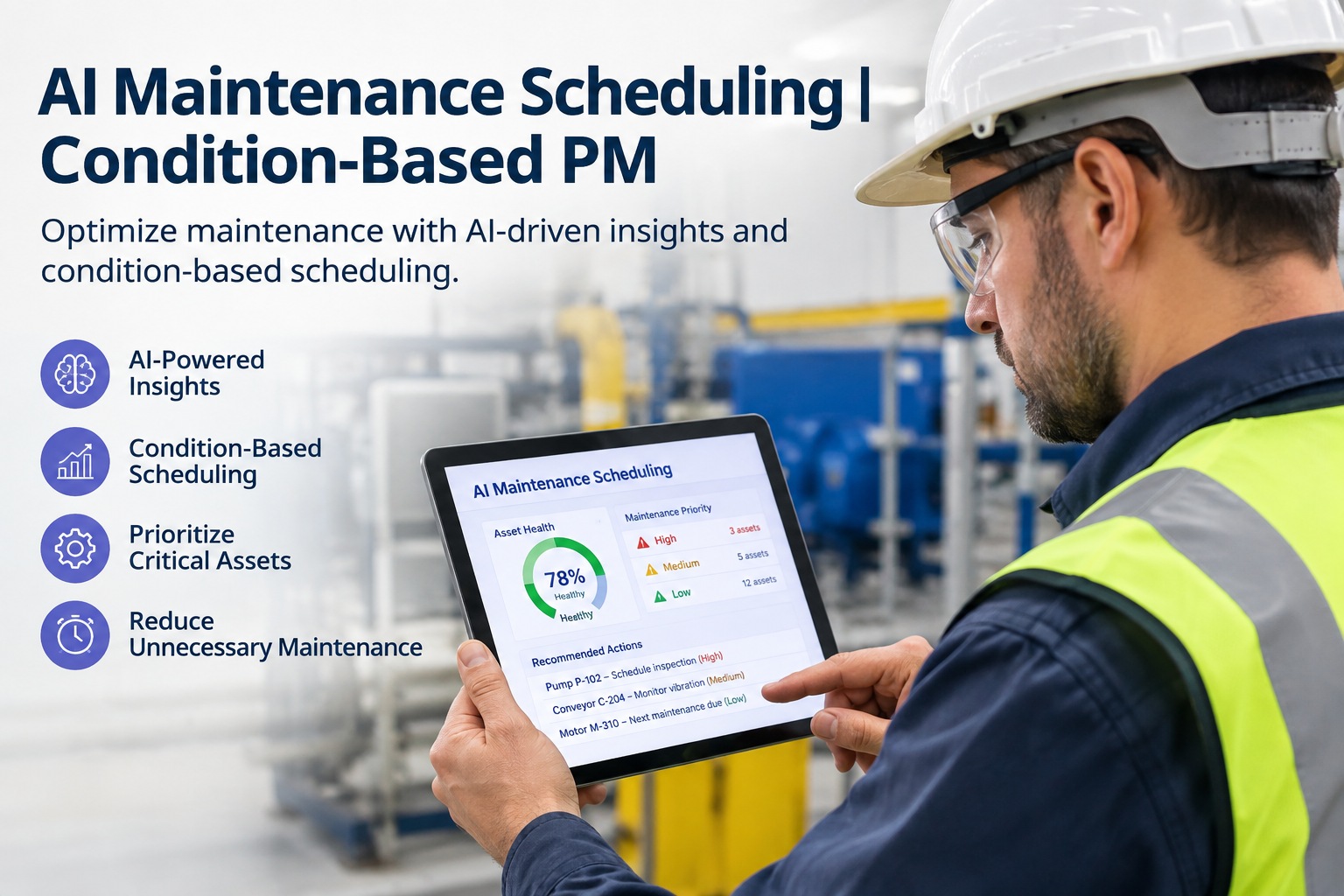
Somewhere in your facility, a bearing with 60% remaining useful life is being replaced this week — because the PM schedule says so. Somewhere else, a bearing with 3 weeks left is running quietly, because its calendar interval is still 45 days out. Both are wasteful. The root cause: calendar-based PM assumes every asset ages at the OEM-recommended pace regardless of what it's doing. Machine learning changes that. Oxmaint's condition-aware scheduling uses live asset health data to prioritise the PM that actually needs doing. Book a demo to see AI scheduling in action.
The Maintenance Strategy Spectrum — Where AI Scheduling Actually Sits
Maintenance strategy is not a binary choice between "old" and "AI" — it's a four-point spectrum where each strategy trades cost, effort and prevention capability differently. AI-assisted scheduling doesn't replace the others; it decides which strategy applies to which asset, and when to escalate up the spectrum based on live condition data. Understanding where each strategy fits determines what any AI scheduling investment actually returns.
01
TRIGGER: Breakdown
Reactive
Fix it when it breaks. Highest cost per repair (4-5× planned), guaranteed downtime, safety exposure.
Fit: low-criticality, throwaway assets only
02
TRIGGER: Calendar / hours
Preventive (PM)
Fixed intervals — every 90 days, every 500 hours. Prevents 30-40% of failures. Wastes labour and parts on healthy assets.
Fit: statutory intervals, low-sensor assets
03
TRIGGER: Threshold crossed
Condition-Based (CBM)
Sensor threshold exceeded — vibration > 4.5mm/s, temp > 85°C. Only services what's degrading. Alarms after damage begins.
Fit: mid-tier critical, single-variable failures
04
TRIGGER: ML prediction
Predictive (AI/PdM)
Multi-variable ML forecast — "bearing will fail in 3-6 weeks". Schedules intervention before damage. Runs assets to 85-95% RUL.
Fit: high-criticality, sensor-instrumented assets
Where PM Money Actually Gets Wasted — And Where AI Recovers It
Multiple industry studies place calendar-based PM waste at 30-40% of scheduled tasks — labour and parts spent on assets that didn't need attention. Half that waste comes from over-servicing (replacing healthy parts), half from under-servicing (missing deterioration between intervals). AI scheduling cuts both simultaneously by moving each individual asset onto the right point of the spectrum based on its actual condition. The breakdown below shows where the waste sits in a typical UK manufacturing PM programme.
60%Genuinely needed PM
25%Over-service
10%Under-service
5%Wrong task
60% · Genuinely needed — Asset actually approaching threshold. PM triggered at the right moment.
25% · Over-service — Component replaced with significant remaining useful life. Parts and labour wasted.
10% · Under-service — Failure between intervals. Emergency repair at 4-5× planned cost.
5% · Wrong task — Right asset, wrong PM procedure. Symptomatic of stale asset templates.
AI scheduling attacks the 40% waste band by reading live condition data per asset and dynamically adjusting the PM cycle — moving each asset to condition-based (03) or predictive (04) on the strategy spectrum where the data supports it.
Choosing the Right Strategy Per Asset — A Decision Framework
Not every asset belongs on the predictive tier. A £500 desk fan doesn't need vibration sensors. A £2m turbine absolutely does. The decision framework below is how Oxmaint's asset scoping wizard sorts your inventory — routing each asset to the right point on the strategy spectrum based on criticality, sensor feasibility and failure impact. It's the practical bridge between "AI is powerful" and "AI is worth the investment for this asset". Sign up free to run the asset criticality wizard.
Every Asset in the Register
Is failure impact material?
(downtime cost · safety · compliance)
NO
Run-to-fail
Reactive maintenance
Consumables, low-cost items
YES
Can condition be sensed cost-effectively?
NO
Preventive (calendar/hours)
Statutory-driven PM
Compliance-bound assets
YES
Multi-variable failure modes?
NO
Condition-Based
Threshold triggers
Single-parameter monitoring
YES
Predictive (AI/ML)
Multi-signal forecast
High-value critical assets
See AI Scheduling on Your Assets
Walk through the asset criticality wizard, condition data ingestion from existing sensors or wireless kits, ML failure-window forecasting, dynamic PM cycle adjustment and technician work queue prioritisation — against your actual asset register. Thirty minutes with the Oxmaint team.
Where AI Maintenance Scheduling Actually Delivers ROI
The reported gains are consistent across UK and European deployments: 25-30% total maintenance cost saving versus reactive baseline (US Dept of Energy O&M Best Practices), 35-50% reduction in unplanned downtime (Nucleus Research), 20-40% extension in equipment service life. PwC's IoT research puts the return at £7 for every £1 invested in predictive infrastructure. What actually happens on the shop floor is more concrete: PM completion rates climb from the 54% industry average (calendar-based systems) to above 85% because the work being scheduled is the work that genuinely needs doing — and technicians see that in the priority queue every morning. Sign up free to explore AI scheduling on your assets.
Expert Perspective — What Actually Separates Real AI Scheduling From Marketing
"
Every CMMS vendor claims "AI-powered" now. Very few actually do the thing that matters — which is dynamically re-ranking the PM queue based on live asset condition rather than executing a fixed calendar. The tell is what happens when a vibration reading spikes on Tuesday afternoon. A real AI scheduler pushes that asset up the priority list for Wednesday and defers a lower-criticality PM to make room. A marketing-AI scheduler generates a dashboard chart and carries on with the original calendar. The difference isn't the machine learning model — it's whether the model's output actually rewrites the work queue. If the answer is no, you're paying for analytics, not scheduling.
01
Queue re-ranks on condition change
Vibration spike, temp deviation, current-draw anomaly → PM queue re-prioritises the same day. Not next audit cycle.
02
RUL forecast per asset
Remaining Useful Life calculated from multi-signal ML per bearing, motor, pump. Days-to-intervention, not "healthy/failing".
03
Defer low-priority safely
Healthy assets automatically extend PM interval within safe bounds. Labour freed for the assets that actually need attention.
04
Human-in-the-loop control
ML recommends; maintenance manager approves. No "black box" schedule changes without human sign-off on critical assets.
Who Uses Oxmaint for AI Maintenance Scheduling
The platform is used by the specific UK and European operational roles that own reliability and PM programmes: maintenance managers running site-wide PM cycles across mixed-criticality asset bases, reliability engineers configuring failure-mode libraries and condition thresholds per asset class, engineering managers reporting reliability metrics against reliability-centred maintenance (RCM) programmes, operations managers coordinating maintenance windows against production plans, plant managers tracking maintenance cost as a percentage of replacement asset value, and continuous improvement teams driving OEE gains through better maintenance timing. Each role sees the same asset data filtered to their view — dynamic PM queue, RUL forecasts, deferred-PM audit trail or cost-avoidance dashboard. Sign up free to configure AI scheduling for your team.
Getting AI Scheduling Live
Deployment starts with importing your existing asset register and current PM calendar. The criticality wizard sorts each asset onto the right point of the strategy spectrum — statutory-driven assets stay on calendar PM, mid-tier get condition-based thresholds, high-criticality get full predictive with RUL forecasting. Existing sensor data ingests via API from SCADA, historian or wireless kits; Oxmaint supplies wireless vibration/temperature sensors for assets not yet instrumented. ML models establish baselines during a 30-45 day learning window before generating forecast-driven work orders. Human-in-the-loop approval keeps maintenance managers in control of every automated PM change until confidence is established. Book a walkthrough to see live UK AI scheduling deployments.
Turn PM From Calendar Ritual Into Data-Driven Priority
Oxmaint gives maintenance and reliability teams one platform for AI-assisted scheduling, condition-based PM, ML failure forecasting and dynamic work queue prioritisation — with human-in-the-loop control for every critical asset and full linkage to the CMMS.
Frequently Asked Questions
What is AI-driven maintenance scheduling and how does it differ from preventive maintenance?
AI-driven maintenance scheduling uses machine learning models to dynamically prioritise and time maintenance work based on live asset condition data — vibration, temperature, current draw, runtime hours, historical fault patterns — rather than fixed calendar intervals. Traditional preventive maintenance triggers on time or hours regardless of actual asset health, which industry studies show wastes 30-40% of scheduled PM tasks on healthy assets while missing deterioration between intervals. AI scheduling calculates Remaining Useful Life per specific asset and schedules interventions at the right moment for each asset — not the average asset in its class.
What's the difference between condition-based and predictive maintenance?
Condition-based maintenance (CBM) triggers work when a single sensor threshold is exceeded — vibration crosses 4.5mm/s, temperature exceeds 85°C. It's reactive to damage that has already begun. Predictive maintenance (PdM) uses machine learning to correlate multiple signals (vibration, temperature, current, acoustic, thermographic) into a forecast of when failure is likely — days or weeks in advance — before threshold breaches occur. PdM is the more advanced tier: it forecasts failure windows and lets teams schedule intervention during planned downtime rather than responding to alarms after degradation is under way.
Do I need IoT sensors on every asset to use AI scheduling?
No. AI scheduling in Oxmaint works across the full strategy spectrum. Low-criticality assets stay on calendar PM with no sensors. Statutory-compliance assets stay on time-based intervals (LOLER, PSSR, PUWER) regardless of condition data. Mid-tier critical assets can use simple condition triggers from existing controls (runtime hours, cycle counts). Only high-criticality assets warrant full sensor instrumentation and multi-variable ML forecasting. The asset criticality wizard sorts each item into the right tier — you invest sensor cost only where the failure impact justifies it.
How long before AI scheduling pays back?
Documented deployments across UK and European manufacturing typically show payback within 6-12 months, often from a single prevented emergency breakdown on a high-criticality asset. PwC's IoT research reports £7 return per £1 invested in predictive infrastructure. On the ongoing operational side, US Dept of Energy O&M Best Practices puts total maintenance cost saving at 25-30% versus reactive baseline, with 35-50% unplanned downtime reduction (Nucleus Research). The bigger productivity gain is often labour reallocation — technicians spend their day on assets that genuinely need attention rather than executing calendar PMs on healthy equipment.
Does AI take maintenance decisions out of human hands?
No — and any vendor claiming full autonomous scheduling for critical assets should be treated with caution. Oxmaint's AI scheduling operates on a human-in-the-loop model: ML models recommend interval changes, generate RUL forecasts, and re-rank the PM queue based on condition data, but maintenance managers retain approval control on every change affecting a critical asset. This preserves accountability, keeps engineering judgement in the loop, and builds confidence in the model over time. Fully autonomous scheduling can be enabled for low-criticality assets where the risk profile supports it.