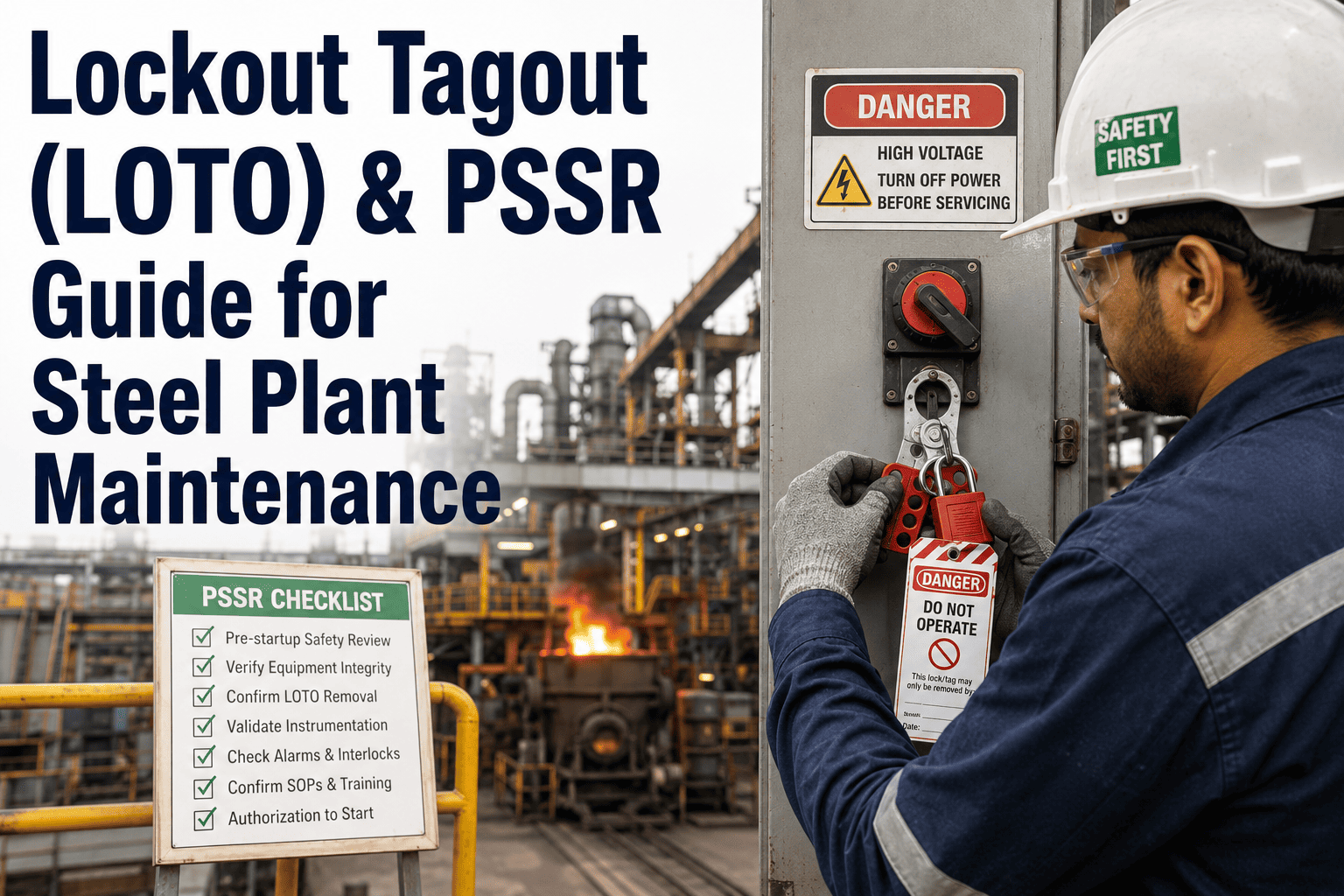
A mill drive that "should" be de-energized has killed people before. Lockout Tagout exists because "should" isn't good enough when someone's hands are inside the machine. Every step in the procedure exists because a skipped one, somewhere, cost someone their life. Sign up to see how Oxmaint turns LOTO and PSSR checklists into a verified digital record instead of a paper form nobody double-checks.
6 Steps
In a standard Lockout Tagout procedure, from preparation through verified isolation
Top 5
LOTO consistently ranks among OSHA's most frequently cited standards across industry
Every Restart
A PSSR is meant to run before any startup following a shutdown or modification, not just major ones
Digital Proof
The difference between a checklist that was completed and one that's provable in an audit
Why Paper-Based LOTO Fails Under Pressure
A paper LOTO tag gets signed, gets attached to a breaker, and gets trusted, but nothing forces a supervisor to actually verify each step was followed before work begins. Under production pressure, a step gets skipped, a stored energy source gets missed, or a tag goes on the wrong isolation point. Digital LOTO doesn't remove the human judgment involved, it just makes every step visible, timestamped, and impossible to sign off without actually completing.
The Six Steps of a Standard LOTO Procedure
| Step |
What Happens |
Common Failure Point |
| 1. Prepare |
Identify all energy sources and notify affected personnel |
An energy source gets overlooked at this stage |
| 2. Shutdown |
Equipment brought to a controlled stop through normal procedure |
Rushed shutdown skipping the normal sequence |
| 3. Isolate |
Disconnect switches, valves, or breakers at every energy source |
A secondary or backup power feed left unisolated |
| 4. Lock and Tag |
Apply personal locks and tags at each isolation point |
A shared lock used instead of one per technician |
| 5. Release Stored Energy |
Bleed pressure, drop suspended loads, discharge capacitors |
Stored energy assumed gone without actually confirming it |
| 6. Verify Isolation |
Attempt a normal start to confirm the equipment truly won't run |
Skipped because "we already know it's locked out" |
A Checklist Step Can't Be Skipped If It Won't Let You
Oxmaint's digital LOTO and PSSR checklists require each step to be confirmed in order, with a timestamp and technician name attached, before the work order can close. Sign up for a free trial to build your first LOTO checklist, or book a demo and we'll walk through it against your own isolation points.
What a Pre-Startup Safety Review Actually Checks
| Review Area |
What Gets Confirmed Before Restart |
| Safety systems |
Guards reinstalled, interlocks functional, emergency stops tested |
| Equipment readiness |
All tools and locks removed, no personnel still working inside the equipment |
| Documentation |
Work permits closed, LOTO devices logged as removed, sign-offs complete |
| Communication |
Affected crews notified the equipment is about to restart |
Paper-Based LOTO vs a Digital LOTO Record
Paper-Based LOTO
A step can be signed off without actually being completed
Records scattered across binders, hard to produce during an audit
No alert if a lock is removed before verification is done
Digital LOTO
Steps must be confirmed in sequence before the next one unlocks
Every record timestamped, searchable, ready for an audit instantly
Supervisors see isolation status on any asset in real time
How Oxmaint Supports LOTO and PSSR Compliance
Oxmaint attaches a step-by-step digital LOTO checklist and PSSR review directly to the work order for that asset, so a technician can't skip ahead without confirming the prior step. Every completed checklist is timestamped and stored against the asset record, ready to pull for an audit without digging through paper files. Book a demo to see it mapped to your own isolation procedures.
Frequently Asked Questions
Q
What's the difference between LOTO and a PSSR?
LOTO isolates energy so work can be done safely. A PSSR happens afterward, confirming everything is truly ready before the equipment is allowed to restart, guards back on, tools removed, permits closed.
Q
Does every technician need their own personal lock?
Yes. A shared lock means one technician could remove it while another is still working on the equipment. Individual locks ensure isolation stays in place until every affected worker has personally cleared.
Q
Why does verifying isolation matter if the switch is already locked out?
A locked switch doesn't guarantee every energy path was actually isolated. Attempting a normal start is the only way to confirm the equipment genuinely won't run before hands go anywhere near it.
Q
How should a plant prepare for a LOTO compliance audit?
Have documented, dated records for every LOTO event over the audit period, ready to produce on request. Digital checklists make this straightforward since every completed step is already logged and searchable.
Make Every Isolation Step Provable, Not Just Assumed
Oxmaint gives steel plant teams digital LOTO checklists, PSSR reviews, timestamped audit trails, and real-time isolation status across every asset. Sign up for a free trial to build your first checklist, or book a demo and we'll walk through it against your own procedures.