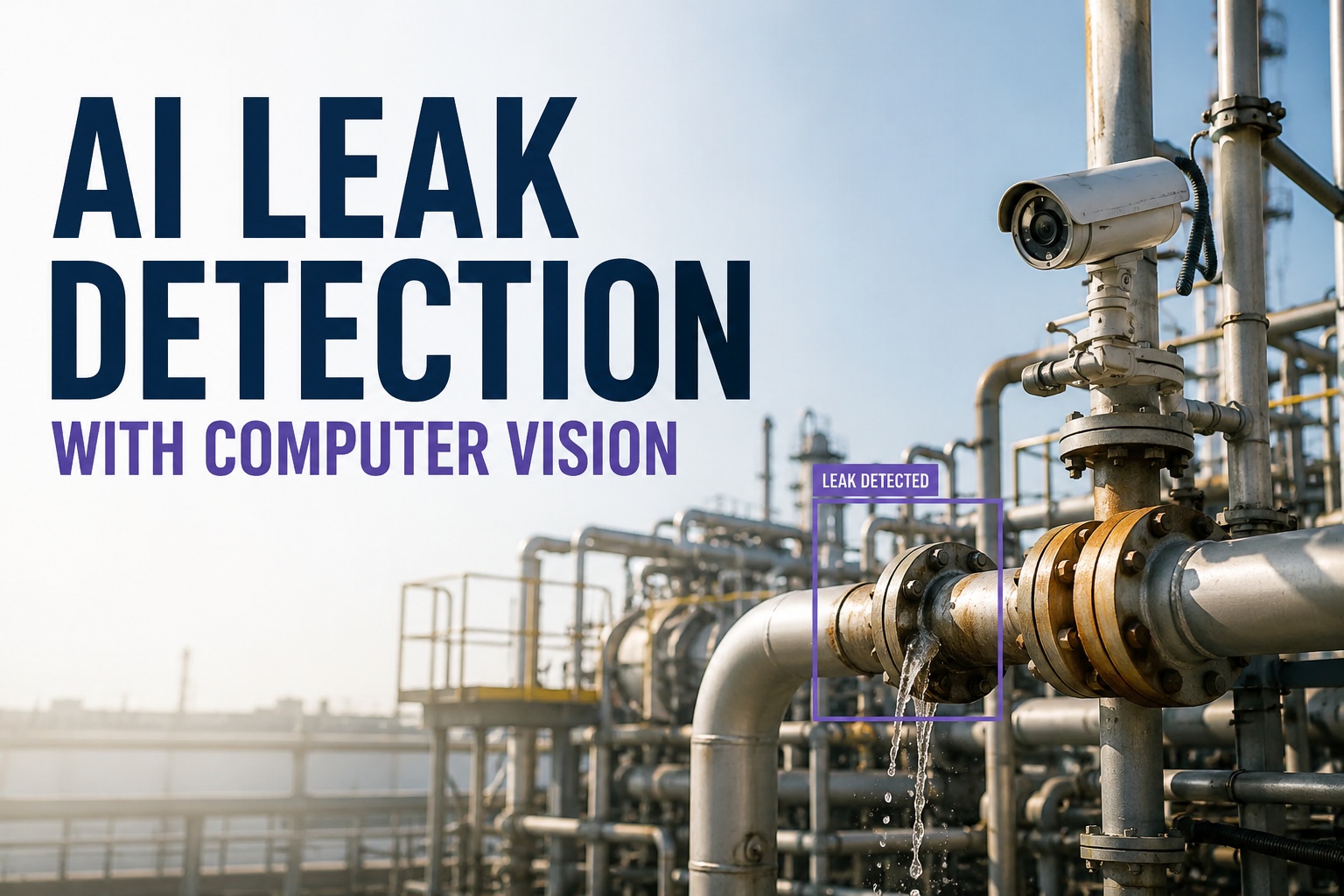
A small industrial leak can run for hours before anyone notices. By the time a shift supervisor walks past a puddle, the leak has already produced product loss, floor contamination, slip risk and — often — damage to the equipment that leaked. Oxmaint AI Vision monitors your existing industrial camera feeds continuously, identifies visible water, oil, chemical and steam leaks the moment they appear, and raises a prioritised alert with dated visual evidence. No new cameras required, no cloud dependency, no waiting for the next inspection. Book a demo to see AI leak detection live.
50ml
detection floor — advanced AI vision systems can identify a pool this small inside a monitored ROI
<10s
from leak visible to alert dispatched — typical latency on edge-processed camera feeds
85%+
detection accuracy uplift reported over manual approaches in industrial water-distribution research
The Four Leak Types AI Vision Handles
Different fluids leave different visual signatures, and a leak detection model has to recognise all of them across day/night lighting, wet floors, condensation and process variability. Water pools reflect and spread differently to oil. Steam produces plume dynamics that need spatio-temporal analysis, not static image classification. Chemical spills often need thermal contrast to separate from the background. The four categories below cover the vast majority of industrial leaks, and each has a different detection pipeline underneath.
Water & process fluid
Signature: Reflection change on floor, spreading pool boundary, standing puddle. Growth rate analysis distinguishes real leaks from routine wet-cleaning.
Where: Cooling systems, boiler feed, process water, CIP lines, utility distribution.
Oil, hydraulic & lubricants
Signature: Dark stain, rainbow sheen on wet surface, dripping pattern at joint or fitting. Distinctive spreading behaviour vs water.
Where: Hydraulic power packs, gearboxes, presses, mobile plant, lubrication systems, compressors.
Steam & vapour
Signature: Plume against dark background, thermal hot-spot on adjacent surface. Spatio-temporal detection separates true leaks from vented emissions.
Where: Boiler pipework, steam headers, gaskets on flanges, PRVs, condensate returns.
Chemical & process reagent
Signature: Coloured fluid pooling, thermal contrast (heated or cryogenic), corrosion halo forming near release. Growth-rate analysis is critical here.
Where: Bunded process areas, chemical storage, reagent dosing lines, laboratory zones, CIP/COP systems.
How the AI Actually Sees a Leak
Leak detection isn't a single-frame classifier. A single frame can't distinguish a fresh puddle from a shadow, or a steam plume from a bit of atmospheric haze. What makes AI vision reliable is spatio-temporal analysis — comparing frames over time, tracking whether the wet area is expanding, and correlating the visual event with the surrounding context. Combined with per-camera regions-of-interest, this is how modern systems drop false alarms low enough to trust as an alert source.
01
Frame capture & ROI
Continuous stream from existing ONVIF/RTSP camera. Regions of interest defined per asset — the model only alerts on defined zones.
02
Fluid classification
CNN identifies fluid type — water, oil, steam, chemical — trained on refractive and thermal properties of each.
03
Growth-rate analysis
Spatio-temporal comparison across successive frames. Expanding = real leak. Stable = existing puddle. Contracting = evaporating spill or cleanup in progress.
04
Alert & work order
Prioritised alert dispatched, dated image evidence attached, CMMS work order raised with fluid type, location and severity classification.
The growth-rate step is what stops the system flagging every mop-water puddle as a critical leak. Sign up free to see spatio-temporal leak analysis running against your own camera feeds.
Response Time — Where Continuous Monitoring Actually Pays
The financial argument for continuous vision leak detection isn't the sensor cost — it's the response time delta versus a manual regime. A leak discovered at the next shift walkaround has typically been leaking for an hour or more. A leak detected in under 10 seconds is a spill contained before it spreads. The cascade below compares the two response profiles for a hypothetical mid-severity hydraulic leak on a press line.
Response Time — Manual Walkaround vs Continuous AI Vision
Manual regime
Leak starts
Operator spots it
Team dispatched
~60-90 min
AI vision
Leak starts
AI detects
Work order live
< 2 min
See AI Leak Detection on Your Own Camera Feeds
Bring a sample RTSP feed from any ONVIF camera — Oxmaint scopes the ROI, runs the detection pipeline live, and shows you what the alerts, evidence packs and CMMS work orders look like on your assets. Thirty minutes.
Which Cameras You Can Use — Existing Infrastructure Wins
The best case for AI leak detection is that most of the hardware you need is already installed. Security CCTV, process cameras, safety cameras — all can be repurposed as leak monitors if they meet basic protocol and placement criteria. New cameras only need to be added where existing coverage has gaps, and thermal cameras are added where fluid types demand thermal contrast (steam, cryogenic chemicals, low-visible-signature releases).
Existing IP / CCTV
ONVIF · RTSP
Standard Axis, Bosch, Hikvision, Hanwha and equivalent security cameras connect directly. Good for water, oil and coloured chemical detection in adequately lit zones.
Process cameras
Existing plant assets
Cameras already positioned for process monitoring, safety observation or remote inspection — often the highest-value first target for leak detection deployment.
Thermal / IR
FLIR · Fluke · thermal IP
Essential for steam, cryogenic fluid and gas-plume detection. Also handles poor-visibility environments where visible-spectrum cameras struggle.
Explosion-proof enclosures
ATEX · IECEx zones
For monitoring in ATEX/IECEx-classified hazardous zones. Certified housings around standard camera modules keep hazardous-area compliance intact.
Fixed vs pan-tilt-zoom
Coverage strategy
Fixed cameras give consistent baselines that trending relies on. PTZ adds coverage flexibility but complicates ROI definition — typically used alongside fixed rather than instead of.
Night operation
24/7 monitoring
Near-IR illumination or thermal-only pipelines run continuous detection through dark hours. Visible-spectrum resumes at daylight — same AI pipeline throughout.
Expert Perspective — What Turns Vision Alerts Into Trusted Alerts
Vision-based leak detection lives or dies on false-alarm rate. If the system fires ten alerts a shift for wet floors, cleaning water and shadow puddles, operators stop trusting it — and a genuine leak eventually gets ignored with it. The systems that actually get relied on share three characteristics: defined regions of interest, spatio-temporal growth-rate analysis, and integration into the same CMMS the operator already uses. Take away any one of those and the alerts don't stick.
Regions of interest
Alerting on defined zones — not the whole frame — dramatically reduces noise. Cleaning zone activity doesn't trigger; process zone activity does.
Growth-rate over snapshots
A single wet-looking pixel is meaningless. Change over time is the actual signal — and it's what separates leaks from ambient wet surfaces.
Alert into the CMMS
A pop-up on a wall screen isn't an operational alert — it's a distraction. Alerts that land as prioritised work orders get actioned.
Evidence pack, not raw video
Attach the dated frame at leak onset and the frame at detection confirmation. Operators trust the finding faster than they would scrubbing footage.
Who Uses AI Leak Detection in Practice
The workflow is used by the roles that carry the cost of undetected leaks day-to-day: maintenance managers running hydraulic and process fleets who lose hours to leak-driven equipment damage, HSE managers responsible for spill containment, environmental reporting and slip-hazard prevention, operations directors tracking product loss and cleaning cost on production lines, and site facilities heads managing utility distribution across buildings. Each role sees the same underlying camera-derived data filtered to their view — real-time alerts, incident history, or environmental evidence packs. Sign up free to scope your leak detection pilot, or book a walkthrough to see live detection on your feeds.
Getting Leak Detection Live in 30 Days
Deployment moves through a defined path: site survey to confirm which existing cameras are usable and where ROI zones need drawing, model configuration for the specific fluid types on your site, edge-appliance install or cloud provisioning, and integration with your existing CMMS work-order workflow. Most single-site deployments cover 20-50 camera locations and move from initial survey to live monitoring inside 30 days. Sign up free to start the site survey conversation and get your leak detection deployment quoted inside the first week.
Stop Discovering Leaks on the Next Walkaround
Oxmaint AI Vision turns existing industrial cameras into continuous leak monitors — classifying water, oil, steam and chemical leaks the moment they appear, raising prioritised work orders with dated visual evidence attached.
Frequently Asked Questions
Can we use our existing security cameras?
In most cases, yes. ONVIF-compliant and RTSP-capable IP cameras — including most Axis, Bosch, Hikvision, Hanwha and equivalent industrial models — connect directly. The important factors are camera placement (leak-prone zones actually in frame), resolution (adequate for the size of leak you care about detecting), and lighting (consistent enough to give the AI a stable baseline). Oxmaint's site survey confirms which of your existing feeds are usable and where any new cameras or thermal additions would materially improve coverage.
How does the AI avoid false alarms from cleaning water or condensation?
Three mechanisms working together. First, regions of interest limit alerting to zones where a leak actually matters — cleaning corridors and wash-down bays are excluded. Second, spatio-temporal growth-rate analysis distinguishes an expanding leak from a stable puddle from a contracting cleanup — a mop passing through gets ignored, an expanding hydraulic pool doesn't. Third, fluid-type classification separates water from oil, so a wet floor from washdown doesn't get treated the same as a hydraulic release. False-alarm rate on properly-configured deployments is typically low enough that operators actually trust and action the alerts.
Does this work at night or in low-visibility conditions?
Yes. Cameras with near-infrared illumination continue visible-spectrum detection through dark hours. For steam, cryogenic and low-visible-signature releases, thermal cameras run detection based on temperature differential regardless of ambient light. Sites often combine both — visible-spectrum for daylight water and oil detection, thermal for 24/7 steam and process-fluid monitoring in critical zones. The AI pipeline processes both stream types through the same alerting workflow.
Can it detect gas leaks as well as liquid leaks?
Visible-spectrum cameras can't see most industrial gases — that's a physics limit, not a software one. Thermal imaging can visualise gases that absorb infrared radiation (many hydrocarbons, VOCs), appearing as plumes against the background. For safety-critical gas detection, AI vision typically complements rather than replaces certified point or open-path gas detectors, adding visual context and localisation to the alarm rather than serving as the primary detection layer. Oxmaint scopes gas-detection coverage separately during site survey.
Does the AI run on-premises or in the cloud?
Both options exist. On-premises deployment via Oxmaint's NVIDIA Jetson edge appliance runs all inference locally — camera feeds never leave the site, alerts fire in under 10 seconds regardless of internet connectivity, and the appliance continues detecting through any external outage. Cloud deployment is available for sites without on-premises hardware requirements and with reliable connectivity. For sites in regulated industries or hazardous zones, on-premises is typically the correct choice for both cybersecurity and latency reasons.